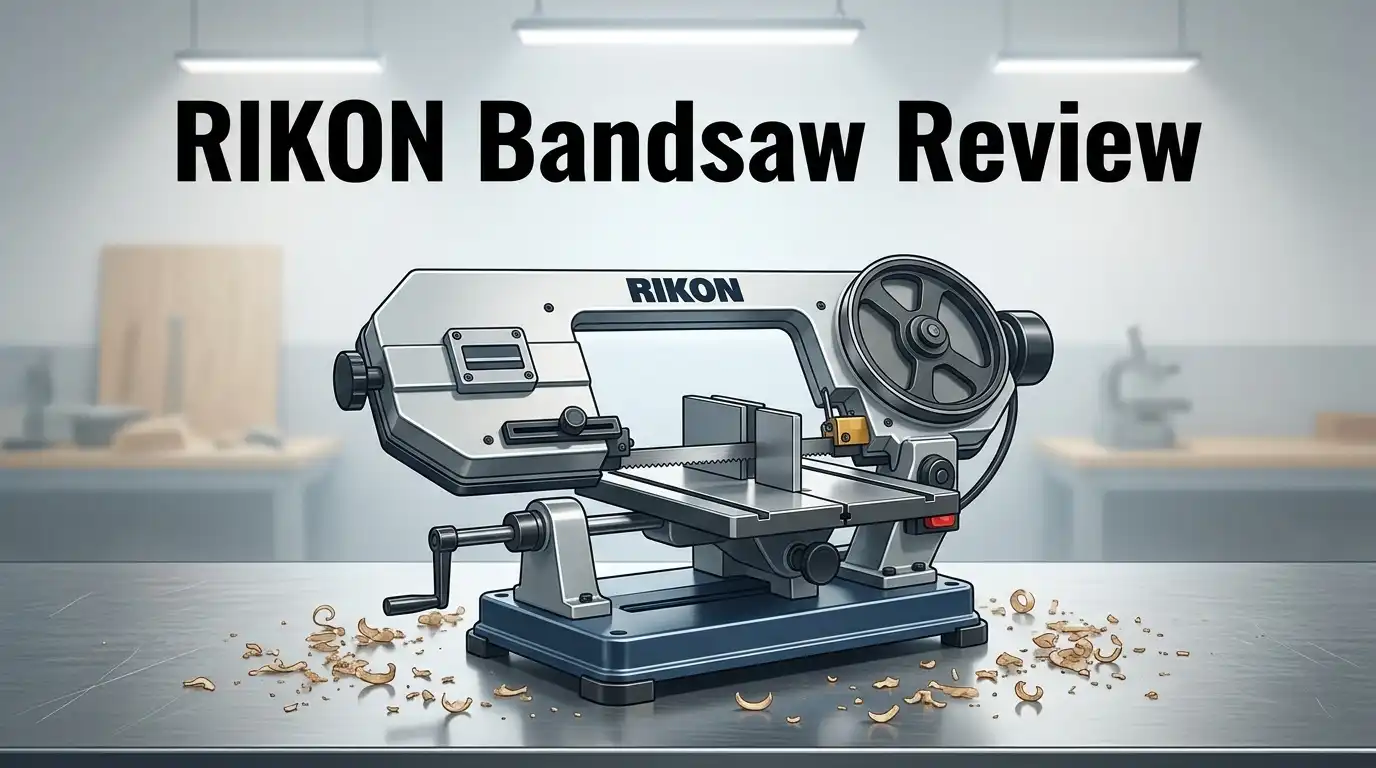
RIKON Bandsaw Review 2026: Still Worth It?
Bandsaws sit at the heart of most small shops. They cut curves, slice veneer, and break down stock that a table saw cannot handle safely. RIKON has built a loyal following in this category for one reason. The company sells serious cast iron machines at prices hobby woodworkers can actually reach.
This review looks at the RIKON lineup in 2026, with the popular 10 inch Deluxe model as the main test subject. You will read about real cutting performance, honest weak points, and how these saws compare to Grizzly, JET, and WEN.
No sponsored fluff here. Just what the saw does well, what it does poorly, and whether your money belongs somewhere else.
In A Nutshell:
- RIKON builds above its price class. The frames use heavy steel and cast iron. Wheels are cast and balanced. You feel that mass the moment you lift a box or make a cut in dense hardwood.
- The 10 inch Deluxe model punches hard for a benchtop saw. A half horsepower motor drives a 5 inch resaw capacity. Fine Woodworking tested this saw and confirmed it resaws at full capacity in gnarly hardwood without stalling.
- Setup is friendly for beginners. Blade guides adjust without tools. A tracking window lets you watch the blade with the door closed. Most owners get their first clean cut inside an hour.
- Customer service draws the loudest complaints. Parts availability runs hot and cold. Several owners report slow replies when they need a warranty part fast.
- Dust collection is average at best. A single 2.5 inch port catches most chips but leaves fine dust inside the lower housing. Plan on occasional vacuuming.
- Value depends on your project size. Hobby woodworkers building boxes, small furniture, and bowl blanks will love these saws. Anyone resawing wide slabs daily should size up to a 14 inch or 18 inch machine.
What Makes RIKON Bandsaws Different In 2026

- Includes 10-3061 Deluxe Bandsaw and 5/16 x 70-1/2 6TPI bandsaw blade|Motor: 1/2HP 5.5Amp 110V (60Hz...
Last update on 2026-08-29 / Affiliate links / Images from Amazon Product Advertising API Some of the links on this website are affiliate links, which means that at no additional cost to you, I earn a commission if you click through and make a purchase. I only recommend products and services that I believe will add value to my readers. Thank you for your support!
RIKON entered the woodworking market in 2001. The brand sells through Woodcraft, Rockler, Acme Tools, and Amazon. Most machines ship from Taiwan and China factories that also build for larger names.
The design philosophy is simple. RIKON puts money into the parts that affect cut quality and trims cost elsewhere. You get cast iron tables, ball bearing guides, and rigid guide posts. You do not get fancy digital displays or premium paint.
That trade works well for woodworkers. A flat table and a stiff frame produce straight cuts. A glossy finish does not.
The 2026 lineup covers four main sizes. The 10 inch benchtop saws suit small shops and apartments. The 14 inch models handle furniture work with resaw heights up to 13 inches. The 18 inch and larger saws serve professional shops.
One detail sets RIKON apart from budget competitors. The company publishes full parts diagrams online with prices. You can order a single M6 screw or a complete fence assembly. Grizzly does this too. WEN and many import brands do not.
Blade quality has improved as well. RIKON now sells carbide tipped resaw blades under its own PRO CT line. These blades cut faster and last far longer than the stock steel blades that ship in the box.
The stock blade remains the weakest part of any RIKON purchase. Budget an extra $40 for a proper blade on day one.
RIKON 10-3061 10″ Deluxe Bandsaw
This is the model most people mean when they search for a RIKON bandsaw. The 10-3061 replaced the older 10-306 and added a fence to the package.
Here are the numbers that matter. The motor produces half a horsepower on 115 volts. Resaw capacity reaches 5 inches. Throat depth measures 9 5/8 inches. The cast iron table spans 13 3/4 by 12 1/2 inches.
Two speeds cover most materials. The high setting runs 3,280 surface feet per minute for wood. The low setting drops to 1,515 SFPM for aluminum, brass, and some plastics.
Blade length is 70.5 inches. Accepted widths run from 1/8 inch up to 1/2 inch. That 1/2 inch limit matters, because wider blades resaw straighter.
The saw weighs roughly 80 pounds assembled. That mass is a blessing during cuts and a curse during moving. Two people make the job easier.
RIKON includes a rip fence with a two position design. Lay it low for standard rips. Stand it tall for resawing. A locking cam holds it firmly against the rail.
The upper wheel house carries a small viewing window. You can check blade tracking while the door stays shut. Small feature, big convenience.
Price sits near $600 in 2026, though sales drop it lower. That places it above WEN and below JET.
Unboxing And First Impressions
The 10-3061 arrives in a single cardboard box roughly the size of a mini fridge. Expect scuffs on the outside. Freight handling is rough on tool boxes.
Open the top and you find the saw body sitting upright in molded foam. The main casting comes fully assembled. Wheels, motor, guides, and guide post are already installed and aligned at the factory.
A smaller accessory carton holds the table, the fence rail, the fence, the miter gauge, and a bag of hardware. RIKON packs the hex wrenches you need. That saves a trip to the toolbox.
The first thing you notice is weight. Lifting the body out of the box feels like lifting a small engine block. Bend your knees.
The second thing you notice is grease. Cast iron parts ship coated in rust preventative oil. It smells industrial and it stains rags. Mineral spirits and a shop towel clean it off in ten minutes.
Fit and finish look good under that grease. The table machining shows fine tool marks but no ridges. Paint coverage is even, with a few thin spots on inside edges.
One common gripe appears in owner reports. Some boxes arrive with a loose or missing hardware bag. Check your parts list before you start.
The included blade looks thin and generic. It cuts, but it wanders. Order a better one.
Top 3 Alternative for RIKON 10-3061 Deluxe Bandsaw

- 3.5 amp motor creates cuts up to six inches deep and 9-3/4 inches wide
- Uses 72-inch blades anywhere from 1/8 to 1/2 inches in size
Last update on 2026-08-28 / Affiliate links / Images from Amazon Product Advertising API Some of the links on this website are affiliate links, which means that at no additional cost to you, I earn a commission if you click through and make a purchase. I only recommend products and services that I believe will add value to my readers. Thank you for your support!
WEN 3962T 3.5 Amp 10 Inch Two Speed Band Saw

- 1 HP motor, pre-wired 110V / 220V compatible, single-phase (11A at 110V, 5.5A at 220V)
- Max cutting height: 6"
Last update on 2026-08-28 / Affiliate links / Images from Amazon Product Advertising API Some of the links on this website are affiliate links, which means that at no additional cost to you, I earn a commission if you click through and make a purchase. I only recommend products and services that I believe will add value to my readers. Thank you for your support!
Grizzly Industrial G0555 14 Inch 1 HP Bandsaw

- 13" RESAW CAPACITY FOR THICK STOCK - A 1.75 HP capacitor-run motor and 116" blade loop resaw...
- JET BLACK COATED CAST-IRON TABLE - The ground cast-iron table’s corrosion-resistant JET Black...

Last update on 2026-08-29 / Affiliate links / Images from Amazon Product Advertising API Some of the links on this website are affiliate links, which means that at no additional cost to you, I earn a commission if you click through and make a purchase. I only recommend products and services that I believe will add value to my readers. Thank you for your support!
JET JWBS-14SFX-BLK 14 Inch Woodworking Band Saw
Assembly And Setup Time
Plan on 45 minutes for assembly and another 30 for tuning. The written instructions are adequate. The pictures are small.
Start by mounting the table trunnion bolts. Four hex bolts hold the table to the trunnion casting. Snug them, then drop the table over the blade through the access slot.
Install the table insert next. Then square the table to the blade with a machinist square and set the stop bolt underneath.
The fence rail bolts to the front edge of the table. Two carriage bolts and two wing nuts hold it. Take your time squaring this rail, because a crooked rail makes every rip crooked.
Blade tensioning uses a large hand wheel on top. RIKON prints a tension scale on the side. Treat that scale as a rough guide only.
Most experienced users tension by feel. Press the blade sideways with a finger at the midpoint. Roughly 1/4 inch of deflection works for a 1/2 inch blade.
Blade guides adjust by hand. No wrenches required. Set the side bearings just shy of touching the blade body. Set the thrust bearing about a paper thickness behind the blade.
Tracking adjusts with a knob behind the upper wheel. Spin the wheel by hand and center the blade on the crown.
Total time from box to first cut runs about 90 minutes for a first timer.
Cutting Power And Resaw Performance
Half a horsepower sounds small. In practice it handles more than you expect.
Straight rips in 1 inch poplar and pine feel effortless. The blade never slows. Feed rate depends more on your patience than the motor.
Hardwood resawing is where the saw earns its keep. Testing in hard maple at the full 5 inch height showed steady progress with a 1/2 inch, 3 TPI blade. The motor pulls down slightly but does not stall.
Push too hard and the belt slips before the motor bogs. That is actually a safety feature. A slipping belt tells you to slow your feed.
Curve cutting with a 1/4 inch blade is clean and controlled. Tight radius work with a 1/8 inch blade works too, though the small wheels stress narrow blades faster.
Green wood and bowl blanks cut fine up to 5 inches. Anything thicker needs a bigger saw or a bandsaw sled trick.
Aluminum cuts well on the low speed with a fine tooth blade. Use lubricant and go slow. Brass behaves similarly.
The 9 5/8 inch throat limits panel work. You cannot swing a wide board past the frame. Keep that number in mind before buying.
Cut quality on the stock blade is mediocre. Cut quality with a quality carbide blade is genuinely excellent. The difference is night and day.
Blade Guides, Tension And Tracking
RIKON uses ball bearing guides above and below the table. Cheaper saws use plastic or metal blocks that wear quickly.
Bearings run cooler and last longer. They also make setup faster, because you can spin them by hand to check clearance.
The guide adjustment needs no tools. Small thumb levers lock each bearing in place. This detail sounds minor until you change blades three times in one afternoon.
The lower guides sit in a tight space below the table. Reaching them means kneeling and squinting. A flashlight helps. This is the least pleasant part of blade changes.
Tension release uses a quick lever on the upper housing. Flip it and the tension drops instantly. Flip it back and your setting returns.
Owners should release tension when the saw sits unused for weeks. Constant tension flattens tires and stresses bearings.
Tracking holds well once set. Several owners report needing a small adjustment after the first hour of running. Bearings and belts settle in. That is normal for any new saw.
The upper guide post travels smoothly on a rack and pinion. A single lever locks the height. Some users find the lock slips slightly under heavy resaw pressure.
Tighten the lock firmly and the issue disappears.
Table, Fence And Miter Slot Quality
The cast iron table is the star component here. It is thick, flat, and heavy for a saw this size.
Flatness testing across the surface with a straightedge shows very little light. Most tables measure within a few thousandths of flat. That beats several competitors in this price band.
Table tilt runs 0 to 45 degrees to the right. A scale and pointer show the angle. Like all bandsaw scales, treat it as approximate and verify with a gauge.
The trunnion is cast iron rather than stamped steel. That means the table stays put during hard cuts.
The fence is decent but not premium. It locks square and holds position. It also flexes slightly under heavy resaw pressure against tall stock.
The two position design is genuinely useful. Standing the fence tall gives you 6 inches of support for resawing. Laying it flat gives you clearance for wide boards.
The miter slot accepts standard 3/4 inch bars. The included miter gauge is basic and a little sloppy. Most users replace it or ignore it.
Table insert fit is snug. RIKON sells replacements in four packs, which tells you they wear out. Zero clearance shop made inserts improve small part support.
Dust Collection Reality Check
Bandsaws are messy machines. RIKON does an average job of controlling that mess.
A single 2.5 inch port sits at the bottom of the lower wheel housing. A small vent below the lower guides lets air flow through the cabinet.
Connected to a shop vacuum, the port captures most chips. Fine dust still escapes at the table slot and around the guide post.
Expect a light dusting of powder on the table after resawing. This is normal for the design, not a defect.
The lower housing collects packed sawdust over time. Open the door every few hours of use and vacuum it out. Packed dust builds on the lower wheel and causes tracking problems.
A 4 inch dust collector with a reducer moves more air than a shop vacuum. Airflow matters more than suction here.
Some owners add a second port at the table level. A magnetic dust hood behind the blade catches escaping chips. This modification takes 20 minutes and helps noticeably.
Compared to WEN, RIKON collects dust better. Compared to a modern Laguna or JET with dual ports, RIKON falls behind.
Set expectations accordingly. This saw will not keep your shop spotless.
What The RIKON Bandsaw Does Not Do Well
Honest reviews cover failures. Here are the real weak points.
Customer service frustrates a meaningful number of owners. Reports on woodworking forums describe unanswered emails and long waits for replacement parts. When RIKON responds, the help is usually good. Getting that first response is the problem.
The 9 5/8 inch throat is genuinely limiting. You cannot cut a curve in the middle of a wide panel. Plan projects around this constraint.
The 1/2 inch maximum blade width caps resaw accuracy. Wider blades track straighter through tall stock. This saw cannot use them.
The included blade is poor. Calling it a starter blade is generous.
Vibration exists at higher speeds. The saw walks slightly on a smooth bench during long cuts. Bolting it down or adding rubber feet fixes this.
Shipping damage appears in a noticeable share of reviews. Bent fence rails and dented housings happen. Inspect everything before assembly and photograph any damage immediately.
Price creep is real. The 10-3061 launched near $500 and now approaches $600. At that number, 14 inch saws from Grizzly enter the conversation.
Finally, the tension scale is inaccurate on many units. Learn to tension by feel instead of trusting the pointer.
Pros And Cons Of RIKON Bandsaws
Here is the honest scorecard after extended use and review of owner feedback.
Pros:
- Strong cutting power for the size class. The half horsepower motor resaws hardwood at full 5 inch capacity without stalling, which many competitors cannot manage.
- Cast iron table and trunnion. These parts stay flat and stay put, which directly improves cut accuracy on every project you run.
- Ball bearing blade guides that adjust without tools. Blade changes take minutes instead of a frustrating half hour with wrenches.
- Rigid frame and guide post. Deflection stays minimal under resaw pressure, so cuts stay square through the full height.
- Complete parts diagrams published online. You can order any single component years after purchase, which extends the useful life of the machine.
- Two speed drive. Wood, aluminum, and plastic all cut properly with a simple belt change.
Cons:
- Customer service response times draw frequent complaints. Warranty parts sometimes take weeks to arrive, and emails occasionally go unanswered.
- The included blade is low quality. Budget an extra $40 for a proper carbide or bimetal blade before your first serious project.
- Throat depth of 9 5/8 inches limits panel work. Wide boards will not clear the frame.
- Dust collection is average. Fine dust escapes at the table and packs into the lower housing.
- Shipping damage occurs more often than it should. Inspect the machine thoroughly the day it arrives.
RIKON 10-3061 vs 10-305 vs 10-306
Three similar model numbers confuse a lot of shoppers. Here is the difference.
The 10-305 is the entry model. It carries a 1/3 horsepower motor and a 4 5/8 inch resaw capacity. It costs the least and does the least.
The 10-306 stepped up to a half horsepower motor and 5 inch resaw. It also added tool free guide adjustment and a better guide post.
The 10-3061 is the 10-306 with a fence included. That is essentially the entire difference. Same motor, same capacity, same frame.
If you find a 10-306 at a discount and already own a fence, buy it. Otherwise the 10-3061 package makes more sense.
All three use 70.5 inch blades. Accessories and replacement parts cross over between models, which simplifies ordering.
For most buyers, the 10-3061 is the correct choice. The extra power over the 10-305 matters during resawing, and the fence is not an optional accessory for serious work.
Stepping up further leads to the 14 inch models. The 10-324TG offers a 13 inch resaw height, a 1.75 horsepower motor, and 111 inch blades. That saw costs roughly double.
Choose based on what you cut, not on what looks impressive in the shop.
Who Should Buy A RIKON Bandsaw
Match the machine to your work. That saves money and frustration.
The 10 inch Deluxe suits hobby woodworkers with limited space. Box makers, small furniture builders, and pen turners will find it capable and easy to store.
Luthiers use these saws often. Guitar body blanks and neck stock fall inside the capacity range. The fine cut quality with a good blade matters here.
Bowl turners get real value from the 5 inch resaw height. Rounding blanks on the bandsaw is faster and safer than hacking at them on the lathe.
Metal hobbyists benefit from the low speed setting. Aluminum and brass cut cleanly with the right blade.
Skip this saw if you resaw wide slabs. Skip it if you cut curves in large panels. Skip it if you run a production shop.
Those users need a 14 inch machine minimum. The RIKON 10-324TG, Grizzly G0555, and JET JWBS-14SFX all serve that market well.
Beginners on a tight budget should consider the WEN 3962 instead. It costs far less and cuts adequately, though the build quality gap is obvious.
Renters and garage woodworkers appreciate the benchtop footprint. It fits on a rolling cart and tucks against a wall.
Price, Warranty And Value In 2026
RIKON pricing sits in the middle of the market. That position is intentional.
The 10-3061 runs near $600 at most retailers in 2026. Sales and holiday promotions drop it into the $450 to $500 range a few times each year.
Patience saves real money here. Set a price alert and wait for a sale.
The warranty covers five years on most RIKON woodworking machines. That is longer than many competitors offer at this price.
The warranty terms are good. The claims process is the weak link. Keep your receipt and register the product immediately after purchase.
Compare that to WEN, which sells its 10 inch saw for roughly a third of the price. The WEN cuts wood. It also vibrates more, uses lighter castings, and wears faster.
Compare it to JET, which charges considerably more for its 14 inch steel frame saws. Those machines are excellent and outclass the RIKON in every measurement except price.
Grizzly sits closest in philosophy. Similar value approach, similar build quality, generally better parts support.
Resale value holds up reasonably well. Used RIKON saws move quickly on local marketplaces, usually at 60 to 70 percent of new price.
Maintenance Tips To Keep It Cutting Straight
A bandsaw rewards small amounts of regular attention.
Release blade tension when the saw sits idle. This single habit doubles tire life and protects the upper wheel bearing.
Vacuum the lower wheel housing every few hours of cutting. Packed dust on the tire causes the blade to wander and creates tracking problems that look like defects.
Wax the cast iron table monthly. Paste wax reduces friction and blocks rust. Skip silicone products, because they contaminate wood finishes.
Check blade guide bearings for flat spots. A bearing that stops spinning has failed. Replacement bearings cost a few dollars each.
Inspect tires annually. Cracked or glazed rubber causes vibration. RIKON sells urethane replacements that outlast the original rubber significantly.
Change the belt if it shows cracking. A slipping belt robs power and mimics motor failure.
Keep spare blades on hand. A dull blade burns wood, wanders off the line, and stresses the motor. Most woodworkers wait far too long to change blades.
Clean pitch off the blade with a citrus based cleaner. Resin buildup on the teeth kills cutting speed within a few hours of pine work.
Store blades coiled in three loops and hang them dry. Rust ruins more blades than dull teeth do.
Final Verdict: Is A RIKON Bandsaw Worth Buying In 2026?
Yes, with clear conditions attached.
The RIKON 10-3061 delivers cast iron construction and real resaw power at a price most hobby shops can justify. It cuts accurately once tuned, and it holds that tune well.
The machine is not perfect. Customer service is inconsistent. The included blade is disappointing. Throat depth limits the projects you can attempt.
None of those issues affect the actual cutting quality. They affect convenience and support.
Buy this saw if you want a compact machine that behaves like a bigger one. Buy a WEN if budget dominates your decision. Buy a 14 inch Grizzly or JET if your projects have already outgrown 5 inches of resaw height.
Order a quality blade at the same time you order the saw. That single purchase transforms the machine from decent to genuinely good.
Inspect the shipment carefully on arrival. Photograph any damage before you assemble anything.
Tune it properly, keep it clean, and this saw will serve a hobby shop for many years. That is a reasonable return on $600.
Frequently Asked Questions
How much can a RIKON 10 inch bandsaw resaw?
The 10-3061 and 10-306 resaw up to 5 inches. The entry level 10-305 manages 4 5/8 inches. All three handle those heights in hardwood with a proper blade installed.
What blade size fits the RIKON 10-3061?
The saw uses 70.5 inch blades. Widths from 1/8 inch to 1/2 inch fit the wheels and guides. A 1/2 inch, 3 TPI blade works best for resawing.
Are RIKON bandsaws made in the USA?
No. RIKON is a US company headquartered in Massachusetts, but manufacturing takes place in Asia. Design, quality control, and parts distribution run from the United States.
Is RIKON better than WEN?
RIKON uses heavier castings, better bearings, and more powerful motors. WEN costs far less. For occasional light cutting, WEN is adequate. For regular hardwood work, RIKON is the stronger machine.
How long is the RIKON warranty?
Most RIKON woodworking machines carry a five year warranty. Register your product after purchase and keep your receipt, because the claims process moves faster with documentation ready.
Does the RIKON 10-3061 come with a stand?
No. The 10-3061 is a benchtop saw. RIKON sells a matching stand separately, and the 10-3062S package bundles a stand with the saw.
Can a RIKON bandsaw cut metal?
Yes, on the low speed setting of 1,515 SFPM. Aluminum, brass, and soft metals cut well with a fine tooth blade. Steel requires a dedicated metal cutting bandsaw.

Hi, I’m Amelia Thornton, the founder of ElectroPro.blog.
I write about smart devices, gadgets, electronics, and tech essentials from Amazon.
My goal is to help you discover reliable and innovative tech that truly makes life easier.
From home automation to everyday gear, I test and share what’s worth your investment.
Join me as I explore the smartest tech trends—one gadget at a time.