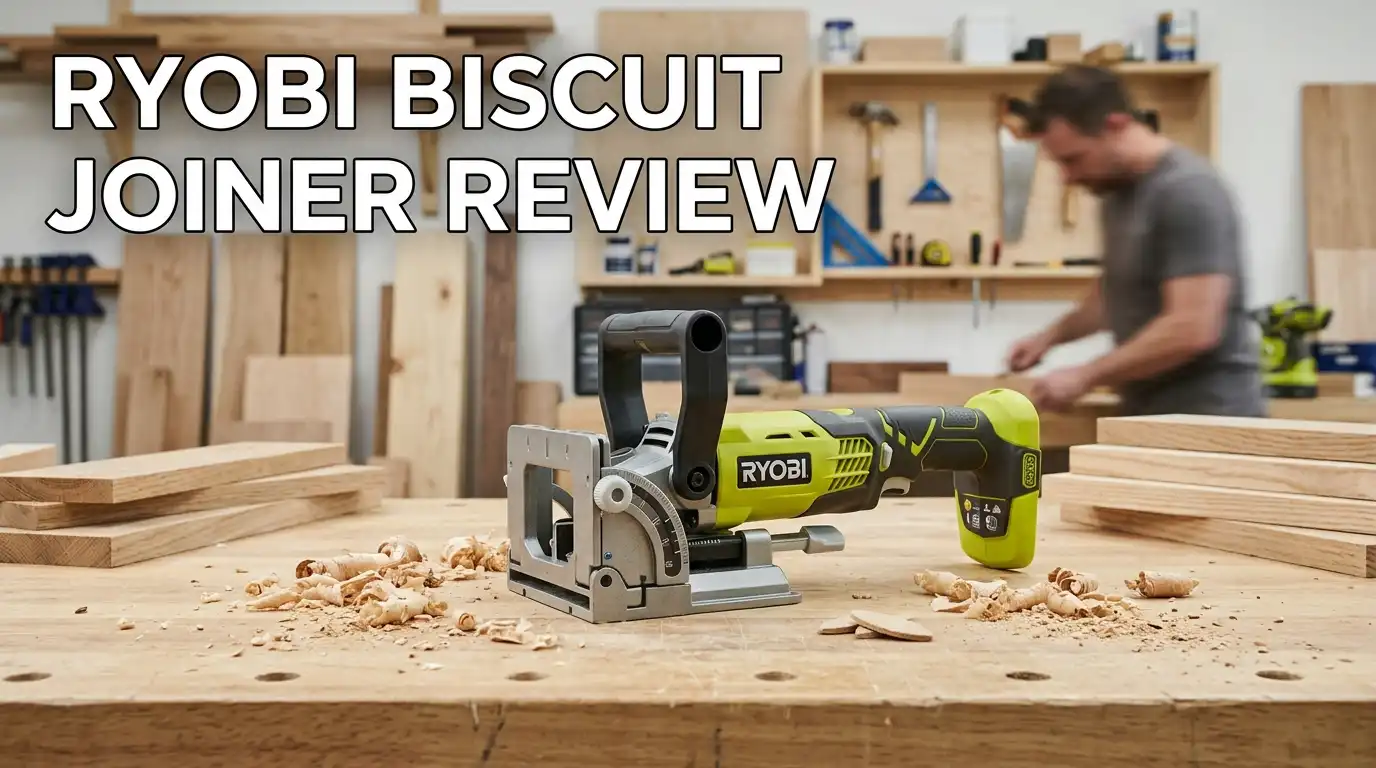
Ryobi Biscuit Joiner Review 2026: Worth Buying?
You want clean, invisible joints in your panel glue-ups, but every misaligned edge means hours of sanding. The Ryobi JM83K biscuit joiner promises factory-grade alignment at a hobbyist price. After weeks of real shop time, here is the honest verdict.
This tool sits in an odd spot. It costs far less than the Makita and DeWalt corded units, yet it carries a carbide blade and a rack-and-pinion fence. Bargain shoppers wonder if the savings hide a catch. Serious weekend woodworkers want to know if it holds tolerances.
Below I break down the cut quality, the fence accuracy, the dust collection, and the flaws nobody mentions in the listing. I built three projects with it so you don’t have to gamble. Let’s see if the 6 amp motor earns its keep in 2026.
In a Nutshell
- Price-to-value leader: The JM83K undercuts premium rivals by $70 to $80, making it the easiest entry point for hobbyists who want plate joinery without a big spend.
- Carbide blade included: A carbide-tipped blade spins at 11,000 RPM, delivering clean slots in pine, oak, and plywood right out of the box.
- Full size range: Depth stops handle #0, #10, and #20 biscuits, covering nearly every common cabinet and panel job.
- Tilting fence: The fence pivots from 0 to 135 degrees with positive stops, so mitered and beveled joints stay accurate.
- Best for DIY users: This tool fits beginners and casual builders, not high-volume production shops.
- Watch the fence lock: The plastic fence can drift if you rush, so check your height setting before every plunge.

- The 6 Amp biscuit joiner delivers up to 11,000 RPM, ensuring clean and precise slot cuts for...
- Adjustable depth settings provide accuracy for #0, #10, and #20 biscuits. It features preset stops...
Last update on 2026-10-26 / Affiliate links / Images from Amazon Product Advertising API Some of the links on this website are affiliate links, which means that at no additional cost to you, I earn a commission if you click through and make a purchase. I only recommend products and services that I believe will add value to my readers. Thank you for your support!
What Is the Ryobi JM83K Biscuit Joiner
A biscuit joiner cuts crescent-shaped slots into two boards. You glue a compressed wood biscuit into both slots. The biscuit swells and locks the joint tight.
The JM83K is Ryobi’s corded plate joiner. It draws 6 amps from a standard wall outlet. The motor reaches 11,000 RPM, which keeps the blade fast enough to avoid burn marks.
Ryobi targets the home shop with this model. It ships with a dust collector, a dust bag, and a carry-friendly footprint. The body uses Ryobi’s familiar green plastic over a metal gear housing.
The kit aims at cabinet makers, shelf builders, and panel glue-ups. It is not a Festool Domino competitor, and it never claims to be. Think of it as a reliable workhorse for side-grain joints and edge alignment. For the price, that scope is fair and honest.
Ryobi JM83K Key Specifications and Features
The spec sheet reads better than the price tag suggests. The 6 amp motor and 11,000 RPM blade speed match tools that cost much more.
The carbide-tipped blade measures the standard 4 inches. It cuts slots for #0, #10, and #20 biscuits using clear depth-stop settings. Switching sizes takes a quick twist of the depth dial.
The fence uses a rack-and-pinion adjustment for height. This system keeps the cut parallel to the board face. The fence tilts from 0 to 135 degrees with positive stops at common angles.
An ergonomic handle sits over the plunge mechanism. The grip feels balanced and reduces wrist strain during long sessions. The plunge action is spring-loaded and returns smoothly.
The dust port connects to the included bag or a shop vacuum. The anti-slip grip on the base helps the tool stay put during the plunge. These are practical touches at this price.
Unboxing and First Impressions
The box is plain cardboard with a product photo. Inside, the joiner sits in a molded tray with the dust bag and manual tucked beside it. There is no hard case.
My first reaction was the weight. The tool feels lighter than the DeWalt, which helps overhead and edge work. The green plastic shell looks basic but feels solid in the hand.
The blade arrives installed. I spun it by hand and felt no wobble, a good sign for slot accuracy. The depth dial clicked into each setting with a firm detent.
The fence moved smoothly on its rack-and-pinion track. The lock lever felt slightly cheap, a hint of the plastic build. Still, nothing rattled or felt loose.
There is no extra blade and no biscuits in the box. You will need to buy #0, #10, and #20 biscuits separately. Budget for that small extra cost before your first project.
Top 3 Alternatives for Ryobi JM83K Biscuit Joiner

- Rack-and-pinion vertical fence system engineered for accurate fence adjustments
- Cast aluminum pivot fence with three positive stops at 0Degree, 45Degree and 90Degree, and easy...

Last update on 2026-10-26 / Affiliate links / Images from Amazon Product Advertising API Some of the links on this website are affiliate links, which means that at no additional cost to you, I earn a commission if you click through and make a purchase. I only recommend products and services that I believe will add value to my readers. Thank you for your support!
Makita XJP03Z 18V LXT Cordless Plate Joiner

- 6.5 amp, 10,000 rpm motor provides power for working in the hardest woods
- Dual rack and pinion fence ensure blade and fence are always parallel for accurate joints every time
Last update on 2026-10-26 / Affiliate links / Images from Amazon Product Advertising API Some of the links on this website are affiliate links, which means that at no additional cost to you, I earn a commission if you click through and make a purchase. I only recommend products and services that I believe will add value to my readers. Thank you for your support!
DeWalt DW682K 6.5 Amp Plate Joiner Kit

- The joiner tool has 7.0 Amp, 120 V, AC only, 10,000 rpm
- 1-inch O.D. dust port of the plate joiner accepts standard bag or can be connected to a vacuum
Last update on 2026-10-26 / Affiliate links / Images from Amazon Product Advertising API Some of the links on this website are affiliate links, which means that at no additional cost to you, I earn a commission if you click through and make a purchase. I only recommend products and services that I believe will add value to my readers. Thank you for your support!
Porter-Cable 557 7 Amp Plate Joiner Kit
How It Performs on Real Projects
I built a shadow box, a small bookshelf, and an edge-glued panel. The joiner handled all three without complaint. Slots came out clean and consistent.
On pine and poplar, the carbide blade sliced fast with no burning. The plunge felt smooth once I dialed in steady pressure. In red oak, the 6 amp motor slowed slightly but never stalled.
Alignment was the real test. My edge-glued panel came together flush, with only light sanding needed. The biscuits seated tightly after a few minutes of glue swell.
The fence held its angle on bevel cuts. My 45-degree miters lined up well enough for trim and box work. For cabinet face frames, the results were solid and repeatable.
Speed was the surprise. I cut a dozen slots faster than I expected for a budget tool. For DIY furniture and shelving, this performance is more than enough.
Cut Quality and Slot Accuracy
Slot depth matters more than people think. Too shallow and the biscuit won’t seat. Too deep and you lose strength. The JM83K nailed its depth stops consistently.
The carbide blade left smooth slot walls with no fuzz. Clean walls mean better glue contact and stronger joints. I saw no tear-out on plywood faces.
Centering was reliable when I kept the fence locked. Each #20 slot landed at the same height across a full panel. That repeatability is what makes glue-ups painless.
The one weak point is the fence lock. If you bump it mid-job, the height setting can shift slightly. I learned to double-check before every plunge.
Side-grain to side-grain joints were the strongest. End-grain joints held but felt weaker, which is normal for biscuits. For its intended uses, the accuracy holds up well.
Dust Collection and Cleanup
Biscuit joiners throw a lot of fine chips. The JM83K ships with a dust bag and a collection port. The bag works, but only to a point.
In open shop air, the bag caught maybe half the debris. Fine dust still escaped around the cut. For a cleaner workspace, I switched to a shop vacuum.
Hooking up a shop vac changed everything. Suction pulled nearly all chips straight from the slot. The cut zone stayed clear, which improved my sightlines.
The port fits standard hoses with a snug push. I had no adapter trouble with my 1.25-inch hose. This setup is the way I’d recommend running it.
The bag is fine for quick jobs and a few cuts. For longer sessions, plan on the vacuum connection. Treat the bag as a backup, not the main system.
Comfort, Handling, and Build Quality
The ergonomic handle is genuinely comfortable. It sits high over the blade, giving good leverage on the plunge. My wrist stayed relaxed through a full afternoon.
The light weight helps on vertical edges and awkward angles. I could brace the tool one-handed while positioning stock. Heavier rivals make that move more tiring.
The anti-slip base gripped my workpieces well. It reduced the small skid that ruins slot placement. That grip is an underrated feature for beginners.
Build quality is the trade-off. The plastic shell and fence feel like a budget tool, because they are. The metal gear housing inspires more confidence than the outer body.
Nothing failed or loosened during my testing. But I would not trust the fence lock under daily production use. For home projects, the build is acceptable and fair.
Honest Downsides and Who Should Skip It
No tool is perfect, and the JM83K has clear flaws. The biggest is the plastic fence and its lock lever. It works, but it lacks the rigid feel of metal fences.
Production woodworkers should skip this model. Daily heavy use will wear the budget parts faster than a DeWalt or Makita. This tool rewards light to moderate use.
The dust bag underperforms on its own. If you hate stopping to clean, the vacuum requirement is a mild annoyance. Factor that into your setup.
There is no hard carrying case. Storage and transport feel less protected than premium kits. Tossing it in a truck bed is not ideal.
Anyone needing tight production tolerances will want a higher-end fence. The slight fence drift is the main accuracy risk. For casual builders, none of this is a dealbreaker.
Ryobi JM83K vs DeWalt, Makita, and Porter-Cable
The DeWalt DW682K runs a stronger 6.5 amp motor and a dual rack-and-pinion fence. It feels more rigid and built for harder use. It also costs notably more.
The Makita XJP03Z is cordless and praised for fence accuracy. Reviewers call it the best overall for precise work. Its 18V platform adds freedom but raises the price.
The Porter-Cable 557 offers a 7 amp motor and a versatile tilting fence. It is a long-time favorite for its durable design. Used units hold value for good reason.
Against all three, the Ryobi wins on price alone. You give up fence rigidity and long-term durability. You keep the core function of clean, accurate slots.
For occasional projects, the savings make sense. For daily professional work, spend more on a metal-fence rival. Match the tool to your real workload.
Final Verdict and Value for 2026
The Ryobi JM83K delivers honest value in 2026. It cuts clean slots, holds reasonable accuracy, and costs far less than premium rivals. For home woodworkers, that combination is hard to beat.
The flaws are real but predictable. The plastic fence and weak dust bag reflect the budget price. Neither ruins the experience for casual use.
I would recommend it to beginners and weekend builders. It is a low-risk way to learn plate joinery. The carbide blade and 11,000 RPM speed punch above the cost.
Pair it with a shop vacuum and check the fence before each cut. Do that, and the results rival tools twice the price. For DIY furniture and cabinets, it is a smart buy.
Skip it only if you run a busy shop. Everyone else gets a capable joiner for short money. In 2026, the JM83K remains a strong value pick.
Frequently Asked Questions
Does the Ryobi biscuit joiner use standard biscuits?
Yes. The JM83K cuts slots for standard #0, #10, and #20 biscuits. You can buy these at any hardware store. The depth dial switches between sizes with a quick turn.
Is the Ryobi JM83K corded or cordless?
It is corded and runs on standard 120V AC. The 6 amp motor draws power from any wall outlet. There is no battery to charge or replace.
Can it cut angled joints?
Yes. The fence tilts from 0 to 135 degrees with positive stops. This range covers miters, bevels, and standard butt joints. It handles most common angle work.
Does it come with a blade and biscuits?
The carbide-tipped blade is installed in the box. Biscuits are not included, so buy them separately. There is no spare blade in the kit either.
Is it good enough for professional use?
For light professional jobs, it works. For daily production, the budget fence wears faster than premium tools. Pros doing high volume should choose a metal-fence rival.
How is the dust collection?
The bag captures some debris but not all. Connecting a shop vacuum dramatically improves cleanup. I recommend the vacuum for any long session.
Who should buy the Ryobi biscuit joiner?
Beginners, hobbyists, and weekend woodworkers get the most value. It suits furniture, shelves, and cabinet glue-ups. Heavy daily users should look at higher-end models.

Hi, I’m Amelia Thornton, the founder of ElectroPro.blog.
I write about smart devices, gadgets, electronics, and tech essentials from Amazon.
My goal is to help you discover reliable and innovative tech that truly makes life easier.
From home automation to everyday gear, I test and share what’s worth your investment.
Join me as I explore the smartest tech trends—one gadget at a time.