Razor Wolf Chainsaw Sharpener Review 2026: Worth It?
Your chainsaw stopped cutting. It now pushes, smokes, and spits out hot powder instead of chips. That moment ruins a good Saturday.
The Razor Wolf chainsaw sharpener promises a fix in your pocket. Clamp it on the bar, turn a crank, and cut clean again.
Ads for this tool are everywhere in 2026. Some claim two minute sharpening. Some claim professional results with zero skill.
In a Nutshell:
- The Razor Wolf is a bar mounted manual jig, not a magic tool. It clamps onto your chainsaw bar, holds a carbide burr at a fixed angle, and you turn a small crank. The chain stays on the saw. That part works as advertised.
- The marketing runs far ahead of the reality. Official pages claim 4.8 stars and thousands of reviews. The actual Amazon listings for Razorwolf branded jigs sit near 2.2 to 2.5 stars with a small review count. That gap matters.
- Speed claims of three to five seconds per tooth are optimistic. Expect eight to fifteen minutes for a full chain on your first try. Speed improves with practice, but it never beats a bench grinder.
- It ignores your depth gauges completely. The jig sharpens cutters only. You still need a raker file and a flat gauge, or your saw will feel dull even with sharp teeth.
- Build quality is mixed at the price. The aluminum body feels solid. The burrs, knobs, and small plastic parts feel cheap and draw the most complaints.
- Best fit: casual users with one or two saws. Heavy cutters, firewood sellers, and pros should skip straight to a Timberline jig or a bench grinder.
What Is the Razor Wolf Chainsaw Sharpener?

- 【Wide Compatibility for All Chainsaws】 Works with virtually all mainstream chainsaw models, from...
- 【Portable Hand Crank Design】 Completely manual hand crank system—no electricity or bulky...
Last update on 2026-10-21 / Affiliate links / Images from Amazon Product Advertising API Some of the links on this website are affiliate links, which means that at no additional cost to you, I earn a commission if you click through and make a purchase. I only recommend products and services that I believe will add value to my readers. Thank you for your support!
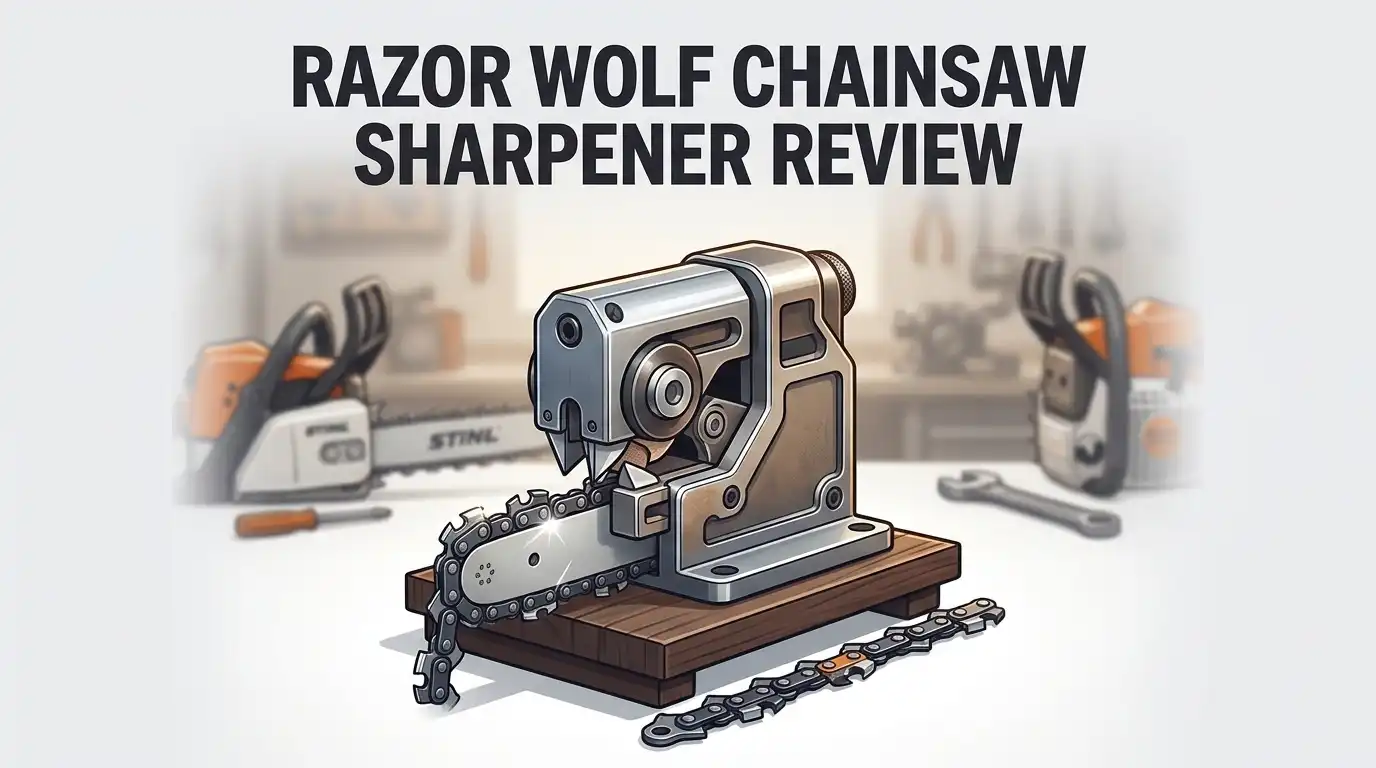
The Razor Wolf is a compact sharpening jig for chainsaw chains. It belongs to a fast growing category of hand crank bar mounted sharpeners sold on Amazon and through direct offer pages.
The design copies a proven idea. You clamp a guide body over the chainsaw bar. A bushing holds a carbide burr at a set angle. You crank the burr across one cutter, advance the chain, and repeat.
Listings describe an aluminum alloy body with grip knobs. Sellers say the jig fits saws from 4 inch mini saws up to 22 inch bars. Most kits ship with three to seven burrs or grinding stones plus a wrench.
You never remove the chain. That single feature drives most of the sales. Chain removal scares new owners, and this tool skips it.
Price sits around 29 to 37 dollars depending on the version and the seller. The brand name changes across listings, which tells you plenty about the supply chain.
One important note. Razor Wolf is not one company with one product. Several sellers use the name on near identical jigs with different colors, bit counts, and prices. Xeijayi, Liuewsy, and other unfamiliar seller names appear on the same tool.
Treat it as a generic jig with clever branding, not a premium engineered instrument.
Unboxing the Razor Wolf: First Impressions
The box arrives small. Think paperback book size, wrapped in thin cardboard with a printed sleeve.
Inside sits a molded foam tray or a plain plastic bag, depending on the batch. Mine came in foam, which felt reassuring for a 29 dollar tool.
The main body lifts out first. It weighs less than expected, roughly half a pound. The anodized finish looks sharp in orange or blue.
Under the body you find the burrs. My kit had three carbide bits in small paper sleeves. Larger kits ship five or seven grinding stones instead of carbide.
A small hex wrench sits in a side cutout. There is also a crank handle that threads into the drive shaft.
The instruction sheet is the first disappointment. Mine was one folded page with tiny diagrams and rough translations. No file size chart. No guidance on which burr matches which chain pitch.
The knobs feel plasticky in hand. They tighten fine, but the threads felt gritty until I worked them a few times.
First impression summary: the body impresses, the accessories do not. The aluminum frame feels like a real tool. Everything bolted to it feels like a budget accessory pack.
Assembly took under three minutes with no tools beyond the included wrench. That part genuinely pleased me.
How the Razor Wolf Works on Your Bar
Setup follows three steps, and the steps are simple.
First, you set the brake and open the clamp. The jig slides over the bar between the tip and the powerhead. You tighten the knobs until the body sits square and firm.
Second, you drop the burr through the guide bushing. The bushing sets the angle for you. Most kits fix that angle near 30 degrees, which suits general purpose chains.
Third, you seat the cutter against the stop and turn the crank. Two or three full turns cut the face of the tooth.
Then you release, pull the chain forward one link, and repeat on the next cutter facing the same direction. After finishing one side, you flip the jig or reverse the setup for the opposite cutters.
This is where beginners lose time. Counting cranks matters. Uneven crank counts create uneven cutter lengths, and uneven cutters make the saw pull to one side.
A useful trick: mark your starting cutter with a paint pen. Otherwise you will lose your place halfway around a 72 link chain.
Chain tension changes results. A loose chain lets the cutter shift under the burr. Snug the chain before you start, then loosen it again for cutting.
The learning curve is real but short. My second chain went twice as fast as my first.
Top 3 Alternatives for Razor Wolf Chainsaw Sharpener
If the Razor Wolf feels too thin for your workload, these three tools earn stronger reputations.
Timberline Chainsaw Sharpener

- The only real and original Timberline Chainsaw Sharpener. We are the only Timberline patented and...
- Buying with us supports American made businesses with American made products. This offers great...
Last update on 2026-10-21 / Affiliate links / Images from Amazon Product Advertising API Some of the links on this website are affiliate links, which means that at no additional cost to you, I earn a commission if you click through and make a purchase. I only recommend products and services that I believe will add value to my readers. Thank you for your support!
Sharp Pebble Electric Chainsaw Sharpener Kit

- Chainsaw Sharpening Kit: Sharp Pebble electric chainsaw sharpener kit comes with - Chainsaw Tool...
- Easy To Use Tool: This simple electric chainsaw sharpener enables both novices and professionals to...
Last update on 2026-10-21 / Affiliate links / Images from Amazon Product Advertising API Some of the links on this website are affiliate links, which means that at no additional cost to you, I earn a commission if you click through and make a purchase. I only recommend products and services that I believe will add value to my readers. Thank you for your support!
Oregon Q90405 Chainsaw Chain Sharpening and Guide Bar Maintenance Kit

- Sharpening kit for chain and bar maintenance
- Includes one assembled file holder for chain top plate maintenance
Last update on 2026-10-21 / Affiliate links / Images from Amazon Product Advertising API Some of the links on this website are affiliate links, which means that at no additional cost to you, I earn a commission if you click through and make a purchase. I only recommend products and services that I believe will add value to my readers. Thank you for your support!
Real World Sharpening Test Results
I ran the jig on three chains with different levels of damage.
Chain one was mildly dull from clean firewood cutting. The Razor Wolf handled it well. Fifteen minutes of work restored a chain that pulled itself into oak and threw real chips.
Chain two had rock damage on six cutters. Here the jig struggled. Removing that much steel took twenty plus crank turns per damaged tooth, and the burr heated up fast.
Chain three was an old worn chain with uneven cutter lengths. The jig cannot fix uneven cutters. It sharpens each tooth from a fixed stop, so short teeth stay short and long teeth stay long.
Cut speed after sharpening improved noticeably on chain one. My test log went from a 45 second cut to a 19 second cut through the same 10 inch section.
Chain two improved less. Rock damaged teeth needed more removal than the jig comfortably delivers.
Finish quality sits below a good file job. Under a loupe, the carbide burr left a slightly rougher edge than a fresh round file. Rough edges dull faster.
Longevity was fair. Chain one held a working edge through about forty minutes of cutting before it slowed again. A file sharpened chain in the same wood held closer to an hour.
That result is acceptable for weekend work. It is not professional grade.
Build Quality and Materials Check
The frame earns real credit. Cast aluminum alloy, clean machining on the guide bore, and no visible casting flash on my sample.
Clamping pressure held through three full chains. The body never slipped off the bar during cranking.
Now the weak points.
The burrs are the biggest question mark. Sellers advertise industrial grade tungsten carbide. Some kits deliver genuine carbide. Other kits ship coated steel or bonded grinding stones that wear quickly.
You can tell the difference by feel. Real carbide bites hard steel with light pressure. Coated bits skate and polish instead of cutting.
The crank handle uses a small set screw. Mine loosened twice during one chain and needed a wrench check.
Plastic knobs are the second weak point. The threads accept grit easily. Keep them clean or they bind.
Several buyer complaints mention bent guide pins, missing bits, and burrs that snap during use. Carbide hates side load and impact, and this design invites both if you crank carelessly.
I would not call the tool fragile. I would call it inconsistent. Two units from the same listing may feel like different products.
Store it dry. The frame resists rust, but the small steel parts do not.
What the Razor Wolf Does Not Do Well
Honest reviews name the failures, so here they are.
It does not touch depth gauges. Your rakers control how deep each cutter bites. After several sharpenings, rakers sit too high and your saw feels dull even with razor cutters. The Razor Wolf offers no raker function at all.
It does not fix damaged chains. Rock strikes, dirt damage, and badly uneven cutters need a grinder or serious file work. The jig only refreshes an edge that already exists.
It does not match the two minute claim. Real chains have 55 to 84 cutters. Two minutes covers maybe eight teeth once you are practiced. Plan on fifteen minutes.
It does not fit every bar cleanly. Very narrow mini saw bars and wide professional bars can create clamp fit problems. Some buyers report the jig rocking on thin bars.
It does not include useful documentation. The instruction sheet skips chain pitch, burr matching, and angle adjustment entirely.
It does not offer reliable customer support. Direct order pages push urgency timers and stock warnings. Refund experiences vary widely across buyers.
The average Amazon rating tells the story. Razorwolf branded jigs currently sit in the low 2 star range. That is well below the 4.8 stars shown on promotional pages.
Buy with clear eyes, not with hype expectations.
Pros and Cons of the Razor Wolf Chainsaw Sharpener
Here is the honest scorecard after testing.
Pros
- No chain removal required. You sharpen with the chain mounted, which removes the biggest barrier for new saw owners.
- Genuinely portable. The jig fits a jacket pocket or a small tool bag. Field touch ups become realistic.
- Consistent angle guidance. The fixed bushing prevents the wandering angles that ruin freehand filing for beginners.
- No power needed. No cords, no batteries, no bench. It works in the woods, on a trailer, or in a driveway.
- Low entry price. Around 29 dollars gets you a working sharpening system, which beats repeated shop fees.
- Solid aluminum frame. The main body feels far better than the price suggests.
Cons
- Ignores depth gauges entirely. You must buy a separate raker file and gauge for complete maintenance.
- Inconsistent bit quality. Some kits ship real carbide, others ship soft coated bits that wear in one chain.
- Slow for full chains. Fifteen minutes per chain is normal, and rock damage takes far longer.
- Poor instructions. No pitch chart, no burr matching guide, no troubleshooting help.
- Weak brand accountability. Multiple sellers, changing listings, and low review counts make warranty support unreliable.
- Cannot true uneven cutters. Worn chains stay uneven, so cuts may drift sideways.
- Marketing overstates results. Star ratings and speed claims on promo pages do not match verified buyer data.
Razor Wolf vs Hand Files vs Electric Grinders
Three tools solve the same problem in different ways.
Hand files cost the least. A round file, a flat file, and a guide run about 20 dollars. Files cut cleanly, produce the smoothest edge, and last a long time.
The catch is skill. Freehand filing takes practice, and bad habits create hooked or backslanted teeth.
Bench grinders cost the most. Entry electric grinders start near 60 dollars and climb past 200. They fix damage fast, true uneven cutters, and handle raker work with the right wheel.
The catch is setup. You remove the chain, mount it, set angles, and work at a bench. Nothing about that helps you mid job in the woods.
The Razor Wolf sits between them. It gives file level portability with guide assisted consistency, at file level pricing.
Compared with a Timberline jig, the Razor Wolf loses badly on precision and durability. The Timberline costs several times more and shows it in machining, burr quality, and support.
Here is my simple rule. Cut under a cord of wood a year, and the Razor Wolf plus a raker gauge covers you. Cut more than that, and a grinder pays for itself in saved time.
Owning two tools makes sense. Keep a jig in the truck for touch ups and a grinder in the shop for reconditioning.
Who Should Buy the Razor Wolf?
This tool fits a specific person, and it frustrates everyone else.
Good fit: the occasional homeowner. You own one saw. You cut storm limbs, trim trees, and fill a small woodpile. You sharpen four times a year and you hate driving chains to a shop.
Good fit: the nervous beginner. Freehand filing intimidates you. A guided bushing removes the fear of ruining a chain, and the low price removes the fear of wasting money.
Good fit: the trail and camp user. You cut away from power and you want a pocket tool for emergencies.
Poor fit: the firewood seller. Volume work needs speed and raker control. This jig delivers neither.
Poor fit: the arborist or logger. Your income depends on chain performance. Buy a proper grinder and a quality field jig.
Poor fit: the perfectionist. If you inspect cutters under magnification and measure gauge heights, the rough burr finish will bother you.
One more group deserves a warning. If you already file well by hand, this tool will feel slower and less precise than your files.
Match the tool to your workload. That single decision predicts your satisfaction better than any star rating.
Price, Value, and Where to Buy

- No Expertise Required for Beginners: Works the same way as a pencil sharpener! Built with dual...
- 3–5 Second Rapid Sharpening & Ultra Portable: Lightweight, space-saving compact design works...
Last update on 2026-10-10 / Affiliate links / Images from Amazon Product Advertising API Some of the links on this website are affiliate links, which means that at no additional cost to you, I earn a commission if you click through and make a purchase. I only recommend products and services that I believe will add value to my readers. Thank you for your support!
Pricing varies more than it should for one product.
Amazon listings run from about 29 dollars for the basic three bit kit to roughly 37 dollars for versions with seven grinding stones. Color options change price for no clear reason.
Direct order pages advertise steep discounts, often 57 percent off, alongside countdown timers and low stock warnings. Those tactics deserve skepticism.
Buying through Amazon gives you two advantages. You see verified review counts, and you get a standard return path if the tool disappoints.
One caution on returns. Some Razorwolf listings show a non returnable status tied to shipping regulations, so read the return terms before you click buy.
Value depends entirely on your alternative. A shop charges 8 to 15 dollars per chain sharpening. Three visits equal the jig price.
If the tool survives ten chains, it paid for itself. If the burrs die after two chains, you overpaid.
Replacement burrs are the hidden cost. Generic carbide burrs in matching sizes run 10 to 15 dollars for a small set, and availability for this exact brand is spotty.
Budget for a raker gauge too. A flat file and depth gauge tool add about 12 dollars and complete the system.
Total realistic cost of ownership: roughly 45 dollars for a working setup.
Care Tips to Keep Your Chain Sharp Longer
Sharpening less often beats sharpening faster. These habits stretch every edge.
Keep the chain out of the dirt. Soil dulls a chain in seconds. Roll logs, use a cant hook, or set a scrap board under your cut.
Watch your chips. Long ribbon chips mean a sharp chain. Fine powder means you waited too long, and waiting too long means more metal removal later.
Touch up early and briefly. Two crank turns every tank of fuel beats twenty turns once a month. Light work keeps cutters even.
Check rakers every third sharpening. Set a flat file across the depth gauge tool and file the raker flush. This step restores bite that sharpening alone cannot.
Keep the bar oiled and the groove clean. A starved bar overheats the chain, and heat softens cutter steel.
Clean the jig after each use. Metal filings pack into the guide bushing and change how the burr seats.
Rotate two chains. Cut with one while the other waits sharp. You keep working instead of stopping to file.
Inspect for cracks. Any cracked tie strap or cutter means the chain goes in the trash, sharp or not.
Good habits cost nothing. They also protect your bar, your sprocket, and your engine from strain.
Final Verdict: Is the Razor Wolf Worth It in 2026?
My verdict lands in the middle, leaning cautious.
The Razor Wolf works. It clamps securely, it guides the angle, and it restores a usable edge on a mildly dull chain without removing anything from the saw.
That value is real for a casual user. Fifteen minutes and 29 dollars beats a drive to the shop.
The problem is the gap between promise and product. Promotional pages sell a patented precision instrument with 4.8 stars. Verified Amazon data shows a generic jig near 2.5 stars sold under rotating brand names.
Bit quality decides your experience. A good carbide burr makes this tool feel like a bargain. A soft coated bit makes it feel like a waste.
It also solves only half the maintenance job. Without raker filing, your chain will disappoint you within a few sharpenings.
I would buy it as a truck tool for field touch ups. I would not buy it as my only sharpening system.
Score: 6 out of 10. Useful concept, decent frame, weak accessories, overstated marketing.
Spend a little more on a Timberline if precision matters to you. Spend a little less on a quality file kit if you enjoy learning a skill.
Choose based on your woodpile, not the countdown timer.
Frequently Asked Questions
Is the Razor Wolf chainsaw sharpener a scam?
No, the tool exists and it functions. The advertising overstates its performance and its ratings, so treat promotional claims carefully and buy through a seller with a clear return policy.
Does the Razor Wolf fit all chainsaw sizes?
It fits most bars between roughly 4 and 22 inches. Very thin mini saw bars and wide professional bars can create a loose or awkward clamp fit.
How long does sharpening a full chain take?
Plan on eight to fifteen minutes for a standard chain once you learn the rhythm. Your first attempt will likely take longer than twenty minutes.
Do I need to remove my chain to use it?
No. The jig clamps directly onto the bar with the chain installed. You advance the chain by hand between cutters.
Does the Razor Wolf sharpen depth gauges or rakers?
No. It sharpens cutters only. You need a separate flat file and depth gauge tool for raker maintenance.
How many chains will one burr sharpen?
Quality carbide burrs handle several chains. Softer coated bits sometimes wear out within one or two chains, which is the most common buyer complaint.
Is it better than a hand file?
A hand file produces a cleaner edge in skilled hands. The Razor Wolf produces a more consistent angle in unskilled hands, so the answer depends on your experience.
Can it fix a chain damaged by rocks?
Not well. Heavy damage requires a bench grinder or extensive filing. This jig handles routine dulling far better than repair work.

Hi, I’m Amelia Thornton, the founder of ElectroPro.blog.
I write about smart devices, gadgets, electronics, and tech essentials from Amazon.
My goal is to help you discover reliable and innovative tech that truly makes life easier.
From home automation to everyday gear, I test and share what’s worth your investment.
Join me as I explore the smartest tech trends—one gadget at a time.