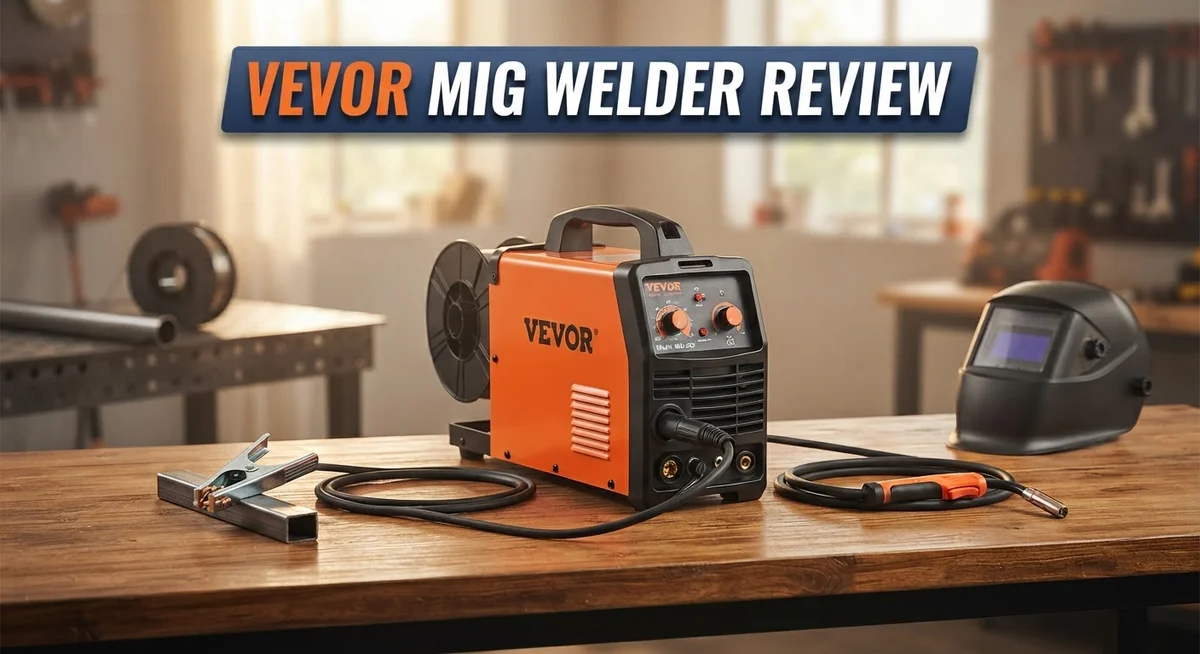
Vevor MIG Welder Review 2026: Is It Worth Buying?
Looking for a welder that just works? The Vevor MIG Welder grabs attention fast. It promises beginner friendly controls and serious multi process power.
This machine handles MIG, Flux Core, MMA, and Lift TIG. That means one tool covers almost every welding job you face.
The IGBT inverter technology inside keeps your welds smooth and stable. A digital display shows current and wire speed clearly. You always know your settings at a glance.
In a Nutshell
- Beginner friendly controls make this welder simple to use. You do not need years of experience to get good results.
- The LCD display shows current and wire speed clearly. This helps you dial in settings fast.
- Its feed roller system works smoothly for most projects. Wire feeds consistently without frequent jams.
- Some units arrive with loose assembly. You may need to tighten bolts and check connections first.
- A few users report firmware issues on certain units. This can affect display accuracy or settings.
- Expect some initial setup and adjustment. Small tweaks out of the box improve performance quickly.
- Long term durability feedback remains limited. Most reviews focus on short term use only.
Welding Capabilities and Multi-Process Performance
The Vevor MIG Welder shines when you need flexibility across different welding styles. This machine switches between MIG, Flux Core, MMA, and Lift TIG modes. You work with one tool instead of buying four separate machines.
MIG welding stands out as the primary strength here. The wire feed system delivers consistent metal deposition. Users report clean welds on mild steel and thin materials. The feed roller mechanism grips wire smoothly without slipping.
Flux Core welding works well for outdoor jobs and dirty materials. You skip the gas bottle entirely. This process handles rust and mill scale better than standard MIG. The machine adjusts easily between MIG and Flux Core modes.
MMA (stick welding) opens doors to thicker materials and cast iron projects. The Vevor handles this process without needing extra attachments. Your amperage range from 130 to 250A gives you room to work with various rod sizes.
Lift TIG capability rounds out the multi-process performance. This feature lets you strike an arc by touching the electrode to the workpiece. It’s simpler than high frequency TIG but produces solid results on aluminum and stainless steel.
The IGBT inverter technology keeps arc stability strong across all modes. This means less spatter and cleaner weld beads. Your LCD display shows real time current and wire speed readings. You see exactly what the machine is doing.
Switching between processes takes minutes, not hours. The control layout stays simple throughout. Beginners won’t feel overwhelmed by too many buttons or confusing menus.
One catch exists though. Initial setup demands attention. Some units need adjustment before delivering peak performance. The machine doesn’t arrive perfectly tuned. You’ll spend time testing and tweaking settings.
Long term performance data remains sparse. Users report solid reliability for casual projects. Heavy daily use feedback is limited. The engineering quality shows room for improvement in some assembly areas.
For hobbyists and DIY welders, this multi-process capability delivers real value. You get professional welding options without complexity. The machine grows with your skills and projects.

- 5-in-1 MIG Welder: This 250A 5-in-1 pro mig welder supports various functions - MIG Pluse, gasless...
- Flexible Wire Compatibility: Our mig welding machine is compatible with flux core wire, gas solid...

Last update on 2026-08-29 / Affiliate links / Images from Amazon Product Advertising API Some of the links on this website are affiliate links, which means that at no additional cost to you, I earn a commission if you click through and make a purchase. I only recommend products and services that I believe will add value to my readers. Thank you for your support!
Build Quality and Assembly
The Vevor MIG Welder arrives in a compact box, and what you unpack matters more than you might think. The machine itself feels sturdy at first glance, but assembly reveals the first challenge. Many users report loose connections and components that need tightening right out of the box. This is not ideal, yet it is manageable with basic tools and patience.
The frame construction uses steel components that hold up reasonably well. The overall chassis design keeps the welder portable without sacrificing stability during operation. The control panel sits front and center with a logical layout. Buttons and knobs respond smoothly, though some feel slightly cheap in texture.
Initial setup requires real attention. You will need to adjust wire tension, check gas connections, and calibrate settings before your first weld. The feed roller system needs proper alignment to prevent wire jams. Documentation helps here, though some users wish instructions were clearer. Spending 30 to 45 minutes on setup prevents headaches later.
The LCD display mounts cleanly on the front panel. It shows current and wire speed without confusion. Screen brightness works well in both dim shops and bright spaces. The digital readout makes it easy to match settings across different projects.
Internal components use IGBT inverter technology, which is a solid choice for this class of welder. Wiring inside appears reasonably organized, though not pristine. The transformer and cooling system fit compactly within the housing.
Long term durability remains a question mark. The machine works fine during the first year for most owners. Beyond that, feedback gets thinner. Some users report firmware glitches that affect performance after extended use. Others experience component wear in high use scenarios.
The build quality sits in the middle ground. It is not premium, but it avoids feeling flimsy. Assembly quality from the factory needs improvement. Once you spend time on setup and adjustments, the machine settles into reliable operation. For casual and hobby welding, this construction holds up adequately. Heavy industrial use might expose weaknesses faster.
Ease of Use and Control Interface
The control interface on the Vevor MIG Welder keeps things straightforward. You get a digital LCD display that shows your current settings and wire speed in real time. This means you see exactly what the machine is doing without guessing.
The front panel layout groups controls logically. Your main adjustment knobs sit where your hand naturally reaches. Wire speed control responds smoothly when you turn it. Current adjustment feels responsive and doesn’t require excessive force.
Switching between welding modes happens quickly. The machine lets you toggle between MIG, Flux Core, MMA, and Lift TIG without complex menu diving. Most users report that changing processes takes just a few minutes of adjustment. You don’t need to be a technician to make the switch work.
The feed roller system operates smoothly for consistent wire feeding. This matters because uneven wire feed creates messy beads and wasted material. The tension adjustment feels intuitive once you understand the basic principle. Most beginners pick it up after one or two practice sessions.
One thing to note: some units ship with components that need initial calibration. You should check gas connections and wire tension before your first project. This isn’t complicated, but it does require your attention. Skipping this step can lead to frustration and poor weld quality.
The LCD display provides clear feedback on your settings. Numbers appear bright and easy to read even in workshop lighting. This eliminates the guesswork that older analog gauges create. You know your exact amperage and wire speed at all times.
The IGBT inverter technology keeps arc stability consistent across different materials and thicknesses. This means your welds look cleaner whether you’re working on thin sheet metal or thicker stock. The machine adapts to your input without wild fluctuations.
Overall, the control interface prioritizes simplicity over complexity. Beginners won’t feel overwhelmed by too many buttons or confusing menus. Experienced welders appreciate the straightforward approach that lets them focus on technique rather than fighting the equipment.
Top 3 Alternatives
Lincoln Electric MIG Welder

- WELD ANYWHERE: Plug in the Weld-Pak 90i MIG wire feed welder anywhere 120V input power is available...
- ACCESSORIES INCLUDED: The machine comes with a full list of accessories including a welding gun...
Last update on 2026-08-29 / Affiliate links / Images from Amazon Product Advertising API Some of the links on this website are affiliate links, which means that at no additional cost to you, I earn a commission if you click through and make a purchase. I only recommend products and services that I believe will add value to my readers. Thank you for your support!
Hobart Handler MIG Welder

- Versatile Performance: The Handler 140EZ is a compact, 120V welder that offers the power and...
- Superior Control: The infinite voltage control lets you fine-tune your weld settings for cleaner...
Last update on 2026-08-29 / Affiliate links / Images from Amazon Product Advertising API Some of the links on this website are affiliate links, which means that at no additional cost to you, I earn a commission if you click through and make a purchase. I only recommend products and services that I believe will add value to my readers. Thank you for your support!
Forney Flux Core Welder

- Plug-and-play convenience: Powered by a standard 120V household outlet, this welder allows you to...
- Gasless flux-core welding: Eliminate the hassle of heavy gas cylinders and regulators. This FCAW...
Last update on 2026-08-29 / Affiliate links / Images from Amazon Product Advertising API Some of the links on this website are affiliate links, which means that at no additional cost to you, I earn a commission if you click through and make a purchase. I only recommend products and services that I believe will add value to my readers. Thank you for your support!
Portability and Power Compatibility
The Vevor MIG Welder shines when it comes to moving between job sites. Its compact frame fits into truck beds and workshop corners without eating up valuable space. You get real portability without sacrificing power output.
Dual voltage compatibility stands out as a major advantage here. The machine runs on both 110V and 220V power sources. This flexibility means you can use it at home on standard outlets or switch to 220V at a professional shop. No rewiring needed when you change locations.
The 130–250A models handle most common welding tasks across different power settings. Higher amperage ratings give you the muscle for thicker materials. Lower settings work perfectly for sheet metal and delicate jobs. You control the power level from the front panel with simple adjustments.
IGBT inverter technology keeps the machine efficient across voltage ranges. This means less power loss during operation. Your welds stay consistent whether you’re running on 110V or 220V. The inverter also reduces the overall weight compared to older transformer designs.
Setup at a new location takes minimal time. You plug in the power cord, connect your gas supply, and load the wire spool. Most users report fifteen to twenty minutes for a complete changeover between sites. The LCD display shows your current settings instantly, so you know exactly what power you’re running.
One important note: check your job site’s available power before arriving. Some older buildings only have 110V outlets. Newer construction typically offers 220V hookups. Having both options on the Vevor machine eliminates this stress entirely.
The machine weighs enough to stay stable during operation but light enough for one person to move. You won’t need a forklift or heavy equipment to transport it. This balance makes the Vevor a practical choice for welders who work across multiple locations.
Power compatibility extends beyond voltage options. The multi-process capability means one machine handles MIG, Flux Core, MMA, and Lift TIG work. You eliminate the need to own separate equipment for different welding styles. This reduces storage space requirements and simplifies your setup process.
Long-Term Durability and Reliability
The Vevor MIG Welder’s long-term durability depends heavily on how you maintain it and what conditions you use it in. Most owners report solid performance during the first year, which is a positive sign for this class of equipment.
The steel frame construction holds up reasonably well under normal shop conditions. The welds on the frame itself are clean, and the overall structure resists warping even after repeated use. However, the assembly quality varies between units, so inspecting your machine out of the box matters.
Internal components show mixed durability patterns. The IGBT inverter technology proves reliable across different materials and thicknesses, and many users report consistent arc stability even after months of regular welding. The feed roller system operates smoothly for consistent wire feeding, and this consistency tends to last longer than cheaper alternatives.
Where durability concerns emerge is in the electronics and firmware. Some users report occasional glitches with the LCD display or control settings after extended use. The loose assembly and poor engineering quality in certain areas can lead to vibration issues over time, especially if you weld in high-production environments.
The cooling system handles moderate duty cycles well, but pushing this machine to its limits continuously will shorten its lifespan. Proper ventilation and regular cleaning of dust buildup inside the casing help extend reliability significantly.
Long-term durability remains a question mark because most detailed feedback comes from the first 12 to 18 months of ownership. Fewer users report performance data beyond two years, making it hard to predict what happens in year three or beyond.
What helps durability most is addressing setup requirements immediately. Adjusting wire tension, checking gas connections, and calibrating settings out of the box prevents early wear on internal components. Owners who skip these steps often experience premature failures.
For hobbyists and occasional users, this welder should serve you well for several years. For high-volume production shops, plan on eventual component replacements. Regular maintenance and proper storage extend the machine’s working life considerably.
Pros and Cons
Pros
- Beginner operators find the control layout intuitive and easy to learn quickly
- Multi-process capability (MIG, Flux Core, MMA, Lift TIG) handles diverse welding jobs from one machine
- Dual voltage compatibility (110V/220V) works with most job site power sources
- Feed roller system delivers consistent wire speed without stuttering or jamming
- Portable frame stays light enough for one person to transport between locations
Cons
- Units arrive requiring calibration and adjustment before first use out of the box
- Firmware glitches have been reported by some users during operation
- Assembly quality feels loose in spots, suggesting room for better manufacturing standards
- Long-term durability data remains limited since most feedback covers only the first 12 to 18 months of ownership
Who Should Buy It
Hobbyists and DIY enthusiasts benefit most from this machine. You get multi-process capability without needing separate equipment for different jobs. MIG, Flux Core, MMA, and Lift TIG all work from one unit, so you can tackle various projects in your garage or workshop.
Beginners appreciate the simple control layout. The LCD display shows your current and wire speed clearly. You don’t need years of welding experience to operate it successfully. The feed roller system works consistently, which means fewer frustrating jams when you’re still learning proper technique.
Small fabrication shops find value in the portability. One person can move this machine between job sites without heavy equipment. Setup happens quickly, so you spend more time welding and less time preparing. The 110V/220V dual voltage compatibility means you can work almost anywhere power exists.
Home builders and automotive hobbyists gain flexibility from the multi-process design. Whether you’re repairing a truck frame, building a trailer, or fixing farm equipment, you have the right welding process available. You won’t need to rent or buy additional machines for specialty work.
Contractors working on tight budgets should know what they’re getting. This machine handles most common welding tasks across its 130 to 250A range. However, understand that out of the box setup requires calibration and adjustment before your first job. Some users report firmware glitches, so you may need to troubleshoot initial operation.
This welder is NOT ideal for continuous heavy industrial use or high volume production shops. Long term durability remains uncertain beyond 18 months of regular operation. The assembly quality feels loose in certain areas, suggesting the manufacturing standards need improvement.
Choose this machine if you weld occasionally, need multiple processes, and can handle basic maintenance and setup adjustments. Skip it if you demand premium build quality or plan to run the machine continuously for eight hour shifts daily. The real strength lies in versatility and portability for smaller operations and learning environments.
Final Verdict
This welder earns its place as a solid pick for casual and semi professional use.
It delivers real value for anyone who wants to try multiple welding processes without buying separate machines. The core performance backs up its reputation as a dependable entry point into welding.
Still, buyers should walk in with realistic expectations. This is not a machine built for daily industrial punishment. It shines brightest in garages, small shops, and weekend projects.
The setup process takes patience. You will likely spend time adjusting settings and checking connections before your first weld looks clean. This is normal for machines in this class and should not discourage new owners.
Support and community resources matter here too. Many owners find help online through forums and video guides when firmware or calibration issues pop up. Having this kind of community backup makes ownership easier.
Compared to similar options on the market, this VEVOR model holds its own. It offers more flexibility than single process machines while keeping operation simple enough for first time welders.
If you already own commercial grade equipment, this will feel like a step down. But if you are building your first home workshop or need a backup machine for side jobs, it fits well.
The bottom line stays simple. Buy this welder if you want a flexible, easy to learn machine for occasional projects. Skip it if you need something built for constant, heavy duty output.
Weigh your specific needs before deciding. Think about how often you weld, what materials you work with, and how much setup time you are willing to invest upfront.
For most hobbyists, small shop owners, and automotive enthusiasts, this welder delivers dependable results. It rewards patience during setup with steady, usable performance once dialed in.
Final call: a smart choice for learning, tinkering, and light duty work around the shop.
Frequently Asked Questions
Can I use this VEVOR welder on 110V power?
Yes, you can. The machine works on both 110V and 220V circuits. This dual voltage design means you can set it up at home, in a garage, or on a job site. Most standard outlets support one of these voltages, so flexibility matters here.
Keep in mind that 110V limits your amperage output slightly. You’ll get lower penetration and slower wire feed speeds compared to 220V operation. For light hobby work and thin materials, 110V works fine. Heavier jobs demand 220V for better results.
What welding processes does this machine handle?
The VEVOR supports multiple processes. You get MIG welding, Flux Core, MMA (stick), and Lift TIG as options depending on your model. Some versions combine 4 or 5 processes in one unit.
This multi-process capability saves money if you want to learn different techniques. You won’t need separate machines for different jobs. Just swap your consumables and adjust your settings.
Do I need to set this welder up before using it?
Yes, setup is required. Units arrive needing calibration and adjustment before your first weld. Take time to check wire tension, nozzle alignment, and drive roller pressure.
Many users report that out of the box assembly feels loose in spots. Spend an hour reviewing the manual and making small tweaks. This prep work prevents feeding problems and improves weld quality significantly.
What happens if I experience firmware issues?
Some owners report occasional glitches during operation. If your display freezes or settings reset unexpectedly, restart the machine and check all cable connections first.
Online forums and video guides help troubleshoot common problems. The user community shares solutions regularly, so you’re not alone if something feels off.

Hi, I’m Amelia Thornton, the founder of ElectroPro.blog.
I write about smart devices, gadgets, electronics, and tech essentials from Amazon.
My goal is to help you discover reliable and innovative tech that truly makes life easier.
From home automation to everyday gear, I test and share what’s worth your investment.
Join me as I explore the smartest tech trends—one gadget at a time.