Corona Hand Saw Review 2026: Still Worth It?
Pruning season arrives fast. One weekend your maple looks tidy, and the next weekend a low branch is scraping your roof. That is the moment most people reach for a folding saw instead of dragging out a chainsaw.
The Corona hand saw has been the default answer for gardeners, arborists, campers, and trail crews for years. It is cheap, it is sharp, and it fits in a back pocket. But cheap and popular does not always mean good in 2026, especially with Silky, Bahco, and Fiskars fighting for the same shelf space.
I spent a full season cutting live oak limbs, dry pine, bamboo, and seasoned firewood with Corona saws. I also dulled one, cleaned sap off another, and pinched a blade badly enough to bend it. This review covers what worked, what annoyed me, and where the saw simply falls short.
In A Nutshell:
- The Corona RazorTOOTH RS 7265D is the best value folding saw under $30. Its 10 inch curved blade handles branches up to 6 inches thick, and the triple ground teeth cut on the pull stroke. For homeowners, this saw does 90 percent of what a $70 Silky does.
- Cutting speed is genuinely fast. Six teeth per inch bite deep and clear sawdust well. A 4 inch green limb takes roughly 25 to 40 seconds with steady strokes.
- The blade dulls faster than premium Japanese steel. Impulse hardened teeth last a long time in clean wood, but dirt, bark grit, and ground contact wear them down quickly. Expect to replace the blade rather than sharpen it.
- The lock is secure but stiff. The thumb lock holds the blade open and closed safely. Cold hands and thick gloves make it awkward to operate.
- Corona sells three main sizes. The 7 inch RS 7245 suits tight canopies, the 10 inch RS 7265D is the sweet spot, and the 14 inch RS 7395 fixed blade handles big limbs.
- It is not a bushcraft hero. The saw is a pruning tool first. Heavy batoning style abuse, frozen hardwood, and lumber ripping will expose its limits.
What Is The Corona Hand Saw?

- 3 SIDED RAZOR TEETH FOR EFFICIENT CUTTING: 10" blade is ideal for cutting 5" - 6" diameter, small to...
- ERGONOMICALLY DESIGNED, COMFORTABLE, CO-MOLDED HANDLE: Provides a comfortable grip for extended use
Last update on 2026-10-21 / Affiliate links / Images from Amazon Product Advertising API Some of the links on this website are affiliate links, which means that at no additional cost to you, I earn a commission if you click through and make a purchase. I only recommend products and services that I believe will add value to my readers. Thank you for your support!
Corona Tools is a California based brand founded in 1928. The company started serving citrus growers in Corona, California, and it still builds most of its lineup around orchard and landscape work.
The Corona hand saw family covers folding saws, fixed blade pruning saws, pole saw blades, and bow saws. When people say “Corona hand saw,” they almost always mean the RazorTOOTH folding pruning saw.
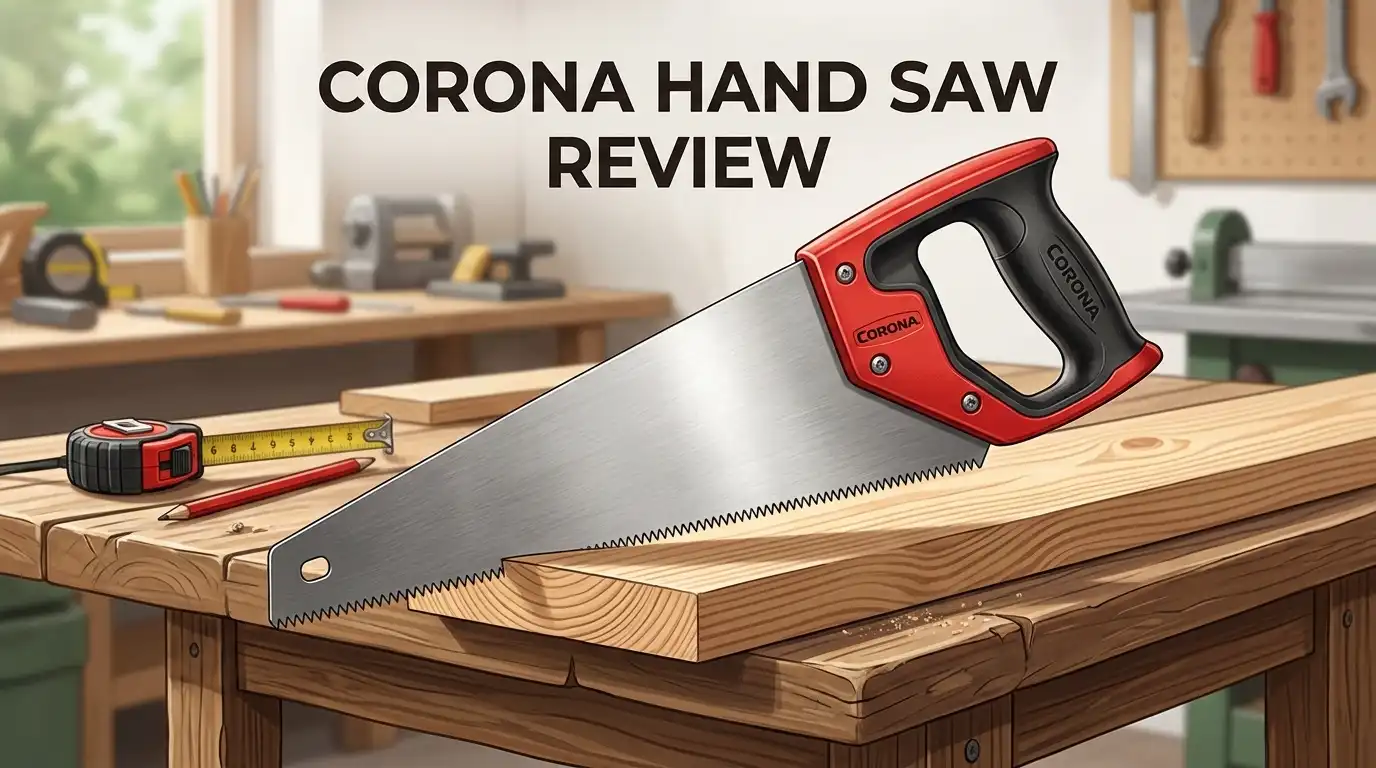
The flagship model is the RS 7265D. It carries a 10 inch curved blade made from high carbon steel with a chrome plated finish. The teeth are impulse hardened, which means the tips are heat treated to a much higher hardness than the blade body.
Curved blades matter more than most buyers realize. The curve pulls the teeth into the wood as you draw the saw back. You supply less downward force and the saw does the work.
Corona rates the 10 inch model for branches up to 6 inches in diameter. That rating is optimistic but not dishonest. A 6 inch limb is possible. A 4 inch limb is comfortable.
The saw cuts on the pull stroke only. This is the Japanese style approach, and it lets the blade stay thin without buckling. Western push saws need thicker steel and wider kerfs.
Corona also sells replacement blades separately, usually around $14 to $18. That single detail makes the saw a long term tool instead of a disposable one.
Unboxing The Corona RazorTOOTH RS 7265D
There is no ceremony here, and that is fine.
The saw arrives in a thin cardboard sleeve with a plastic clamshell window. My unit came with a molded plastic guard slipped over the teeth. Pull it off carefully because those teeth are aggressive straight out of the package.
The first thing you notice is the weight, or the lack of it. The 10 inch model weighs around 11 ounces. It feels light enough to forget in a tool belt.
The second thing you notice is the smell. The blade ships with a light oil coating to stop rust in transit. Wipe it down before your first cut or the sawdust will stick to everything.
The handle is a black and orange composite with a rubberized overmold. The finish is clean. There were no sharp mold seams on my unit, though I have seen photos of units with slight flashing near the pivot.
Open the saw by pressing the orange thumb lock forward and swinging the blade out. It clicks into place with a solid sound. There is zero blade wobble side to side on a new saw.
My first test cut was a 3 inch dry pine branch in my driveway. It took nine strokes. That is genuinely impressive for a saw that costs less than a pizza.
The included documentation is minimal. You get a small care card and nothing else. No sheath, no lanyard, no belt clip. For the price, that is expected.
Build Quality And Materials
The RazorTOOTH blade is the star of the show.
Corona uses SK5 grade high carbon steel, then chrome plates the surface. The plating reduces friction and slows rust. It does not stop rust completely, so sap and moisture still need attention.
The teeth use a three sided grind. Each tooth has three cutting edges instead of one flat face. This design slices wood fibers rather than scraping them, which explains the speed.
Tooth spacing is roughly six teeth per inch on the 10 inch model. The 7 inch model runs finer at about eight and a half teeth per inch. Finer teeth cut smoother but slower.
Impulse hardening turns the tooth tips a slightly darker color. Those tips reach around 60 HRC while the blade body stays softer and more flexible. You cannot file these teeth with a standard saw file.
The handle uses a glass filled nylon core. It flexes slightly under heavy load but does not creak. I put my full body weight behind an awkward overhead cut and nothing failed.
The pivot bolt is the weak point in the design. It can loosen after months of hard use. A quick turn with a screwdriver and a drop of thread locker solves it permanently.
Made in China, assembled to a consistent standard. Corona quality control is decent, though buyers occasionally report a blade that arrives slightly off center in the handle slot.
Cutting Performance In Real Yards
Numbers help more than adjectives, so here are mine.
I timed cuts on live green limbs at a steady working pace, not a race pace. A 2 inch maple branch took about 8 seconds. A 4 inch limb took roughly 32 seconds.
A 6 inch live oak limb took just under two minutes and left my forearm burning. The saw can do it, but the 10 inch blade length becomes the limiting factor, not the teeth.
Dry seasoned wood cuts faster than green wood. A 4 inch dry maple round took about 22 seconds. Green sappy wood loads the gullets and slows everything down.
The curved blade shines in overhead work. Reach up, hook the branch, and pull down. Gravity and the curve do most of the job for you.
Flush cuts against a trunk are trickier. The handle geometry keeps the blade slightly off the bark, so you leave a small collar stub. That stub is actually correct pruning practice, so it works out.
Bamboo is where this saw surprised me. Thick bamboo culms shred cheap saws. The RazorTOOTH sliced through 3 inch culms cleanly with no splintering.
Frozen wood is a different story. In hard freeze conditions the teeth skate more and the cut slows noticeably. That is true of most pull saws, not just Corona.
Sawdust ejection is good but not perfect. In deep cuts past 5 inches, dust packs in and you feel the drag increase.
Top 3 Alternatives for Corona RazorTOOTH Folding Saw

- With refined Japanese cutting technology and fitting a myriad of applications, it’s not surprising...
- Precision-ground, impulse-hardened teeth, matched with a premium Japanese handle, the GomBoy...
Last update on 2026-10-21 / Affiliate links / Images from Amazon Product Advertising API Some of the links on this website are affiliate links, which means that at no additional cost to you, I earn a commission if you click through and make a purchase. I only recommend products and services that I believe will add value to my readers. Thank you for your support!
Silky GomBoy Professional Folding Saw 240mm

- READY FOR ANY CUT: Built for hunters, campers, and survivalists, this folding saw tackles green/dry...
- PRECISION XT TOOTHING: The 7-1/2" blade features XT toothing with 7 TPI for fast, clean cuts through...
Last update on 2026-10-21 / Affiliate links / Images from Amazon Product Advertising API Some of the links on this website are affiliate links, which means that at no additional cost to you, I earn a commission if you click through and make a purchase. I only recommend products and services that I believe will add value to my readers. Thank you for your support!
Bahco 396 LAP Laplander Folding Saw

- IDEAL FOLDING SAW: Fiskars small hand saw for wood cutting with a triple-ground, power tooth blade...
- MAXIMUM POWER AND PRECISION: Hand saw for tree trimming with triple-ground power tooth blade...

Last update on 2026-10-21 / Affiliate links / Images from Amazon Product Advertising API Some of the links on this website are affiliate links, which means that at no additional cost to you, I earn a commission if you click through and make a purchase. I only recommend products and services that I believe will add value to my readers. Thank you for your support!
Fiskars 10 Inch Folding Pruning Saw
Pros And Cons Of The Corona Hand Saw
Every tool trades something. Here is the honest ledger after a season of use.
Pros
- Outstanding price to performance ratio. You get near professional cutting speed for roughly a third of the cost of a Silky.
- Curved blade improves leverage. Overhead and downward cuts require less arm strength than straight blade saws.
- Replacement blades are available and affordable. The handle outlives several blades, which lowers long term cost.
- The safety lock works in both positions. The blade cannot flop open in your bag or close on your fingers mid cut.
- Comfortable non slip handle. The rubberized overmold stays grippy in wet conditions and reduces hot spots.
- Light enough for backpacking. At around 11 ounces, it earns its place in a pack.
- Widely available. You can find one at almost any hardware store, which matters when a blade breaks mid project.
Cons
- Teeth dull faster than premium Japanese saws. Grit and soil contact accelerate wear significantly.
- Cannot be resharpened at home. Impulse hardened teeth resist files, so replacement is the only real option.
- No sheath or belt clip included. You need to buy or make your own carry solution.
- The thumb lock is stiff with gloves on. Cold weather makes it fiddly.
- Pivot bolt can loosen over time. Occasional tightening is required.
- Chrome plating scratches easily. Cosmetic only, but it makes rust more likely on scratched areas.
- Quality control varies slightly between units. Most are excellent, some arrive with minor blade alignment issues.
Corona RS 7245 vs RS 7265D vs RS 7395
Picking the right size matters more than picking the right brand.

- Sharp 7” Curved Steel Blade for Faster Cutting – Features a durable, high-carbon steel blade...
- Compact Folding Design with Secure Lock – Folds safely into the handle for easy storage and...
Last update on 2026-10-24 / Affiliate links / Images from Amazon Product Advertising API Some of the links on this website are affiliate links, which means that at no additional cost to you, I earn a commission if you click through and make a purchase. I only recommend products and services that I believe will add value to my readers. Thank you for your support!
The RS 7245 is the 7 inch folding model. It weighs under 7 ounces and handles branches up to about 3 inches. Its finer tooth pitch leaves smoother cuts on delicate ornamentals.
Choose the 7 inch model if you prune roses, fruit trees, or dense shrubs. It slips into tight canopies where a longer blade cannot swing.
The RS 7265D is the 10 inch folding model. This is the version most people should buy. It manages small twigs and 5 inch limbs equally well.
The 10 inch blade gives you longer strokes, which means fewer strokes per cut. Fewer strokes means less fatigue on a long pruning day.
The RS 7395 is the 14 inch fixed blade saw. It does not fold, so it needs a scabbard. In exchange you get real reach and the ability to cut 8 inch limbs.

- Razortooth saw technology removes more material with each pass
- 3 sided razor teeth efficiently cut limbs up to 8 in.
Last update on 2026-10-24 / Affiliate links / Images from Amazon Product Advertising API Some of the links on this website are affiliate links, which means that at no additional cost to you, I earn a commission if you click through and make a purchase. I only recommend products and services that I believe will add value to my readers. Thank you for your support!
Professionals often carry the fixed blade because it deploys instantly. No unfolding, no locking, just draw and cut.
My recommendation is simple. Homeowners buy the 10 inch. Detail gardeners buy the 7 inch. Anyone clearing storm damage buys the 14 inch.
Corona also sells an 18 inch version for large limb work, plus pole saw blades that mount to extension poles.
What The Corona Hand Saw Does Not Do Well
This section matters more than the praise, so read it carefully.
The saw is not a lumber tool. Ripping along the grain is painfully slow because the teeth are ground for crosscutting green fiber. Use a proper carpentry saw for boards.
Dirty wood destroys the edge. I cut a fence post that had soil on it and lost noticeable sharpness in one afternoon. Trail crews report the same issue constantly.
The blade binds in wet green wood. Living wood closes behind the kerf. Without a wedge or a helper holding tension, you will pinch the blade.
I bent my first blade this way. The steel is thin, and a sideways twist under pressure sets a permanent kink.
Sap cleanup is a chore. Pine and fir resin gum the teeth and the chrome does not shrug it off. You need mineral spirits or a citrus cleaner after every conifer session.
The handle is not ambidextrous friendly for everyone. Left handed users report the thumb lock sits awkwardly. It still works, it just requires a grip shift.
Cold weather stiffens the pivot. Below freezing, the folding action gets noticeably tighter.
It is not a chainsaw replacement. Anything above 6 inches is a workout, and anything above 8 inches is unrealistic. Do not buy this expecting to fell trees.
Comfort, Grip And Safety Features
Ergonomics decide whether you finish the job or quit early.
The handle measures about 8.5 inches long. That leaves room for a gloved hand plus a little extra for repositioning.
The overmold has raised ridges along the top spine. Your thumb naturally lands on a flat pad, which helps you steer the cut.
I pruned for three straight hours and had no blisters. I did get forearm fatigue, but that comes from the cutting itself, not the handle shape.
The pistol style angle points the blade slightly downward. This helps with waist level cuts and overhead cuts. It hurts slightly on ground level cuts near the soil.
The safety lock is the standout feature. Push the orange tab forward to release, swing the blade, and the tab snaps back automatically. It engages in both the open and closed positions.
I tested the lock by whacking the spine of the open blade against a log. It did not budge.
There is a small hole at the base of the handle for a lanyard. Corona does not include a lanyard, but a length of paracord fixes that in a minute.
Vibration is minimal because the blade is short and stiff. You will not get the buzzing feedback that longer bow saws produce.
One safety note. These teeth are sharp enough to open skin with light contact. Treat the blade like a knife, not like a lumberyard handsaw.
Blade Care, Sharpening And Replacement
Maintenance is short and simple, which is good news.
Clean sap after every session. Mineral spirits, isopropyl alcohol, or a citrus degreaser all work. Wipe the blade dry immediately afterward.
Apply a thin coat of light oil before storage. Camellia oil is traditional for Japanese style saws. Ordinary 3 in 1 oil works just as well.
Do not attempt to sharpen impulse hardened teeth with a file. The file will skate off and you will ruin both the file and the tooth geometry.
Some users grind them with a diamond file. This works but removes the hardened layer, so the teeth dull much faster afterward.
The practical answer is replacement. Corona sells the AC 7265 replacement blade for the 10 inch model. Swapping takes about two minutes with a screwdriver.
A blade should last one to three seasons for a homeowner. Trail crews and arborists often burn through one per season.
Extend blade life with three habits. Keep the blade out of soil, avoid cutting wood with embedded nails or wire, and never twist the blade sideways in a bind.
Storage matters too. Do not leave the saw in a damp shed or truck bed. Condensation plus scratched chrome equals rust spots.
If rust appears, a fine wire brush and oil will remove surface bloom. Deep pitting means the blade is finished.
Price And Value In 2026
Pricing has stayed remarkably stable for a decade.
The 7 inch RS 7245 usually sits between $16 and $22. The 10 inch RS 7265D usually lands between $22 and $32. The 14 inch RS 7395 runs about $30 to $40.
Compare that to a Silky GomBoy at roughly $55 to $70, or a Silky Katanaboy at well over $150.
The value math is clear. You could buy three Corona saws for the price of one premium Japanese saw. If you dull one, you swap it and keep working.
The counterargument is real though. A Silky holds its edge longer and cuts marginally faster in hardwood. Professionals who saw daily often prefer paying once.
Replacement blades cost around $15. Since the handle typically outlasts three blades, your effective cost per season drops fast.
Corona backs the saw with a limited lifetime warranty against manufacturing defects. Normal blade wear is not covered, which is standard across the industry.
Watch for pricing spikes on Amazon during spring. Late autumn and mid winter are usually the cheapest windows.
My verdict on value is straightforward. For anyone cutting fewer than 200 branches a year, Corona is the smarter purchase.
Who Should Buy The Corona Hand Saw
Match the tool to the job and you will be happy.
Homeowners with a few trees should buy it. You will prune a handful of times each year, and the blade will last several seasons easily.
Campers and backpackers should buy the 7 inch or 10 inch folding model. Under 11 ounces is acceptable weight for processing firewood up to wrist thickness.
Trail volunteers should buy it, with a caveat. Buy two blades at once. Trail wood is dirty and you will chew through the first blade quickly.
Beginner gardeners should buy it. The low price means a bent or dulled blade is a lesson, not a disaster.
Professional arborists should probably skip it. Daily use exposes the edge retention gap, and pros benefit from Silky durability and finer replacement blade options.
Anyone cutting dimensional lumber should skip it. Buy a proper carpentry saw or a circular saw instead.
People with limited hand strength should consider the 7 inch model. The lighter weight and finer teeth reduce effort per stroke, though total cuts take longer.
If you already own a chainsaw, the Corona still earns space in your kit. Small cuts near fences, wires, and delicate plants are safer with a hand saw.
Final Verdict: Is The Corona Hand Saw Worth Buying In 2026?
Yes, for most people, without hesitation.
The Corona RazorTOOTH RS 7265D delivers cutting speed that embarrasses saws costing twice as much. The curved blade, the triple ground teeth, and the secure lock form a genuinely good design.
It is not the best folding saw on the market. Silky still owns that title on edge retention and cut smoothness. Bahco still owns the toughness title for rough field abuse.
What Corona owns is the value crown. Nothing else in the $25 range cuts this well.
My honest rating is 4.4 out of 5. Points lost for edge retention, no included sheath, and the stiff glove unfriendly lock.
Buy the 10 inch RS 7265D as your default. Add a spare blade to the same order and forget about saws for two years.
Skip it only if you saw professionally every day, or if you need a saw for construction lumber rather than living wood.
Frequently Asked Questions
Are Corona saws made in the USA?
Corona Tools is headquartered in Corona, California, and the company was founded there in 1928. Most current folding saws, including the RazorTOOTH line, are manufactured overseas, primarily in China and Taiwan. Some fixed blade and professional models are still assembled domestically. Check the packaging on your specific model for country of origin.
How thick a branch can a Corona hand saw cut?
The 7 inch model handles branches up to about 3 inches comfortably. The 10 inch model manages up to 6 inches, though 4 inches is the practical sweet spot. The 14 inch fixed blade handles up to 8 inches. Cutting at the maximum rating works, but it takes significantly longer and tires your arm.
Can you sharpen a Corona RazorTOOTH blade?
Not practically. The teeth are impulse hardened to roughly 60 HRC, which is harder than a standard saw file. A diamond file can reshape them, but it removes the hardened surface layer and the edge dulls quickly afterward. Buying a replacement blade for around $15 is the better option.
Does the Corona saw cut on the push or pull stroke?
It cuts on the pull stroke. This lets Corona use a thinner blade with a narrower kerf, which reduces effort. Apply light pressure on the pull and almost none on the push. Pushing hard will bend or kink the blade.
Is Corona better than Silky?
Silky cuts marginally faster and holds its edge much longer. Corona costs roughly a third as much and performs close enough for homeowner use. If you saw daily for work, choose Silky. If you saw a few times a month, choose Corona and save the money.
How do I stop the blade from binding?
Cut from the underside of the limb first, about a third of the way through. Then finish from the top. This relief cut stops the wood from pinching the blade as the limb sags. Never twist the saw sideways to free a stuck blade.

Hi, I’m Amelia Thornton, the founder of ElectroPro.blog.
I write about smart devices, gadgets, electronics, and tech essentials from Amazon.
My goal is to help you discover reliable and innovative tech that truly makes life easier.
From home automation to everyday gear, I test and share what’s worth your investment.
Join me as I explore the smartest tech trends—one gadget at a time.