Ryobi Wood Chipper Review: Worth It?
Yard cleanup eats up entire weekends. You rake, you pile, and then you stuff overflowing bags into bins that never seem big enough.
The Ryobi 15-Amp electric wood chipper promises a faster path: feed in branches, get bagged mulch out the other side.
I spent several weeks running it through real yard debris to see if it actually shrinks the chore. This review covers the build, the feed experience, the noise, and the honest downsides nobody mentions in the product photos.
In a Nutshell
- Corded power, no fumes: The 15-Amp motor runs clean and starts instantly. No gas, no pull cord, no choke fiddling on cold mornings.
- Branch limit is real: It handles branches up to roughly 1.7 to 1.8 inches thick. Push past that and it bogs down fast.
- Best for dry, woody material: Dry sticks and twigs feed beautifully. Wet, leafy, or stringy material clogs the chute.
- Mulch reduction works: You get close to a 15:1 reduction ratio, turning a tall pile of branches into one small bag.
- Light and movable: At around 30 pounds with wheels, one person can roll it across a lawn without strain.
- Not a heavy-duty machine: This is a homeowner tool, not a contractor chipper. Match your expectations to your yard.

- Turn your excess lawn clippings, twigs and foliage into high-grade, nutrient-rich mulch
- Shred sticks and branches up to 1.75 inches in diameter with ease

Last update on 2026-08-29 / Affiliate links / Images from Amazon Product Advertising API Some of the links on this website are affiliate links, which means that at no additional cost to you, I earn a commission if you click through and make a purchase. I only recommend products and services that I believe will add value to my readers. Thank you for your support!
What Is the Ryobi Wood Chipper?
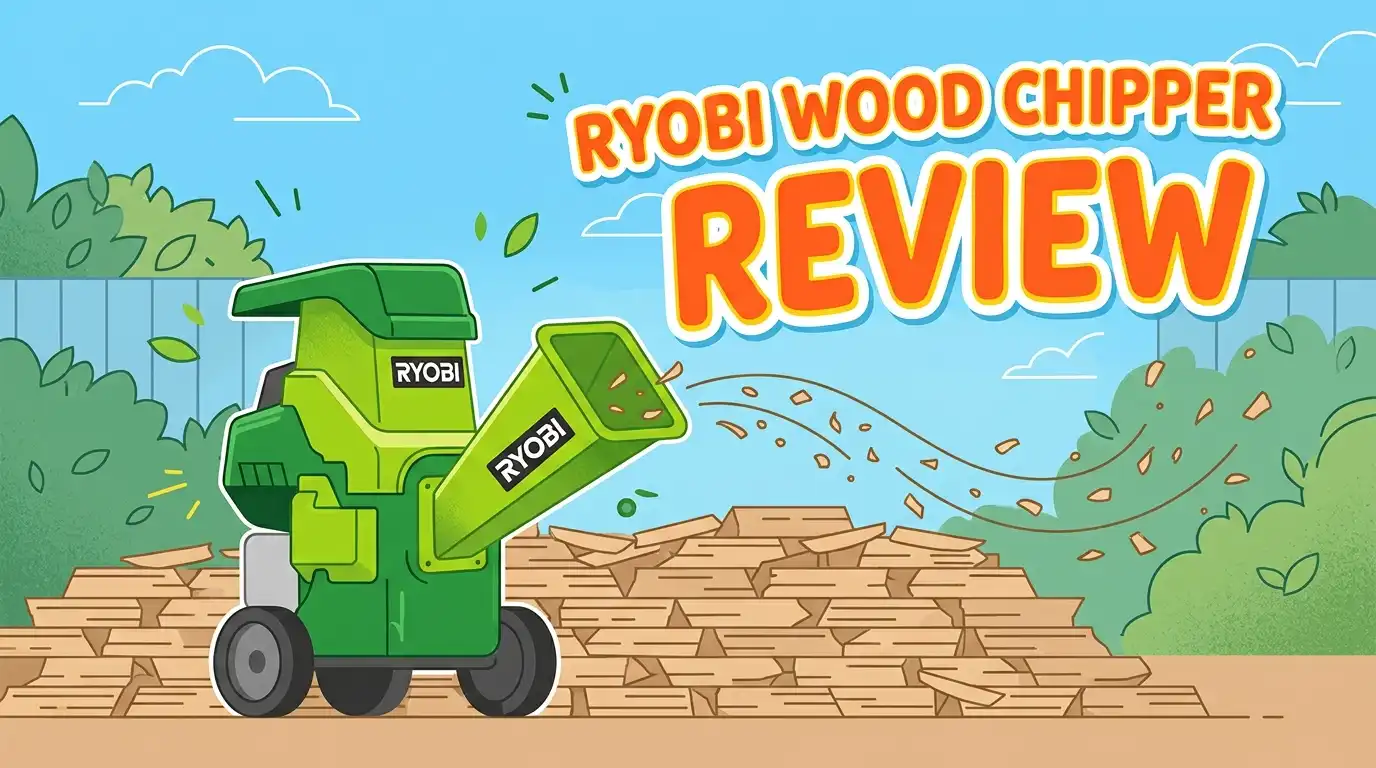
The Ryobi wood chipper is a corded electric chipper shredder built for residential yards. It plugs into a standard outlet and uses a 15-Amp motor to power dual steel blades that slice branches into chips. A separate shredder chute handles softer debris like leaves and small clippings.
The design targets one job: shrinking yard waste so it fits in fewer bags. It feeds twigs, prunings, and thin branches into a hopper, then drops fine mulch into a collection bag below. The body sits on wheels for short moves around the yard.
This is a plug-and-go machine. There is no engine to maintain, no oil to change, and no gas to store. For homeowners with a few trees and seasonal prunings, that simplicity is the main draw. It is not built for clearing acres or processing thick logs.
Who Is This Chipper For?
This chipper fits a specific user. If you have a small to medium suburban yard with a few trees and shrubs, it earns its place in the garage. Light pruners and casual gardeners get the most value here.
It suits people who hate engine maintenance. There is no carburetor to clean and nothing to winterize beyond a wipe-down. If you compost, the fine mulch output feeds your beds and pile directly.
It also works for noise-sensitive neighborhoods. Electric motors run quieter than gas chippers, so you can run it without rattling the whole street. People who store tools in tight spaces will like the compact footprint too.
Skip it if you clear large lots, drop full trees, or process thick hardwood limbs regularly. Heavy users need a gas-powered or PTO chipper. This Ryobi is a maintenance-light helper for steady, small jobs, not a land-clearing workhorse.
Top 3 Alternatives for the Ryobi Wood Chipper

- This refurbished product is tested and certified to work properly. The product will have minor...
Last update on 2026-08-29 / Affiliate links / Images from Amazon Product Advertising API Some of the links on this website are affiliate links, which means that at no additional cost to you, I earn a commission if you click through and make a purchase. I only recommend products and services that I believe will add value to my readers. Thank you for your support!
Sun Joe CJ603E Electric Silent Wood Chipper Shredder

- Turn your excess lawn clippings, twigs and foliage into high-grade nutrient-rich mulch
- Shred sticks and branches up to 1.5 inches in diameter with ease
Last update on 2026-08-29 / Affiliate links / Images from Amazon Product Advertising API Some of the links on this website are affiliate links, which means that at no additional cost to you, I earn a commission if you click through and make a purchase. I only recommend products and services that I believe will add value to my readers. Thank you for your support!
WEN 41121 15-Amp Rolling Electric Wood Chipper and Shredder
- Turn your excess lawn clippings, twigs and foliage into high-grade, nutrient-rich mulch
- Shred sticks and branches up to 1.75 inches in diameter with ease
Last update on 2026-08-29 / Affiliate links / Images from Amazon Product Advertising API Some of the links on this website are affiliate links, which means that at no additional cost to you, I earn a commission if you click through and make a purchase. I only recommend products and services that I believe will add value to my readers. Thank you for your support!
WEN 41119 Electric Wood Chipper and Shredder
Unboxing and First Impressions
The box arrives heavy but manageable for one person. Inside you get the main body, the wheels, the collection bag, and the hopper hardware. A printed manual sits on top, and the parts come wrapped to prevent scratches in transit.
Assembly is straightforward. You bolt on the wheels and the feed hopper, then attach the bag. It took me under 30 minutes with a basic wrench. Nothing felt fiddly, though a few bolt holes needed a small nudge to line up.
First impressions are positive but modest. The plastic shroud feels lighter than a gas unit, which is expected at this price. The steel blades, though, look serious and arrive sharp. It does not feel premium, but it feels honest for what it costs. You can tell this is a tool meant to do a job, not impress on a showroom floor.
How Loud Is It Really?
Electric chippers get marketed as quiet. That label needs context. At idle, the motor hum is genuinely mild, much softer than any gas engine. You could chat next to it while it spins empty.
The moment you feed a branch, that changes. The cutting noise spikes sharply as blades bite wood. It is a loud, grinding crunch, not a gentle whir. The “silent” claim only holds when nothing is going through it.
In practice, it lands in the middle. Quieter than gas, louder than you expect. I still wore hearing protection during long sessions, and I would recommend it. Your neighbors will notice when you are working, but they will not be driven indoors. For noise-conscious yards, it remains the better choice over a screaming gas unit, just do not picture a whisper.
Feeding Performance on Branches
This is where the chipper proves itself or fails. On dry, woody branches up to about 1.7 inches, it performs well. Feed them in straight and the blades pull them through with a satisfying crunch.
The catch is consistency. Branches with side shoots or forks snag at the chute opening. You have to trim the offshoots first, which adds time. The machine wants clean, straight sticks, and it rewards you when you give it that.
Push a branch near the maximum diameter and the motor audibly strains. It still chips it, but slowly, and it can stall if you force it. The honest read: this handles light pruning waste smoothly and chokes on anything thick or twisted. Patience and pre-trimming make the difference between a smooth session and a frustrating one. Treat the stated limit as a ceiling, not a target.
Shredding Leaves and Soft Debris
The second chute handles softer material, and results are mixed. Dry leaves and small clippings shred fine and reduce nicely into the bag. When everything is crisp and dry, it works as advertised.
The problem is moisture. Wet leaves, green clippings, and stringy vines are this machine’s weakness. They wrap around the blades and clog the chute fast. I cleared jams more than once when feeding damp material.
My advice is simple: let yard waste dry first. Stringy plants like ivy and tall weeds are best kept out entirely. They tangle and stall the motor. For dry autumn leaves and brittle stems, the shredder earns its keep and saves bag space. For anything wet or fibrous, you will spend more time unclogging than shredding. Knowing this upfront saves a lot of frustration during real cleanup days.
Mulch Quality and Reduction Ratio
The payoff for chipping is the mulch, and here the Ryobi delivers. The reduction ratio sits near 15:1, meaning a large pile of branches collapses into one modest bag. That is a real, visible space saving.
The chip output is coarse but usable. Pieces come out in small, irregular chunks rather than fine, even mulch. For garden beds and pathways, the texture works well and breaks down over time in compost.
Do not expect decorative, uniform bark mulch. This is functional mulch for covering soil and feeding a compost pile, not landscaping-grade material for a front-yard display. If your goal is reducing waste volume and making free mulch, it succeeds clearly. If you want bagged-store mulch consistency, you will be slightly let down. For most homeowners turning prunings into something useful, the output is exactly what they need.
Durability and Build Quality
After weeks of use, the build holds up with a few caveats. The steel blades stay sharp through normal pruning waste and cut cleanly. The motor never overheated during reasonable sessions with breaks.
The weaker areas are the plastics. The hopper and shroud feel light, and I would not trust them under rough handling or heavy impact. The wheels roll fine on grass but feel basic. This is a value-tier build, and it shows in the housing rather than the cutting core.
Longevity depends on how you treat it. Feed it the right material at the right thickness and it should serve a casual user for years. Abuse it with thick limbs or constant heavy loads and parts will wear faster. Blade replacement is part of ownership over time. As a seasonal homeowner tool, the durability is acceptable. As a daily workhorse, the plastic parts become the limit long before the motor does.
Maintenance and Cleanup
Maintenance is genuinely light, which is the whole point of going electric. There is no engine, no oil, and no fuel system. You skip the entire gas-chipper upkeep routine, and that alone saves real hassle.
Routine care is simple. Clear the chute of debris after each session, brush out chip buildup, and wipe the body down. Leaving wet pulp inside invites clogs and corrosion, so a quick cleanout matters.
Over time you will sharpen or replace the blades, which is the main wear item. Dull blades tear instead of cut and strain the motor. Replacement blades are affordable and swap out with basic tools. Storage is easy too: it tucks into a corner of the garage without needing fuel stabilizer or winter prep. For anyone who dreads engine maintenance, this is the chipper’s quiet strength and a major reason to pick electric over gas.
Honest Downsides and Drawbacks
No tool is perfect, so here is the unfiltered list. The corded design ties you to an outlet, which means an extension cord and a limited working radius. You cannot wander to the back of a large lot.
The biggest letdown is the narrow material range. Thick, wet, or stringy debris clogs it or stalls the motor. You must pre-trim branches and dry leaves first, which adds prep time. The “silent” marketing also overstates how quiet it is under load.
Build quality is value-tier, with light plastics that demand careful handling. Feed speed slows near the maximum branch size. This is not a contractor machine, and treating it like one leads to disappointment. If your yard produces heavy or constant waste, look at a gas unit instead. For light, dry, seasonal pruning, these flaws are livable. For anything heavier, they become daily annoyances worth avoiding.
Final Verdict
So, is the Ryobi wood chipper worth it? For the right user, yes. It turns a frustrating bagging chore into a faster, cleaner routine and makes free mulch in the process. The no-maintenance electric design is its strongest selling point.
It earns its spot for light pruners, composters, and small-yard owners who feed it dry, thin branches. Within that lane, it performs reliably and saves real effort. Outside that lane, it disappoints.
Set your expectations correctly and you will be happy. Treat the branch limit as a ceiling, dry your leaves, and trim your forks. Do that, and this becomes a handy seasonal helper that quietly shrinks your yard waste. Push it beyond its design and you will fight it. For its price and purpose, it is a sensible buy for casual homeowners, and a poor fit for heavy-duty work.
Frequently Asked Questions
What size branches can the Ryobi wood chipper handle?
It handles branches up to roughly 1.7 to 1.8 inches in diameter. Stay below that for smooth feeding. Branches near the maximum slow the motor and feed more slowly, so trim thick or forked pieces first for the best results.
Is the Ryobi wood chipper gas or electric?
This model is corded electric with a 15-Amp motor. It plugs into a standard outlet, needs no fuel, and requires no engine maintenance. You will need an outdoor extension cord rated for the load to reach across your yard.
Can it shred wet leaves?
Not well. Wet, green, or stringy material clogs the chute and wraps the blades. Let leaves and clippings dry first for clean shredding. Stringy vines and damp pulp cause the most jams, so keep those out of the machine.
Does it make good mulch?
It produces coarse, functional mulch near a 15:1 reduction ratio. The chips work well for garden beds and compost, but they are not uniform decorative bark mulch. Expect useful, irregular pieces rather than landscaping-grade material.
How often do the blades need replacing?
The steel blades stay sharp through normal use but dull over time. Dull blades tear wood and strain the motor. Most casual users sharpen or replace them seasonally depending on workload. Replacement blades are affordable and install with basic tools.
Is it loud?
It is quieter than gas chippers at idle, but the cutting noise spikes sharply when feeding branches. Wear hearing protection during long sessions. The “silent” label only applies when the machine runs empty, not under an actual cutting load.

Hi, I’m Amelia Thornton, the founder of ElectroPro.blog.
I write about smart devices, gadgets, electronics, and tech essentials from Amazon.
My goal is to help you discover reliable and innovative tech that truly makes life easier.
From home automation to everyday gear, I test and share what’s worth your investment.
Join me as I explore the smartest tech trends—one gadget at a time.