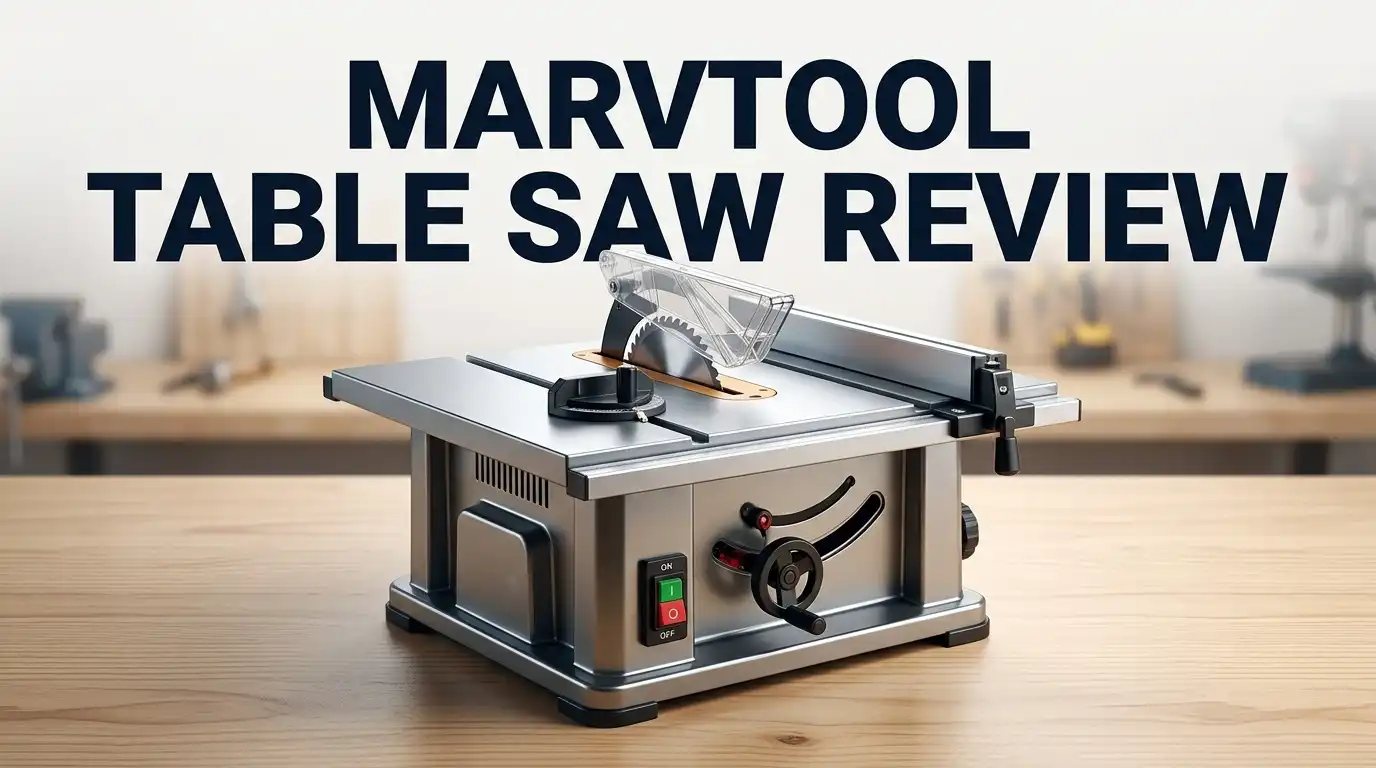
MarvTool Table Saw Review 2026: Worth Buying?
Budget table saws keep getting better. They also keep getting more confusing. MarvTool is one of those newer names that shows up on Amazon with strong specs and a low price, and shoppers immediately wonder if the deal is real.
This review looks at the MarvTool 15Amp Portable Table Saw 10 inch, the brand’s main benchtop model. We cover the specs, the setup process, the cutting performance, and the parts that fall short. No hype. Just a clear picture so you can decide.
One quick note before we start. MarvTool is a young brand with a shorter track record than DeWalt or Skil, so long term reliability data is still thin. Keep that in mind as you read.
In a Nutshell:
- Strong motor for the money. The saw runs a 15 amp motor at roughly 4600 RPM with a 10 inch, 36 tooth blade. That is genuine jobsite level power, and it rips construction lumber without bogging down.
- Very light and easy to move. At about 28 to 30 pounds, this is one of the lighter 10 inch saws available. One person can carry it to a truck bed or a garage shelf without help.
- Good cut capacity. Expect around 3 1/8 inches of depth at 90 degrees and about 2 1/4 inches at a 45 degree bevel. That handles 4×4 posts, stacked plywood, and thick hardwood stock.
- The fence is the weak point. Like most saws in this price class, the rip fence needs checking and tuning. It is not a rack and pinion system, so squareness depends on you.
- Rip capacity is limited. This is a compact benchtop saw, not a sheet goods machine. Cutting full plywood panels solo is awkward without an outfeed setup.
- Best for hobbyists and light trade use. If you build furniture on weekends, install trim, or cut a lot of small stock, this saw earns its keep. If you run production work every day, buy a heavier saw.
MarvTool 15Amp Portable Table Saw 10 Inch Overview

- 【Efficient Cutting】The table saw is equipped with a powerful 15 amp motor and a 36T blade. It...
- 【Compact & Portable】Weighing only 28.3 pounds, the Portable Table Saw features a compact design...
Last update on 2026-10-21 / Affiliate links / Images from Amazon Product Advertising API Some of the links on this website are affiliate links, which means that at no additional cost to you, I earn a commission if you click through and make a purchase. I only recommend products and services that I believe will add value to my readers. Thank you for your support!
The MarvTool table saw sits in the compact benchtop category. It uses a full size 10 inch blade instead of the 8 1/4 inch blade many portable saws use, which gives it more depth of cut.
The motor pulls 15 amps on standard 120V household power. No load speed lands near 4600 RPM. That number matters because higher blade speed helps a direct drive saw push through dense material without stalling.
Physical size stays small. The listed footprint runs roughly 26 inches by 24.8 inches by 19.7 inches, and weight sits between 28 and 30 pounds depending on the listing. You can set this on a workbench, a folding stand, or even a pair of sawhorses with a plywood top.
Cut capacity is the headline feature. The saw cuts about 3 1/8 inches deep at 90 degrees, which covers 4×4 material in a single pass. Bevel the blade to 45 degrees and you still get around 2 1/4 inches.
The bevel adjustment covers 0 to 45 degrees. A miter gauge handles crosscuts at 90 degrees and angled cuts within that same range. A 36 tooth carbide blade comes preinstalled, along with a blade guard, riving knife, push stick, and wrenches.
MarvTool markets the saw for plywood, OSB, hardwood, PVC pipe, and thin aluminum sheet. The aluminum claim is true but conditional. You need a blade meant for nonferrous metal, not the stock wood blade. Swap it first.
Price generally hovers in the mid 100s to around 200 dollars depending on the seller and any current promotion. That places it well under the DeWalt and Bosch jobsite saws.
Unboxing Experience and What Comes in the Box
The box arrives heavier than it looks, mostly because of the cast aluminum table and the packed accessories. Two people make the lift easier, though one person can manage it.
Inside, the saw sits in molded foam with the motor housing wrapped in plastic. Owners consistently report the unit arriving undamaged, which is a real concern with budget tools shipped from overseas warehouses.
The accessory bag holds the essentials. You get the rip fence, the miter gauge, the blade guard assembly with riving knife and antikickback pawls, a push stick, two blade wrenches, and a small hardware pack.
The 36 tooth blade comes already mounted on the arbor. That saves a step, but check the arbor nut for tightness before your first cut. Shipping vibration loosens hardware more often than you would expect.
The manual is thin. Diagrams are readable, and the English is understandable, but the instructions skip the details that matter most. Nothing explains how to calibrate the fence or check blade to slot parallelism. New woodworkers will need a YouTube video or a guide like this one.
Assembly takes about 15 to 25 minutes. You attach the guard assembly, slide the fence on, and confirm the bevel stops. No stand comes in the box, so plan your work surface ahead of time.
First impressions are mixed in a predictable way. The motor housing and trunnions feel solid. The plastic fence body and the thin table extensions feel like where the cost savings landed. That trade is honest at this price.
Cutting Power and Motor Performance
Power is where this saw genuinely surprises people. A 15 amp direct drive motor spinning a 10 inch blade at 4600 RPM gives you real cutting authority.
Ripping 2×4 pine happens without hesitation. Push at a steady pace and the blade holds speed. Two inch thick oak slows the saw noticeably but does not stall it, provided you feed at a controlled rate and use a sharp blade.
Plywood cuts cleanly with the stock 36 tooth blade. Melamine and veneered panels chip more than they should, which is normal for a low tooth count blade. Upgrade to a 60 or 80 tooth blade for finish work and the results improve dramatically.
Startup is abrupt. There is no soft start circuit, so the saw jumps slightly when you flip the switch. Clamp it down or bolt it to a stand and this stops being an issue.
Noise sits where you expect for a universal motor. It is loud, roughly comparable to other direct drive benchtop saws. Hearing protection is not optional.
There is no electric brake. When you shut the saw off, the blade coasts for several seconds. Premium saws stop the blade in about two seconds, and this one does not. Treat that spin down time with respect.
Heat buildup during long sessions is manageable. Owners running 20 to 30 minutes of continuous ripping report the housing getting warm but not alarming. Still, give the motor a break during heavy work. Budget motors have less thermal headroom than pro units.
Top 3 Alternative for MarvTool Table Saw

- Site-Pro Modular Guarding System allows for tool-free adjustments of the guarding
- 24.5 in. of rip capacity for ripping 4x8 plywood or OSB sheets

Last update on 2026-10-21 / Affiliate links / Images from Amazon Product Advertising API Some of the links on this website are affiliate links, which means that at no additional cost to you, I earn a commission if you click through and make a purchase. I only recommend products and services that I believe will add value to my readers. Thank you for your support!
DEWALT 15 Amp 8 1/4 Inch Compact Portable Jobsite Table Saw DWE7485

- RACK AND PINION FENCE RAILS - Ensures fence stays parallel to blade for fast smooth, and accurate...
- INTEGRATED FOLDING STAND - Legs quickly fold in to provide portability and convenient storage
Last update on 2026-10-21 / Affiliate links / Images from Amazon Product Advertising API Some of the links on this website are affiliate links, which means that at no additional cost to you, I earn a commission if you click through and make a purchase. I only recommend products and services that I believe will add value to my readers. Thank you for your support!
SKIL 15 Amp 10 Inch Portable Jobsite Table Saw with Folding Stand TS6307

- RACK AND PINION RIP FENCE: This BOSCH table saw 10 inch size features color-coded index pins that...
- BOSCH TOOLS SAW: 15-Amp portable table saw with 3,800 rpm for rip-cutting and cross-cutting of fine...
Last update on 2026-10-21 / Affiliate links / Images from Amazon Product Advertising API Some of the links on this website are affiliate links, which means that at no additional cost to you, I earn a commission if you click through and make a purchase. I only recommend products and services that I believe will add value to my readers. Thank you for your support!
BOSCH GTS15 10 Inch Portable Jobsite Table Saw with Gravity Rise Wheeled Stand
Fence, Miter Gauge, and Accuracy
Here is the honest part. The rip fence is the biggest compromise on this saw.
The fence locks with a single front lever. It clamps firmly once set, but it does not self square. Every time you move it, you should measure from the blade to the fence at the front and the back of the table.
Out of the box, fence alignment varies unit to unit. Some arrive close to parallel. Others need shimming or a slight adjustment of the mounting bracket. Budget 30 minutes for a proper tune before your first real project.
Once you dial it in, the fence holds position well enough for repeat cuts. Accuracy within about 1/32 inch across a 24 inch rip is realistic after tuning. That is fine for cabinets, shelves, and framing.
The miter gauge is the second weak spot. It is stamped metal with plastic detents, and the fit in the slot has a small amount of play. Crosscuts will drift unless you hold the workpiece tight against the gauge face.
The easy fix costs nothing. Build a simple crosscut sled from scrap plywood and two hardwood runners. A sled turns this saw’s crosscut accuracy from mediocre to excellent.
Bevel stops at 0 and 45 degrees exist but should be verified with a digital angle gauge. Factory settings on budget saws often sit half a degree off. Correcting them once takes minutes and saves frustration later.
The table itself is reasonably flat. Owners checking with a straightedge report minor variation, not enough to affect general woodworking.
Table Surface, Size, and Portability
The MarvTool uses a cast aluminum table with side extension wings. The surface is smooth and slides material well after a coat of paste wax.
Working surface area is modest. The compact footprint that makes this saw portable also limits how much support you get under a large panel. Half sheets of plywood are workable. Full 4×8 sheets are not, at least not safely without help.
Rip capacity to the right of the blade is limited compared to jobsite saws with rack and pinion extensions. Plan for narrow to medium rips. For wide panel work, a track saw handles the job better anyway.
Portability is the real win. At roughly 28 to 30 pounds, this saw is lighter than nearly every 10 inch competitor. The Skil and Bosch jobsite saws weigh two to three times as much.
That weight makes the saw genuinely mobile. You can carry it up apartment stairs, load it in a car trunk, or store it on a shelf. Small shop owners will appreciate this more than anyone.
The trade off is stability. A light saw wants to move. Bolt it to a stand or clamp it to your bench before ripping long stock. Without anchoring, the saw can shift during a hard push, and that is a kickback risk.
There are mounting holes in the base for exactly this purpose. Use them. Ten minutes with four bolts transforms how the saw feels in use.
Safety Features Reviewed
Safety gear on the MarvTool covers the basics required by standards, and nothing beyond that.
The blade guard is clear plastic with a spring return. It lifts as material passes and drops back down afterward. Visibility through it is acceptable, though it fogs and scratches over time like all plastic guards.
The riving knife sits behind the blade and keeps the kerf from pinching. This is the single most important antikickback feature on any table saw, and its inclusion here is good news.
Antikickback pawls have small teeth that grab wood trying to travel backward. They work, and they also leave marks on your workpiece. Many users remove them and rely on proper technique instead.
The power switch is a paddle style design you can hit with a knee or a hand. That matters in an emergency. Some units include a removable safety key to prevent unauthorized starts, though this varies by production batch.
Here is what the saw does not have. No flesh detection technology, no soft start, and no electric brake. Those features live on saws costing three to ten times more.
Blade change access is straightforward with the included wrenches. The throat plate lifts out, though it is not a zero clearance insert. Making your own zero clearance plate from hardboard is a worthwhile first project.
Bottom line on safety. The included gear is adequate. Your habits matter far more than the hardware on a saw at this price.
What the MarvTool Table Saw Does Not Do Well
Real reviews name the flaws. Here are the honest limits of this saw.
Sheet goods handling is poor. The small table and limited rip capacity mean full plywood panels are a struggle. Break sheets down with a circular saw first, then use this saw for final dimensioning.
Dust collection is minimal. There is a port, but the collection efficiency is low. Fine dust escapes around the blade and the motor housing throws it toward your feet. Expect to sweep.
The fence requires ongoing attention. It does not stay perfectly square across dozens of adjustments. Check it regularly. If you want set and forget accuracy, spend more on a rack and pinion fence.
No stand comes included. You must supply a bench, a stand, or build something. That adds cost and setup time that the listing price does not reflect.
Parts and support are uncertain. MarvTool is not a long established brand. Finding a replacement throat plate or fence bracket in three years may be difficult. Compare that to DeWalt, where parts are available everywhere.
Duty cycle is limited. This is not a production tool. Continuous heavy ripping all day will shorten the motor’s life. Treat it as a hobby and light trade saw.
Stock blade quality is average. The 36 tooth blade cuts, but it is not a premium carbide blade. Budget an extra 30 to 50 dollars for a better one.
None of these problems are dealbreakers at this price. They are simply what you accept when you save several hundred dollars.
Pros and Cons
Pros
- Powerful 15 amp motor delivers around 4600 RPM, matching much pricier jobsite saws
- Full 10 inch blade gives about 3 1/8 inches of cut depth at 90 degrees
- Exceptionally light at roughly 28 to 30 pounds, making one person transport easy
- Compact footprint fits small garages, sheds, and apartment workshops
- Bevel range from 0 to 45 degrees with usable stops
- Complete safety package including blade guard, riving knife, and antikickback pawls
- Blade, miter gauge, push stick, and wrenches all included
- Handles hardwood, plywood, OSB, and PVC pipe capably
- Price sits far below name brand alternatives, often under 200 dollars
- Mounting holes in the base allow secure attachment to a stand
Cons
- Rip fence needs tuning out of the box and periodic rechecking
- No rack and pinion fence system
- Limited rip capacity restricts panel work
- Dust collection performance is weak
- No stand or wheeled base included
- No soft start, no electric brake, no blade coast down control
- Miter gauge has play and feels flimsy
- Stock blade is basic and worth replacing for fine work
- Brand history is short, so long term parts availability is unclear
- Thin manual offers no calibration guidance
Real Cutting Tests: Plywood, Hardwood, and PVC
Specs mean little without material results. Here is how the saw performs across common jobs.
Softwood framing lumber. Ripping 2×4 and 2×6 pine is the saw’s comfort zone. Cuts come out clean with minimal burning as long as the fence is parallel and the feed rate stays steady.
Hardwood. One inch thick maple and oak cut well. Two inch stock is possible but demands a slow feed and a sharp blade. Take a shallow pass and finish the cut rather than forcing it.
Plywood and OSB. Construction grade sheet material cuts fine. Finish grade plywood shows tearout on the underside with the stock blade. A high tooth count blade plus a zero clearance insert fixes most of it.
PVC pipe and trim. PVC cuts beautifully. The high blade speed produces smooth edges with little melting. Support round pipe in a jig so it cannot roll.
Thin aluminum sheet. This works, but only with a nonferrous blade and slow feed. Never attempt aluminum with the stock wood blade. Chips fly, and the risk is not worth it.
4×4 posts. Depth capacity handles these in a single pass at 90 degrees. This is one area where the 10 inch blade beats 8 1/4 inch competitors outright.
Repeat cut consistency after tuning is good. Cutting ten identical shelf pieces produced parts within about 1/32 inch of each other for most owners. That is acceptable for cabinetry with adjustable hardware.
Who Should Buy This Table Saw
This saw fits specific people very well and fits others poorly. Be honest about your category.
Buy it if you are a hobbyist. Weekend furniture builders, box makers, and DIY homeowners get everything they need here. The power is real, and the flaws are fixable with jigs.
Buy it if space is tight. Apartment dwellers and small garage users benefit most. A saw you can lift onto a shelf is a saw you will actually use.
Buy it if you need a second saw. Trim carpenters who already own a big saw can keep this one in the truck for site work without worrying about theft or damage.
Buy it if your budget is firm. Under 200 dollars, the alternatives are mostly weaker 8 1/4 inch saws. This one gives more depth of cut for similar money.
Skip it if you cut sheet goods daily. Cabinet shops need bigger tables and better fences. Look at the Bosch or a contractor saw instead.
Skip it if you want plug and play accuracy. The tuning requirement is real. Buyers who dislike adjusting tools will be frustrated.
Skip it if you need long term brand support. Professionals who depend on fast parts availability should stay with DeWalt, Skil, Bosch, or Metabo HPT.
The pattern is simple. This saw rewards users willing to learn and tune. It punishes users who expect factory perfection.
Setup Tips That Improve This Saw Fast
A few cheap upgrades change this saw from decent to genuinely good. Do these first.
Check blade to slot parallelism. Measure from the miter slot to the front and back of the blade using the same tooth. Adjust the trunnion bolts if the numbers differ.
Square the fence to the blade. Do this after the blade is aligned, not before. Order matters here.
Verify the bevel stops. Use a digital angle gauge on the blade at 0 and 45 degrees. Reset the stop screws as needed.
Wax the table. Paste wax reduces friction and prevents rust on the aluminum surface. Material glides instead of dragging, which improves cut quality immediately.
Make a zero clearance insert. Trace the stock throat plate onto 1/4 inch hardboard, cut it out, and raise the blade through it. Tearout drops sharply.
Build a crosscut sled. This fixes the weak miter gauge permanently. Two plywood pieces and two runners is all it takes.
Upgrade the blade. A quality 40 tooth combination blade or a 60 tooth finish blade transforms cut quality. This is the single best money you can spend on the saw.
Bolt the saw down. Use the base mounting holes. Stability improves safety and accuracy at the same time.
Add outfeed support. A simple roller stand or a bench at matching height keeps long boards from tipping the saw.
Total cost for all of this is under 100 dollars. The improvement is significant.
Final Verdict: Is the MarvTool Table Saw Worth It in 2026?
The MarvTool 15Amp Portable Table Saw is a good value with clear limits.
You get a real 15 amp motor, a full 10 inch blade, over 3 inches of cut depth, and a weight light enough to carry in one hand. No other saw at this price offers that combination.
You also get a basic fence, a wobbly miter gauge, weak dust collection, no stand, and an unproven brand. Those are the costs of the low price.
The right buyer is someone who wants capability now and is willing to spend an hour tuning and building a couple of jigs. For that person, this saw delivers well above its cost.
The wrong buyer is someone who needs precision straight out of the carton or who runs a business on their tools. Spend more on the DeWalt or Bosch and sleep better.
Overall rating: 3.8 out of 5. Strong power and portability. Average fit and finish. Excellent price to performance for hobby use.
FAQs
Is the MarvTool table saw powerful enough for hardwood?
Yes. The 15 amp motor at 4600 RPM cuts oak, maple, and walnut up to about two inches thick. Use a sharp blade and feed slowly for the thickest stock.
What size blade does the MarvTool table saw use?
It uses a standard 10 inch blade with a 5/8 inch arbor. That is the most common size available, so replacement and upgrade blades are easy to find anywhere.
Does the MarvTool table saw come with a stand?
No. The saw is a benchtop unit and ships without a stand. It has mounting holes in the base and fits most universal folding saw stands.
How much does the MarvTool table saw weigh?
Listed weight is about 28.3 pounds, and some listings state 30 pounds. Either way, it is one of the lightest 10 inch table saws sold.
Can it cut a full sheet of plywood?
Not comfortably. Rip capacity and table size are limited. Break sheets down with a circular saw or track saw first, then use this saw for final cuts.
Is the fence accurate out of the box?
Sometimes, but not reliably. Check parallelism before your first project. Most owners need a small adjustment to get consistent results.
Does it have dust collection?
There is a dust port, but collection efficiency is low. Connecting a shop vacuum helps, though fine dust still escapes around the blade area.
Is MarvTool a reliable brand?
MarvTool is newer and lacks the long track record of DeWalt or Bosch. Early feedback is generally positive, but long term durability and parts availability remain unproven.
Can it cut aluminum?
Yes, thin aluminum sheet only, and only with a blade rated for nonferrous metal. Never attempt metal with the stock wood cutting blade.
Who should buy this saw?
Hobby woodworkers, DIY homeowners, and tradespeople needing a light second saw. Daily production users should choose a heavier saw with a rack and pinion fence.

Hi, I’m Amelia Thornton, the founder of ElectroPro.blog.
I write about smart devices, gadgets, electronics, and tech essentials from Amazon.
My goal is to help you discover reliable and innovative tech that truly makes life easier.
From home automation to everyday gear, I test and share what’s worth your investment.
Join me as I explore the smartest tech trends—one gadget at a time.