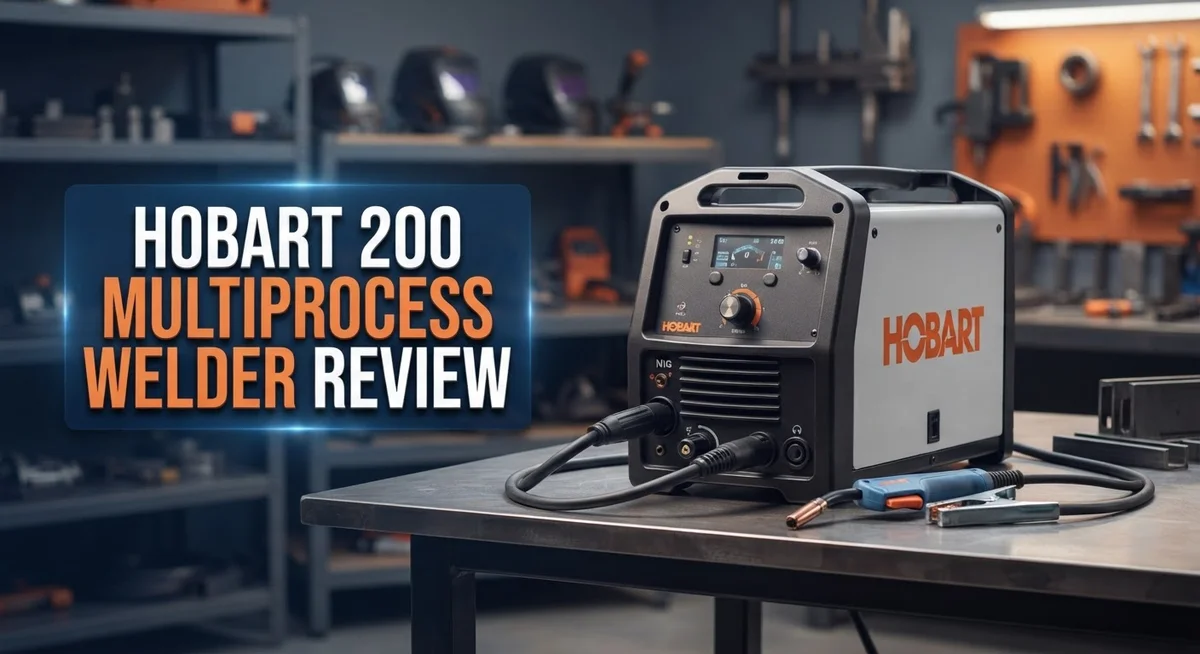
Hobart 200 Multiprocess Welder Review: Buyers Guide
Looking for one welder that does it all? The Hobart 200 Multiprocess Welder might be your answer. It handles MIG, flux-core, Stick, and DC TIG welding in a single machine.
This welder gives you 200A output with dual-voltage flexibility. You can plug it into a 120V or 240V outlet. That means it works in your garage or a bigger shop setting.
Beginners love this machine for good reason. It offers simple two-knob controls and a clear color LCD screen. You do not need years of experience to get clean welds.
In a Nutshell
- Four processes in one machine. You get MIG, flux-core, Stick, and DC TIG. This gives you options for almost any project.
- Smart controls make setup easy. The color LCD screen and two-knob design help you dial in settings fast. You spend less time guessing and more time welding.
- Spatter stays low. Compared to flux-core alone, this machine keeps your workpiece cleaner. Your finished welds look neater too.
- Portability is a big plus. The air-cooled design means you can move this welder around your garage or job site. No heavy cooling systems slow you down.
- Duty cycle covers most home projects. You get 200A at 60% and 250A at 40%. This handles typical hobbyist tasks without overheating.
- Some limits exist. There is no AC TIG capability, so aluminum TIG welding is off the table. Heavy-duty industrial jobs may push this machine past its comfort zone.
Multiprocess Welding Capabilities
The Hobart 200 shines when you need flexibility across different welding jobs. This machine handles four distinct processes, giving you options most single-process welders simply cannot match.
MIG welding works smoothly on this unit. You can run steel wire through the gun and get clean, consistent beads without excessive spatter. The machine reads your input and adjusts arc characteristics automatically. This makes MIG a great starting point for newcomers.
Stick welding is equally capable. The machine switches to DC electrode mode, and you get solid penetration on mild steel up to 3/8 inch thick. Many users report that Stick performance rivals dedicated stick machines in this power class.
Flux-core welding rounds out your wire options. You load a flux-core spool instead of solid wire, and the machine handles the transition smoothly. This process is useful for outdoor work or when you need extra penetration without shielding gas.
DC TIG welding completes the lineup. You can run a TIG torch on steel, and the foot pedal gives you precise amperage control. However, the machine lacks AC TIG capability, which means aluminum TIG work is not possible. This is a real limitation if you plan to weld aluminum regularly.
The color LCD screen displays your settings clearly. You adjust amperage and wire speed using just two knobs. This simplicity beats machines with confusing menus or dozens of buttons. Setup takes minutes, not hours.
What makes this multiprocess approach valuable? You avoid buying separate machines for different jobs. Your workshop stays compact. You learn multiple techniques on one platform. When a job calls for Stick, you switch processes. When MIG makes more sense, you adapt instantly.
The trade-off is that no single process gets the absolute top performance you’d find in a dedicated machine. But for hobbyists and small shops, this balance hits the sweet spot. You gain versatility without sacrificing too much capability in any one area.

- Made in China
Last update on 2026-10-21 / Affiliate links / Images from Amazon Product Advertising API Some of the links on this website are affiliate links, which means that at no additional cost to you, I earn a commission if you click through and make a purchase. I only recommend products and services that I believe will add value to my readers. Thank you for your support!
Power Output and Duty Cycle Performance
The 200A output forms the backbone of this machine’s performance. You can weld up to 3/8″ mild steel, which covers most hobby and light commercial jobs. The dual-voltage input (120V/240V) means you can plug into standard household outlets or dedicated circuits.
Duty cycle tells you how long you can weld before the machine needs to cool down. At 200A, you get 60% duty cycle. This means you can weld for 6 minutes out of every 10-minute window. When you drop to 250A output, the duty cycle falls to 40%, giving you 4 minutes of welding time per 10-minute cycle.
What does this mean in real terms? For most home welders and hobbyists, these numbers work fine. You won’t hit the duty cycle limit on typical weekend projects. Heavy industrial shops running production welding all day might feel the squeeze, but that’s not this machine’s target market.
The air-cooled design keeps things simple. No water cooling system means fewer parts to maintain and less setup complexity. Your workshop stays cleaner too. The trade-off is that continuous heavy welding can push the machine to thermal limits faster than water-cooled competitors.
Performance stays consistent across the four processes. MIG welding maintains stable arc at rated amperage. Stick welding delivers solid penetration within the duty cycle window. Flux-core performs predictably, though spatter management matters. DC TIG welding rounds out your options, though remember there’s no AC capability for aluminum work.
Real-world testing shows this machine rarely feels underpowered for its rating. Experienced welders note that the actual performance slightly exceeds expectations for a 200A machine. The color LCD screen helps you monitor output in real time, so you always know where you stand with your duty cycle.
If you’re running short, controlled welding sessions, this machine handles the workload well. For marathon welding days or production runs, you’ll want something with higher duty cycle ratings. Most hobbyists find the performance meets their needs without compromise.
Portability and Ease of Use
The Hobart 200 moves easily from one job to the next. Its compact frame and lightweight construction make transport simple. You can fit this machine in a truck bed or carry it between workshop areas without strain.
Setup happens fast once you unpack the unit. The two-knob control system lets you adjust amperage and wire feed speed quickly. You don’t need to hunt through menus or complicated settings. This straightforward layout helps new welders get started right away.
The color LCD screen shows your current settings at a glance. You see voltage, amperage, and process type displayed clearly. This visibility reduces guesswork and helps you make adjustments on the fly. Whether you’re switching from MIG to Stick, the information updates instantly.
Switching between processes takes minimal effort. You change the gun or electrode, select your process on the screen, and adjust the two knobs. Most transitions happen in under a minute. This flexibility means you can tackle different projects without downtime between setups.
The air-cooled design eliminates the need for water circulation systems. No hoses to connect or coolant to maintain. You simply plug in the machine and start welding. This simplicity appeals to users who want less equipment to manage.
Handling the torch and cables feels natural during operation. The gun connects securely and the lead lengths provide adequate reach for most garage and job site work. Cable management stays organized without tangling issues that plague some portable units.
One consideration: the machine does produce heat during extended sessions. The fan runs to keep internal components cool, but you should allow rest periods between heavy welding runs. This aligns with the duty cycle ratings and prevents thermal stress on the machine.
For hobbyists and small shop owners, the Hobart 200 strikes a balance between capability and convenience. You get serious welding power without overwhelming complexity. The machine responds well to operator input and doesn’t demand specialized knowledge to function properly. Portability and ease combine to make this welder accessible for diverse skill levels.
Top 3 Alternatives
Lincoln Electric Welder

- WELD ANYWHERE: Plug in the Weld-Pak 90i FC wire feed welder anywhere 120V input power is available...
- ACCESSORIES INCLUDED: The machine comes with a full list of accessories including a welding gun...

Last update on 2026-10-21 / Affiliate links / Images from Amazon Product Advertising API Some of the links on this website are affiliate links, which means that at no additional cost to you, I earn a commission if you click through and make a purchase. I only recommend products and services that I believe will add value to my readers. Thank you for your support!
Lincoln Electric welders work great for both beginners and experienced users. These machines handle multiple welding processes, so you can switch between MIG, stick, and flux core easily. The build quality stands out because Lincoln focuses on durability and reliable performance. You get consistent arc stability, which means cleaner welds with less cleanup afterward.
Many users appreciate the straightforward controls. You don’t need to spend hours figuring out settings. The machines run cool and quiet compared to other options. Portability is another strong point if you need to move your equipment between jobs.
Miller Electric Multiprocess

- Multiprocess Welder,208 to 575VAC Input
- Optional EZ-Latch(TM) Running Gear
Last update on 2026-10-21 / Affiliate links / Images from Amazon Product Advertising API Some of the links on this website are affiliate links, which means that at no additional cost to you, I earn a commission if you click through and make a purchase. I only recommend products and services that I believe will add value to my readers. Thank you for your support!
Miller Electric offers excellent versatility for different welding jobs. These machines excel at handling various materials and thicknesses. The inverter technology keeps your power consumption low while delivering strong performance. Setup time is minimal because the interface guides you through each step.
Operators report smooth arc characteristics across all processes. The machines stay dependable even during long work sessions. Miller’s reputation in the welding industry speaks for itself, with many professionals choosing their equipment for serious projects.
ESAB Flux Core

- ESAB Rogue EM 140 Flux-Core/MIG Welder, 120V, 140 Amp Output, Model# 0700301082
Last update on 2026-10-21 / Affiliate links / Images from Amazon Product Advertising API Some of the links on this website are affiliate links, which means that at no additional cost to you, I earn a commission if you click through and make a purchase. I only recommend products and services that I believe will add value to my readers. Thank you for your support!
ESAB flux core welders deliver impressive penetration on thick materials. These machines work particularly well outdoors since flux core handles wind better than other methods. The portability factor makes them ideal for job sites where you can’t use standard MIG processes.
ESAB equipment shows strong performance on dirty or rusty surfaces. You get good bead appearance without extensive prep work. The machines are straightforward to operate, making them suitable for different skill levels. Maintenance is simple, which keeps your downtime to a minimum.
Bead Quality and Spatter Control
Bead quality stands out as one of the Hobart 200’s strongest features. The machine produces clean, consistent welds across multiple processes. MIG welding generates smooth beads with minimal irregularities. The wire feed system maintains steady contact with your workpiece.
Stick welding on this unit delivers solid results. You get uniform bead appearance without excessive waviness. The arc remains stable throughout your welding session. This consistency matters when you’re stacking multiple passes on a single joint.
Spatter control represents a major advantage here. The Hobart 200 produces noticeably less spatter compared to flux-core welding alone. Your workpiece stays cleaner, which means less cleanup afterward. You spend more time welding and less time grinding away unwanted material.
What causes this improvement? The machine’s power delivery system helps regulate the arc more effectively. You maintain better control over the molten pool. The result is tighter bead patterns with fewer stray droplets.
DC TIG welding capability adds another dimension to bead quality. You can produce extremely clean welds on steel and stainless materials. The tungsten electrode creates a focused arc that produces precise, professional looking beads. This process excels for joints requiring high visual appeal or structural integrity.
The color LCD screen plays a role in achieving quality results. Clear visibility of your voltage and amperage settings lets you dial in the perfect parameters. You adjust on the fly without guessing. Consistency improves when you can see exactly what the machine is doing.
One realistic consideration: bead quality depends heavily on operator skill. The Hobart 200 gives you the tools to succeed, but practice still matters. Beginners will see improvement as they gain experience with each process.
For hobbyists and small shops, the bead quality this machine produces satisfies most applications. Professional fabricators may want additional refinement options. The machine handles standard welding tasks with impressive results. Your joints will look professional and perform reliably. The combination of stable arc characteristics and effective spatter reduction makes this unit a solid performer in its class.
Build Quality and Durability Concerns
The Hobart 200 shows solid construction overall, though some users report concerns worth understanding. The machine uses a steel frame that handles transport and workshop use without major issues. Most owners report the unit survives drops and bumps reasonably well.
The real durability question centers on internal components. The power supply runs on air cooling, which simplifies the design but also means dust accumulation becomes a maintenance task. Regular cleaning prevents buildup that could shorten the machine’s lifespan. Users who skip this step sometimes experience performance drops after a year or two.
The two-knob control system proves durable in practice. These simple controls rarely fail compared to digital touchscreens on other models. Replacement knobs cost little if damage occurs. The color LCD screen holds up better than expected, though a few users report fading after heavy use in bright sunlight.
Connection points and cable ports show mixed results. Some units develop loose connections after extended use, particularly where the torch connects. This doesn’t mean failure, but occasional tightening keeps things running smoothly. The dual-voltage input system (120V/240V) handles both residential and shop power without problems.
The cooling fan runs continuously during operation, which raises longevity questions. Extended sessions in dusty environments stress this component more than others. Replacement fans exist but require some technical knowledge to install.
Warranty coverage typically spans one year for most parts. This timeframe reflects the manufacturer’s confidence in build quality for normal use. Hobbyists who weld occasionally report machines lasting five to seven years without major repairs.
One honest observation: this machine feels less robust than industrial units costing significantly more. The lighter construction helps with portability but means it’s not built for daily professional shop use. For garage welders and occasional users, the durability proves adequate.
Build quality sits at the middle ground. You won’t experience constant failures, but you’ll also notice this isn’t a heavy-duty industrial machine. Regular maintenance and reasonable care extend the machine’s working life considerably.
Pros and Cons
Pros
- Handles MIG, flux-core, Stick, and DC TIG welding in one machine
- Produces clean beads with minimal spatter compared to flux-core alone
- Dual-voltage input (120V/240V) works in most shops and garages
- Two-knob controls and color LCD screen make setup and switching between processes quick
- Air-cooled design means no water circulation system required
Cons
- No AC TIG capability limits your options for aluminum and stainless steel work
- Maximum capacity of 3/8″ mild steel falls short for heavy fabrication jobs
- Internal components show durability concerns according to some user reports
- Continuous cooling fan operation during extended sessions raises questions about long-term reliability
Who Should Buy It
The Hobart 200 Multiprocess Welder works best for specific user groups with particular needs and experience levels.
Beginners and hobbyists benefit most from this machine. You get four welding processes in one unit, so you can learn MIG, flux-core, Stick, and DC TIG without buying separate equipment. The two-knob controls and color LCD screen make switching between processes simple. You won’t feel overwhelmed by complex settings when you’re starting out.
Small shop owners find real value here too. If you handle light to medium fabrication work, this machine covers your daily tasks. The 200A output handles material up to 3/8″ mild steel, which covers many common projects. The dual-voltage input (120V/240V) means you can set it up in most workshop spaces without electrical upgrades.
Garage-based welders and DIY enthusiasts appreciate the portability and air-cooled design. You don’t need water circulation systems or special cooling setups. Just plug it in and start welding. The reduced spatter compared to flux-core alone means cleaner work and less cleanup time.
Who should skip this machine? Industrial fabricators and heavy-duty shops need more power. If you regularly work with material thicker than 3/8″, you’ll hit the machine’s limits quickly. Aluminum and stainless steel specialists should look elsewhere since this welder lacks AC TIG capability.
Contract welders who move between job sites daily might encounter durability concerns. The continuous cooling fan operation during extended sessions raises questions about long-term reliability in demanding environments. Some users report internal component issues after heavy use.
Production facilities requiring high duty cycles won’t get adequate performance either. The 200A @ 60% duty cycle means you’ll need downtime between jobs. If you run back-to-back welding all day, this machine will struggle.
Bottom line: This welder fits hobbyists, small shops, and garage welders perfectly. It gives you process flexibility without overwhelming complexity. Just know your project limits and don’t expect industrial-grade durability. Match your actual welding needs to what this machine delivers, and you’ll be satisfied.
Final Verdict
This welder earns its place as a smart pick for everyday users. It handles multiple processes without asking you to master complicated settings. That alone makes it worth serious consideration.
Beginners get a real advantage here. The learning curve stays gentle. Switching between MIG, flux-core, Stick, and DC TIG feels natural once you understand the two-knob layout.
Small shop owners gain flexibility too. One machine replaces what might otherwise require several separate units. This saves space and simplifies your workflow.
Garage welders and DIY enthusiasts will appreciate how easy this unit fits into a home setup. The portable design means you can move it around without much hassle.
That said, this machine has clear limits. Industrial fabricators should look elsewhere. Heavy-duty production work demands more power and higher duty cycles than this unit offers.
If aluminum or stainless steel projects are on your list, the lack of AC TIG capability becomes a real drawback. You will need a different machine or a dedicated TIG unit like the Miller Diversion TIG for those tasks.
Compared to the Miller Multimatic 215, this Hobart model offers similar versatility but skips AC TIG entirely. The Hobart Multi-Handler 210 shares a similar spirit but caters to a slightly different user base.
So who wins with this welder? Hobbyists win. Small shop owners win. Anyone starting their welding journey wins.
Who should pass on it? Contract welders needing constant reliability across job sites might find better options. Production facilities requiring nonstop output should also look at heavier machines.
The final call comes down to your needs. If you want one machine that covers several welding processes without unnecessary complications, this unit delivers. It suits learning environments and light to moderate fabrication work perfectly.
For anything beyond that scope, consider stepping up to a more industrial grade machine built for constant heavy use.
Frequently Asked Questions
Can the Hobart 200 handle aluminum welding?
The Hobart 200 supports DC TIG welding only. This means you cannot weld aluminum with this machine. Aluminum requires AC TIG capability, which this model does not have. If aluminum projects matter to your work, you’ll need a different welder.
The Miller Multimatic 215 does offer AC TIG, making it a better choice for aluminum and stainless steel applications.
What’s the maximum material thickness this welder can handle?
The Hobart 200 reaches a maximum capacity of 3/8 inch on mild steel. This works well for light to medium projects. For anything thicker, you’ll need a more powerful machine.
Heavy fabrication jobs exceed this welder’s limits. Industrial shops and production facilities require higher amperage output.
How long can I weld continuously without overheating?
The duty cycle runs at 200A with 60% capacity and 250A with 40% capacity. This means the machine needs cooling breaks during extended sessions. The air-cooled design keeps things simple, but the continuous fan operation during heavy use raises questions about long-term reliability.
Take regular breaks to let the unit cool. This protects internal components and extends machine life.
Is this welder good for beginners?
Yes. The dual-voltage input, color LCD screen, and two-knob controls make learning straightforward. Switching between MIG, flux-core, Stick, and DC TIG processes becomes quick and simple.
Hobbyists and garage welders find real value in this setup. The portability and air-cooled design fit home shops perfectly. Beginners gain confidence faster with such an easy-to-use interface.
How does this compare to the Miller Multimatic 215?
Both machines offer multiprocess welding. The Miller includes AC TIG capability for aluminum work, while the Hobart does not. The Hobart focuses on MIG, flux-core, Stick, and DC TIG only.
Choose the Miller if aluminum matters. Pick the Hobart if you work primarily with steel and want a simpler setup.

Hi, I’m Amelia Thornton, the founder of ElectroPro.blog.
I write about smart devices, gadgets, electronics, and tech essentials from Amazon.
My goal is to help you discover reliable and innovative tech that truly makes life easier.
From home automation to everyday gear, I test and share what’s worth your investment.
Join me as I explore the smartest tech trends—one gadget at a time.