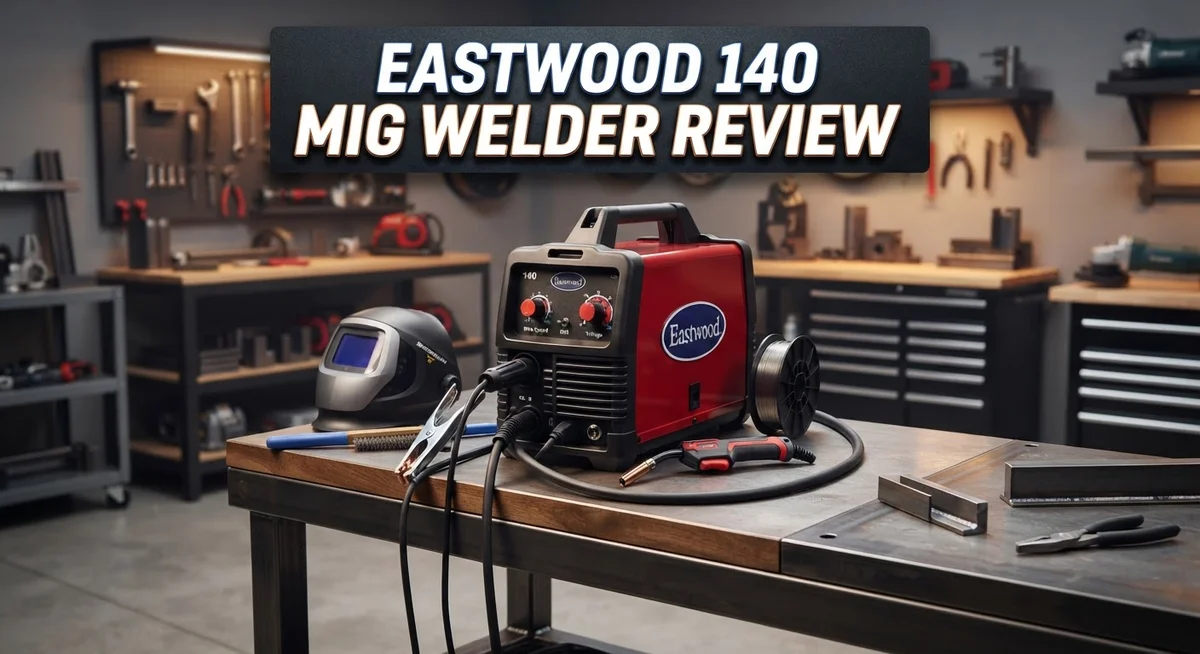
Eastwood 140 MIG Welder Review: Features, Performance, and Specifications
Are you looking for a reliable MIG welder that fits your home garage? The Eastwood 140 might be the tool you need.
This welder uses inverter technology. It stays compact and light. You can carry it anywhere without much effort.
It runs on both 120V and 240V power. This flexibility makes it useful for many projects. Sheet metal welding becomes simple with this machine.
In a Nutshell
- Compact and self contained. The unit is lightweight and easy to store in a small garage or workshop.
- Great for sheet metal. This machine handles thin metal projects with ease and precision.
- Tack weld mode included. You get a handy feature for holding pieces together before a full weld.
- Clear control panel. Indicator lights help you monitor settings without guesswork.
- Solid build quality. The welder feels sturdy and well made for its size.
- Mixed results on thick metal. Some users see weld quality vary based on skill level and material thickness.
- Stacks up against rivals. It sits alongside the Eastwood MIG 90, 180, and 250, and competes with the Miller 140 on features.
Specifications and Power Output
The Eastwood 140 delivers solid power output for home and small shop welding tasks. This machine generates 140 amps of welding current. It uses inverter technology with IGBT components. This means faster response times and better arc stability compared to older transformer models.
Power flexibility matters for different projects. The welder runs on both 120V and 240V circuits. You can set it up in most garages without special electrical work. The 240V connection gives you stronger performance and faster wire feed speeds. The 120V option works for lighter jobs when you need portability.
The output range handles sheet metal welding very well. Thin materials from 24 gauge up to about 1/8 inch work smoothly. The machine produces clean, consistent arcs on these lighter gauge projects. Thicker materials present more challenges. Users report that penetration drops when working with metal between 0.100 and 0.125 inches thick. This limitation means the 140 works best for restoration work, light fabrication, and general repairs rather than heavy structural welding.
The control panel gives you clear feedback on your settings. Indicator lights show you the wire speed, voltage, and operational status at a glance. You don’t need to guess whether your machine is ready to weld. The 2T/4T trigger system lets you choose between two touch and four touch operation. Two touch mode holds the arc continuously once triggered. Four touch mode lets you start and stop the arc with each trigger pull.
Tack weld mode is a practical addition. This feature reduces heat input for temporary joints. You can hold pieces in position before running final welds without burning through thin materials.
The inverter design keeps the unit compact and lightweight. You move it easily between projects. The self contained setup means everything you need sits in one portable package. Power output stays consistent throughout the duty cycle. This reliability helps you maintain quality across multiple welds without waiting for cooldown periods.

- PORTABLE WELDER Lightweight at less than 26 Lb, operates on both 120 and 240 volts for maximum...
- LATEST IGBT INVERTER TECHNOLOGY with 30-180 amp welding range; Eastwood MIG Welder has Metal drive...
Last update on 2026-09-19 / Affiliate links / Images from Amazon Product Advertising API Some of the links on this website are affiliate links, which means that at no additional cost to you, I earn a commission if you click through and make a purchase. I only recommend products and services that I believe will add value to my readers. Thank you for your support!
Build Quality and Design
The Eastwood 140 features a compact design that prioritizes portability and storage. The unit is self contained and weighs significantly less than full size industrial welders. You can fit this machine into tight garage spaces without major compromises.
The frame construction feels solid and well assembled. The metal housing protects internal components from shop dust and minor impacts. Users report that the welder maintains structural integrity even after months of regular use. The overall assembly quality suggests careful manufacturing attention.
The control panel stands out as a practical design choice. Indicator lights show you the current settings at a glance. You don’t need to guess whether your amperage dial matches your actual output. The layout keeps buttons and knobs within easy reach during operation.
The inverter technology using IGBT components enables the compact size. Traditional transformer based welders require much larger frames and heavier materials. This modern approach gives you flexibility without sacrificing too much performance for basic projects.
Cable management on the unit works reasonably well. The power cord stores neatly, and the ground clamp attaches securely. The gun cable moves freely without kinking or tangling during typical shop work. These small details matter when you’re working in confined spaces.
The 2T/4T trigger system reflects thoughtful engineering. You can switch between two touch activation (2T) and continuous hold (4T) modes. This flexibility lets different users find their preferred welding rhythm. The tack weld mode adds another dimension to your control options.
One design consideration involves heat dissipation. The unit runs cooler than many competitors due to inverter efficiency. Extended welding sessions produce less thermal stress on internal parts. This translates to potentially longer service life under regular use.
The overall aesthetic is industrial but approachable. The color scheme and button placement feel intuitive rather than intimidating. First time users can navigate the machine without extensive manual consultation. The design philosophy clearly targets hobbyists and beginning welders who want straightforward functionality without unnecessary complexity.
Welding Performance and Capabilities
The Eastwood 140 MIG welder excels at handling sheet metal projects with consistent results. This machine delivers smooth arc performance on thin materials, making it ideal for automotive bodywork and general fabrication tasks. The 140 amp output provides enough power for most home shop applications without requiring industrial-grade electrical infrastructure.
The inverter technology using IGBT components gives you real advantages. You get a compact unit that doesn’t sacrifice welding capability. The machine produces a stable arc across different material thicknesses, though performance varies based on operator skill and technique.
One important consideration involves penetration on thicker materials. Users report that the 140 struggles when working with steel between 0.100″ and 0.125″ thick. The welder maintains adequate penetration on standard sheet metal, but thicker stock may require multiple passes or slower travel speeds to achieve full fusion.
The 2T/4T trigger system offers flexibility for different welding styles. Two-touch mode works well for short bursts, while four-touch mode suits longer continuous welds. This feature gives you control over how the machine responds to your trigger input.
Weld quality consistency depends heavily on setup and technique. Proper wire feed speed and voltage adjustment produce clean, professional results. However, incorrect settings lead to spatter, porosity, or weak fusion. The control panel with indicator lights helps you dial in the right parameters, but experience matters.
The tack weld mode proves useful for temporary joints before full welding. This function reduces heat input, preventing distortion on delicate assemblies. You can quickly position parts without committing to a permanent weld.
Overall performance characteristics make the Eastwood 140 suitable for hobbyists and small shops working primarily with sheet metal. The machine handles routine fabrication tasks reliably. For projects involving thicker materials or heavy production work, you may need to consider the larger MIG 180 or MIG 250 models from Eastwood’s lineup. Understanding the machine’s limitations helps you match it to the right applications.
Top 3 Alternatives
Lincoln Electric MIG Welder

- WELD ANYWHERE: Plug in the Weld-Pak 90i MIG wire feed welder anywhere 120V input power is available...
- ACCESSORIES INCLUDED: The machine comes with a full list of accessories including a welding gun...

Last update on 2026-09-18 / Affiliate links / Images from Amazon Product Advertising API Some of the links on this website are affiliate links, which means that at no additional cost to you, I earn a commission if you click through and make a purchase. I only recommend products and services that I believe will add value to my readers. Thank you for your support!
The Lincoln Electric MIG Welder stands out as a solid alternative for hobbyists and professionals alike. This machine delivers consistent arc performance across different materials and thicknesses. Users appreciate its straightforward setup process and reliable wire feeding system.
The unit handles both steel and aluminum work, making it versatile for various projects. Its compact design fits nicely in smaller workshops without sacrificing power output. The intuitive controls mean you spend less time learning and more time welding quality joints.
ESAB Flux Core Welder

- ESAB Rogue EM 140 Flux-Core/MIG Welder, 120V, 140 Amp Output, Model# 0700301082
Last update on 2026-09-18 / Affiliate links / Images from Amazon Product Advertising API Some of the links on this website are affiliate links, which means that at no additional cost to you, I earn a commission if you click through and make a purchase. I only recommend products and services that I believe will add value to my readers. Thank you for your support!
The ESAB Flux Core Welder offers excellent portability and flexibility on job sites. This machine works well with self-shielded flux core wire, which requires no external gas supply. That feature makes it ideal if you work outdoors or in windy conditions.
The easy-to-adjust settings allow quick transitions between different material thicknesses. Operators report smooth penetration and minimal spatter when using proper techniques. Its lightweight construction means you can move it between locations without excessive effort.
Miller Electric MIG Welder

- Mig Welding Consumables Tips
- Mig welding consumables tips
Last update on 2026-09-19 / Affiliate links / Images from Amazon Product Advertising API Some of the links on this website are affiliate links, which means that at no additional cost to you, I earn a commission if you click through and make a purchase. I only recommend products and services that I believe will add value to my readers. Thank you for your support!
The Miller Electric MIG Welder brings professional-grade performance to mid-range applications. This machine excels at producing clean, strong welds with excellent bead appearance. The advanced wire feeding mechanism ensures consistent material delivery throughout your project.
Users value its durability and long-term reliability in demanding environments. The control panel layout makes adjustments simple and logical. Its ability to handle multiple wire types and gauges gives you flexibility across different welding tasks.
Ease of Use and Control Features
The Eastwood 140 MIG welder puts control directly in your hands with straightforward features. The 2T/4T trigger system lets you choose between two-touch and four-touch operation based on your preference and welding style.
Two-touch mode keeps the arc running as long as you hold the trigger. Four-touch mode gives you more precision. You press once to start, once to stop, and this works well for tack welding or short bursts.
The control panel displays your settings clearly with indicator lights. You can see your amperage, voltage, and wire feed speed at a glance. This feedback helps you make quick adjustments without guessing.
The tack weld mode is a practical feature for beginners. It reduces heat input for temporary joints, which means less warping on thin materials. You can hold pieces in place before committing to a full weld.
Voltage and amperage adjustments are smooth and responsive. The knobs turn easily, and changes take effect immediately. This makes it simple to dial in the right settings for different material thicknesses and wire types.
The wire feed system operates quietly and consistently. You don’t hear the loud grinding noise that older machines produce. Smooth wire feeding means cleaner arcs and fewer interruptions during welding.
One consideration involves the learning curve with penetration control. Some users report that achieving deep penetration on thicker materials (.100″ to .125″) requires careful technique and proper settings. The machine gives you the tools, but your setup matters.
The compact design keeps controls within easy reach. Nothing feels cramped or hard to access. You can adjust settings without fumbling around the machine.
Cable management works reasonably well. The ground clamp attaches securely, and the power cord stores without tangling. This keeps your work area organized and safe.
The overall control experience feels intuitive for home welders and hobbyists. You spend less time fighting the machine and more time learning proper technique. The straightforward interface means you focus on your welding form rather than complex settings.
Material Compatibility and Thickness Handling
The Eastwood 140 MIG welder handles sheet metal with solid performance. Its 140 amp output works well for thin to medium gauge materials. You get reliable results on steel up to approximately .100 inches thick.
The inverter technology using IGBT components gives you better control over penetration. This means you can adjust power delivery to match your material thickness. The system responds quickly when you change amperage settings.
Thicker materials require careful attention. Users report that penetration becomes inconsistent when working with material thicker than .100 to .125 inches. This limitation stems from the machine’s 140 amp ceiling. For heavier stock, you may need to make multiple passes or consider a higher output model.
Sheet metal welding is where this welder truly shines. The compact power delivery prevents burn through on thin gauge materials. You maintain control over heat input, which protects delicate workpieces from warping.
The 2T/4T trigger system adapts to different material thicknesses. Two touch mode lets you start and stop the arc with simple trigger pulls. Four touch mode keeps the arc running continuously, useful for longer welds on thicker sections. This flexibility helps you optimize technique based on what you are welding.
Wire feed consistency plays a key role in material compatibility. The quiet, steady wire system delivers predictable results. Inconsistent feeding would cause weak welds, but this machine maintains steady flow across its operating range.
Aluminum and stainless steel require different wire types and shielding gas. The Eastwood 140 accepts standard MIG wire spools. You can switch materials by changing your wire and adjusting gas flow. Setup time is minimal for material changes.
For most hobbyist and small shop applications, the Eastwood 140 handles common materials effectively. Steel, mild steel, and thin stainless work reliably. The machine excels at automotive bodywork and general fabrication projects. Understanding its limitations with thicker materials helps you plan your projects appropriately and achieve quality results consistently.
Pros and Cons
Pros
- Beginner friendly with straightforward controls and clear indicator lights on the panel
- Inverter technology with IGBT components delivers solid performance for hobbyist and small shop work
- Flexible 2T/4T trigger system lets you choose between continuous arc or single-pulse welding styles
- Tack weld mode helps you position parts temporarily before running full welds
- Compact and lightweight design fits easily in tight work spaces
Cons
- Penetration becomes inconsistent on thicker materials, especially between 0.100″ and 0.125″
- Weld quality varies depending on your setup and technique, requiring practice to master
- Some users report weaker penetration compared to higher amp machines like the Miller 140
Who Should Buy It
The Eastwood 140 MIG welder works best for hobbyists and small shop owners who weld sheet metal regularly. If you’re just starting out, this machine gives you straightforward controls and clear feedback through indicator lights on the panel.
DIY enthusiasts benefit most from this welder. You get inverter technology with IGBT components that help you control the arc more precisely. The 2T/4T trigger system lets you switch between continuous welding and single-pulse modes depending on what you’re working on.
Home garage welders find the compact, lightweight design especially useful. The machine fits in tight spaces without taking up much room. You can move it between projects easily, and all controls stay within arm’s reach.
Small fabrication shops appreciate the consistent wire feed system. It runs quietly and delivers reliable performance for routine jobs. The tack weld mode helps you position parts before running full welds, which saves time on assembly work.
This welder is NOT ideal for heavy industrial use. Penetration becomes inconsistent on thicker materials, especially between 0.100″ and 0.125″ thick. If your work involves thick steel regularly, you’ll want a more powerful machine.
Experienced welders who demand maximum penetration on heavy materials should look elsewhere. The Eastwood 140 works well for what it’s designed to do, but it has limits. Some users report weld quality varies depending on your setup and technique, so you’ll need practice to master consistent results.
Artists and restoration specialists who work on vintage cars or metal sculpture find this machine practical. Sheet metal work is where the Eastwood 140 truly shines. The inverter technology gives you better control than older transformer machines.
If you need flexibility with different materials like aluminum or stainless steel, remember that these require different wire types and shielding gas. The Eastwood 140 handles this, but you’ll need to adjust your setup between material changes.
Bottom line: Buy this welder if you do occasional to moderate sheet metal work in a home or small shop setting. Skip it if you need heavy penetration on thick steel or plan industrial production runs.
Final Verdict
The Eastwood 140 MIG welder earns its place as a solid choice for specific users. It shines brightest in the hands of hobbyists, DIYers, and small shop owners who work with sheet metal and lighter materials.
This machine does what it promises for everyday welding tasks. The build quality feels sturdy. The controls stay simple enough for beginners to learn quickly.
If you plan to weld thin materials most of the time, this welder fits your needs well. Home garage projects, auto body work, and light fabrication all fall within its comfort zone.
However, you should think twice if your work involves thick materials regularly. Users who need consistent penetration on heavier stock often feel frustrated by this machine’s limits.
Professional welders with demanding penetration requirements might want to explore other options like the Miller 140. That said, most casual users will never push this welder to its breaking point.
The Eastwood MIG 140 represents a smart pick within its intended use case. It does not try to be an industrial powerhouse, and it should not be judged as one.
Think of this welder as a reliable tool for specific jobs rather than an all purpose machine. Match your expectations to its actual capabilities, and you will likely walk away satisfied.
Weekend warriors, restoration hobbyists, and small scale fabricators stand to gain the most value from this unit. The features included, like tack mode and dual trigger settings, add real convenience to daily use.
In short, this welder rewards users who understand its strengths and respect its boundaries. Choose it for sheet metal work and light fabrication, and it will serve you well for years.
Skip it if heavy duty penetration sits at the top of your priority list. Otherwise, the Eastwood 140 earns a fair recommendation for anyone starting their welding journey or running a small shop.
Frequently Asked Questions
Can the Eastwood 140 handle aluminum welding?
No, this welder does not support aluminum. The Eastwood 140 MIG works with solid wire only, which means it’s designed for steel and stainless steel projects. If aluminum is part of your work, you’ll need a machine with a spool gun or push pull system.
What’s the difference between 2T and 4T trigger modes?
The 2T mode keeps the arc running while you hold the trigger. Release it and the arc stops. The 4T mode lets you tap the trigger once to start welding and tap again to stop, which reduces hand fatigue during longer sessions. You can switch between them based on your preference and the job at hand.
Does this welder work on 120V power?
Yes, it operates on both 120V and 240V outlets. The 120V setting gives you lower output, so it works best for thinner materials. If you’re welding heavier stock, 240V delivers better results and more consistent penetration. Check your shop’s electrical setup before purchasing.
How does the tack weld mode help?
Tack weld mode lets you make quick, temporary welds to hold parts in position. You position your pieces, make small tacks to lock them together, then run your full welds without the pieces shifting. This saves time and keeps your work square and aligned.
Is this machine good for beginners?
Yes, absolutely. The Eastwood 140 has straightforward controls and an easy learning curve. The indicator lights show you what’s happening, and the wire feed system is reliable. Most new welders pick up the basics quickly with this unit, though weld quality improves with practice and proper technique.

Hi, I’m Amelia Thornton, the founder of ElectroPro.blog.
I write about smart devices, gadgets, electronics, and tech essentials from Amazon.
My goal is to help you discover reliable and innovative tech that truly makes life easier.
From home automation to everyday gear, I test and share what’s worth your investment.
Join me as I explore the smartest tech trends—one gadget at a time.