Craftsman Table Saw Review 2026: Complete Guide
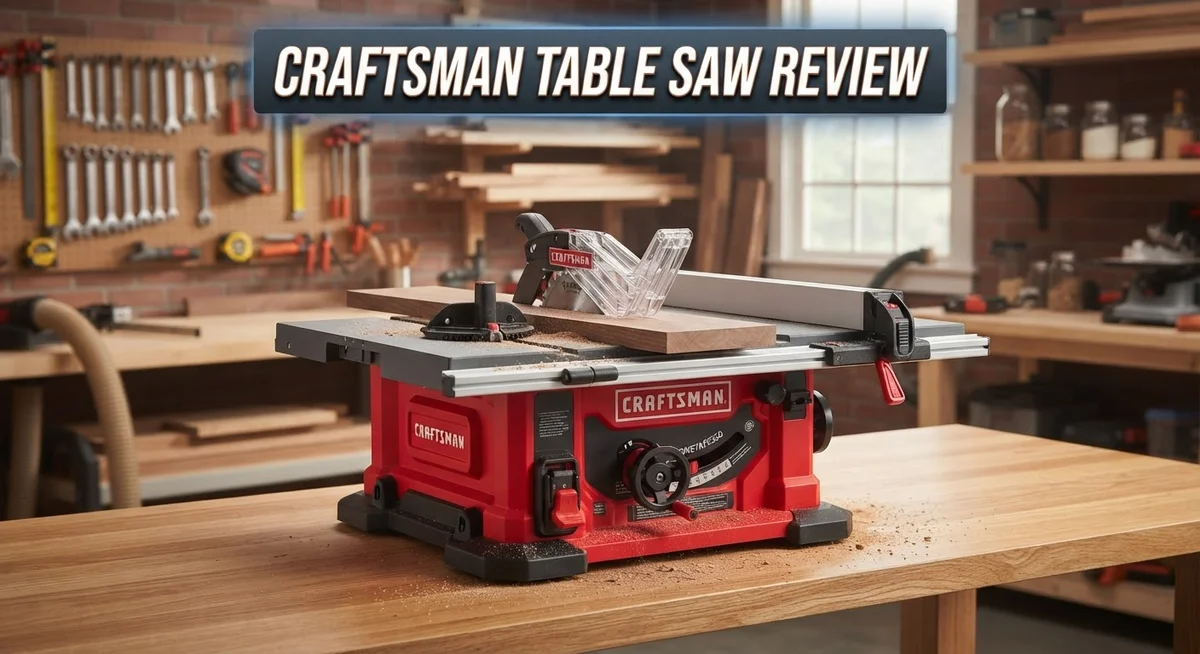
Looking for a table saw that fits your jobsite or garage? The Craftsman table saw might catch your eye. It promises portability and durable construction in one package.
This saw comes with an 8.25 inch or 10 inch blade, depending on the model. A 13 to 15 Amp motor powers it through most cutting tasks with ease.
At just 73 pounds, you can carry it between job sites without much strain. The compact table height makes setup quick and simple.
In a Nutshell
- Motor power: Runs on a 13 to 15 Amp motor at 120V, giving you steady performance for most cuts.
- Speed: Spins up to 5,000 RPM with no load, so it handles wood quickly.
- Cutting depth: Slices through material at 2.2 to 3 inches deep at a 0 degree angle.
- Table height: Sits at about 11.1 inches, which suits tabletop or stand setups.
- Build quality: Feels durable for both jobsite tasks and shop projects.
- Fence trouble: The fence often feels too light, and cuts may not stay parallel.
- Miter limits: Angled and miter cuts are not the strongest feature here.
- Model differences: Older belt drive versions often outperform newer ones in fence quality.
- Competition: Brands like DeWalt and Makita offer stiffer competition in this category.
Motor Power and Cutting Capacity
The motor sits at the heart of any table saw’s performance. Craftsman’s 13 to 15 Amp motor draws power from a standard 120V household outlet. This setup makes the saw convenient for jobsites where heavy-duty power lines may not exist.
At 5,000 RPM with no load, the blade spins fast enough to handle most wood types smoothly. You’ll notice the motor delivers consistent torque during straight cuts through softwood and hardwood alike. The motor runs cool during normal operation, which helps extend its lifespan.
Cutting depth matters when you need to slice through thick stock. The Craftsman reaches 2.2 to 3 inches deep at a 0 degree angle, depending on your blade choice. This depth works well for standard lumber and sheet goods. If you plan frequent rip cuts on dense hardwoods, expect the motor to work harder.
The blade options include 8.25 inch for benchtop models and 10 inch for portable versions. A larger blade creates a wider kerf and demands more motor power. The 10 inch option gives you greater versatility for crosscutting and ripping tasks.
One real limitation emerges with the fence system. The fence feels too light and sometimes causes cuts to drift off parallel. This isn’t a motor problem, but it affects your overall cutting accuracy. You may need to upgrade or reinforce the fence for precision work.
Angled and miter cuts expose another weakness. The motor has enough power, but the saw’s design doesn’t support these cuts as reliably as full size cabinet saws. The blade tilt mechanism and fence alignment make angled cuts less predictable.
For jobsite work and general shop tasks, the motor delivers what you need. Ripping boards, crosscutting lumber, and handling sheet goods fall within its wheelhouse. Heavy production work or professional cabinetry demands a more robust machine.
The real story: this motor performs its core job well, but the saw’s other components hold it back from being a true precision tool.

- RACK AND PINION FENCE RAILS - Ensures fence stays parallel to blade for fast smooth, and accurate...
- INTEGRATED FOLDING STAND - Legs quickly fold in to provide portability and convenient storage

Last update on 2026-09-18 / Affiliate links / Images from Amazon Product Advertising API Some of the links on this website are affiliate links, which means that at no additional cost to you, I earn a commission if you click through and make a purchase. I only recommend products and services that I believe will add value to my readers. Thank you for your support!
Portability and Design
The Craftsman table saw stands out for its lightweight build. At just 73 pounds, you can move it between your garage, workshop, and job sites without breaking a sweat. This weight makes it perfect if you work in multiple locations or have limited storage space.
The design keeps things simple and practical. The table height sits at 11.1 inches, which works well on standard benchtops or portable stands. You won’t need special equipment to get it to a comfortable working height. The compact footprint means it fits into tight spaces where larger saws won’t squeeze.
Portability comes with a trade off though. The lighter frame also means the fence system feels less stable than heavier models. When you push wood through for cuts, the fence can shift slightly. This affects how parallel your cuts stay. For precision work, you’ll need to check alignment often and make adjustments.
The blade options reflect the portable nature of this tool. The 8.25 inch blade works on benchtop versions, while the 10 inch blade comes on portable models. Both sizes are manageable to transport and replace, though the 10 inch gives you more cutting depth and cutting capacity.
Design simplicity helps with maintenance too. You can access the motor and blade area without removing tons of parts. Changing blades takes minutes instead of hours. Cleaning dust and debris stays straightforward since nothing hides in complex compartments.
For jobsite work, this saw shines. Contractors appreciate tools they can toss in a truck bed. The durable construction holds up to bumps and rough handling. You get a tool that works hard without demanding a dedicated workspace.
If you mainly work in one location, a heavier stationary saw might serve you better. But for anyone who values mobility and quick setup, the Craftsman delivers. Its design philosophy puts go anywhere capability first. Performance takes a secondary role to that portability focus.
Fence System and Cut Accuracy
The fence system is where the Craftsman table saw shows real weakness. The fence feels too light and flimsy for consistent parallel cuts. When you push wood through, the blade can drift sideways instead of following a straight line.
This happens because the fence assembly lacks the mass and rigidity that heavier saws offer. A lighter fence moves easier under pressure. Your cuts end up slightly angled instead of square.
The fence quality also varies between models. Some users report better results than others. This inconsistency makes it hard to know what you’re getting. You might need to adjust and readjust the fence multiple times before a cut runs true.
Accuracy suffers most during rip cuts. When you’re slicing wood lengthwise along the grain, a wobbly fence becomes obvious fast. The wood drifts away from the blade path. Your finished pieces end up with uneven widths.
Crosscuts perform better because you’re working against the fence for a shorter distance. The blade has less time to push the fence sideways. Still, you’ll want to double check your measurements before making the cut.
Angled cuts and miter cuts expose another problem. The fence doesn’t lock down firmly enough to hold wood at an angle. The saw struggles to maintain a steady cut when you tilt the blade. If precision angled cuts matter to your projects, this machine will frustrate you.
For rough jobsite work and general cuts, the fence works fine. You can rip boards to approximate widths and crosscut pieces without fussing too much. But if you need tight tolerances and repeatable accuracy, the Craftsman fence system falls short.
The lightweight design keeps the saw portable, but it comes at a cost. A stationary saw with a heavier fence would grip your workpiece better and deliver straighter cuts. Consider your actual needs before buying. Jobsite carpenters tolerate the fence quirks. Woodworkers seeking precision should explore other options.
Top 3 Alternatives
DeWalt DWE7491RS

- Rack & Pinion Telescoping Fence System Make fence adjustments fast, smooth and accurate
- Patented material support, can be used for narrow rip cuts.
Last update on 2026-09-18 / Affiliate links / Images from Amazon Product Advertising API Some of the links on this website are affiliate links, which means that at no additional cost to you, I earn a commission if you click through and make a purchase. I only recommend products and services that I believe will add value to my readers. Thank you for your support!
The DeWalt DWE7491RS brings serious power to your workshop. This saw features a 10-inch blade and delivers 4,800 RPM for clean, fast cuts through hardwood and softwood alike. The rip capacity reaches 24.5 inches, giving you room to work with larger materials.
You get a rolling stand included, which makes moving this machine simple. The dust collection system keeps your workspace clean. Safety features include a blade guard and electric brake that stops the blade quickly. Setup takes about 30 minutes, and most users find it straightforward.
Makita 2705 Table Saw

- Left extension table with smooth sliding action
- Right and rear extension table enables greater cutting capacity
Last update on 2026-09-18 / Affiliate links / Images from Amazon Product Advertising API Some of the links on this website are affiliate links, which means that at no additional cost to you, I earn a commission if you click through and make a purchase. I only recommend products and services that I believe will add value to my readers. Thank you for your support!
The Makita 2705 offers portability without sacrificing cutting power. This 10-inch saw runs at 4,800 RPM and handles both ripping and crosscutting tasks well. The compact design fits easily in smaller shops or garages.
The saw includes a stand that folds up for transport. Dust collection works efficiently, pulling debris away from your work area. The fence system locks firmly in place, keeping your cuts accurate. Many users appreciate how quickly they can set up and start working.
Bosch 4100-09 Worksite

- Includes (1) 2610950148 Rip Fence New, Bulk Packed Replacement Part # 2610950148
- Consult owners manual for proper part number identification proper installation Please refer to list...
Last update on 2026-09-18 / Affiliate links / Images from Amazon Product Advertising API Some of the links on this website are affiliate links, which means that at no additional cost to you, I earn a commission if you click through and make a purchase. I only recommend products and services that I believe will add value to my readers. Thank you for your support!
The Bosch 4100-09 Worksite table saw focuses on job site performance. This 10-inch model delivers 4,800 RPM and handles demanding cuts consistently. The portable design means you can take it between locations without strain.
The stand provides stability during operation. A dust blower keeps the blade area clear so you see your cut line. The fence system stays square to the blade for precision work. Users report that this saw handles both rough framing and finish work effectively. The quick-release blade design makes changing blades simple.
Angled and Miter Cutting Performance
Angled cuts and miter work represent a real challenge for the Craftsman table saw. The fence system struggles most when you tilt the blade to make beveled cuts or angled joints.
The core issue stems from fence stability. When you angle the blade, the fence must hold the wood firmly at a precise angle. The Craftsman’s lightweight fence lacks the mass needed to resist sideways pressure from the tilted blade. This causes the workpiece to shift slightly, throwing off your angle.
Miter cuts demand even more accuracy than simple angled rips. You need both the fence and the miter gauge working together without flex. The Craftsman’s fence wobbles under this dual pressure. Your miter gauge may lock in place, but if the fence moves, your cut won’t be square.
Real world performance reveals the limitation quickly. When you try a 45 degree bevel cut on hardwood, the blade tends to push the workpiece away from the fence. You’ll see the kerf widen slightly as you feed the wood through. The resulting edge comes out slightly beveled instead of true.
Crosscut miter work performs slightly better because you use the miter gauge as your primary guide. The fence plays a secondary role here. Still, any fence movement affects your accuracy. Compound angles (combining tilt and crosscut) become nearly impossible to execute consistently.
For fine woodworking and joinery, this limitation matters greatly. If you’re building cabinet doors with frame and panel construction, you need precise miter joints. The Craftsman won’t deliver that level of accuracy. Your joints will have small gaps that require filling or shimming.
Jobsite work tolerates this weakness better. Rough framing cuts and general demolition work don’t demand precision. You can make angled cuts for temporary bracing or rough stock prep without problems.
The portable design that makes this saw attractive for transport becomes a liability during angled cuts. Consider your project needs carefully. If miter and bevel cuts are central to your work, this saw may frustrate you. For basic straight cuts and jobsite tasks, it handles the job adequately.
Durability and Build Quality
The Craftsman table saw demonstrates solid durability for a portable model. The 13 to 15 amp motor handles consistent cutting without frequent breakdowns. The 120V power requirement means you can plug it in almost anywhere, which adds to its reliability on job sites.
The frame construction uses steel components that resist rust and warping. The lightweight design at approximately 73 pounds does not sacrifice material quality. Instead, Craftsman chose thinner gauge steel to keep weight down while maintaining structural integrity.
The real durability test comes during extended use. The motor runs at 5,000 RPM no load, which generates heat over long shifts. Proper ventilation around the motor keeps temperatures manageable. Users report the saw continues cutting after years of regular work when maintained properly.
Blade stability matters for longevity. The 8.25 to 10 inch blade options stay true during operation. However, vibration increases when the fence wobbles, which stresses both the blade and motor bearings over time. This indirect wear accelerates component fatigue faster than it should.
The cutting depth ranges from 2.2 to 3 inches at zero degrees. This specification remains consistent across multiple units, showing good manufacturing control. The table height sits at 11.1 inches, which keeps the saw ergonomic without straining your back during repetitive cuts.
Maintenance accessibility enhances long term durability. You can reach the motor and blade area without disassembling half the saw. This means cleaning dust buildup becomes simple, and belt tension adjustments take minutes instead of hours.
The fence assembly shows the biggest durability concern. Its lighter construction means it bends under heavy pressure. Over time, repeated stress on the fence rails can create permanent alignment issues. Older Craftsman models with belt drive systems reportedly lasted longer because heavier components reduced flex.
For jobsite work spanning months or years, the Craftsman table saw holds up well. The motor stays reliable, and the blade mechanism functions consistently. The fence system remains the weak point for durability, especially if you push the saw hard with dense hardwoods or extended daily use.
Pros and Cons
Pros
- Lightweight and easy to move between jobsites and workshops
- Steel frame resists rust and warping over time
- Motor runs reliably at 5,000 RPM for consistent cutting performance
- Crosscuts work well because the miter gauge provides solid guidance
- Solid choice for rough jobsite work and general cutting tasks
Cons
- Fence assembly lacks the mass and rigidity needed for accurate rip cuts along the grain
- Angled and miter cuts suffer from poor fence stability, making precision work difficult
- Fence quality varies between individual models, so consistency is not guaranteed
- Limited cutting depth of 2.2 to 3 inches at zero degrees restricts thicker material work
Who Should Buy It
Craftsman table saws work best for specific user types and projects. Understanding who benefits most helps you decide if this model fits your needs.
Jobsite workers get real value from these saws. The lightweight design means you can load it into a truck and carry it between locations. The portable frame doesn’t require a permanent workshop setup. You move from one construction site to another without hassle.
DIY homeowners doing basic cuts find these saws practical. You need to rip boards, make crosscuts, and handle general carpentry tasks. The motor delivers enough power for standard lumber and plywood. Setup takes minutes, and storage doesn’t demand much space.
Beginners learning woodworking fundamentals should consider this option. You get comfortable with blade safety, fence operation, and basic techniques. The saw teaches you proper stance and hand positioning without overwhelming complexity. Mistakes cost less money when you’re learning on an affordable machine.
Rough framing carpenters appreciate the durability and portability. You make quick cuts on 2x4s and dimensional lumber all day long. The steel frame holds up through months of jobsite conditions. Rust resistance matters when your saw sits in trucks and gets exposed to weather.
This saw is NOT ideal for fine woodworkers. Cabinet makers, furniture builders, and joinery specialists need better accuracy. The fence stability issues make precision rip cuts difficult. Angled cuts and miter work suffer from inconsistent results. If your projects demand tight tolerances, look elsewhere.
Production shops running high volume cuts should skip this model. The motor runs hot during extended use. Fence quality inconsistency means you can’t guarantee identical cuts across multiple pieces.
Contractors working with thick hardwoods face limitations. The 2.2 to 3 inch cutting depth restricts your options. Dense materials require multiple passes, which wastes time and creates safety issues.
The Craftsman table saw serves rough work and learning purposes well. It excels at jobsites and general carpentry. It falls short for precision joinery and fine furniture building. Match the tool to your specific work type for best results.
Final Verdict
The Craftsman table saw earns its place as a practical workhorse for everyday cutting tasks. It handles rough jobs with confidence.
This saw does not try to compete with premium brands like Festool or Makita. It focuses on getting basic jobs done without fuss.
If you compare it to older belt drive Craftsman models, this newer version trades some raw power for portability. That tradeoff makes sense for anyone who moves between locations often.
Think about your actual needs before buying. A saw built for speed and mobility works differently than one built for precision joinery.
Woodworkers who need tight tolerances should look elsewhere. Systems like the Leigh FMT or Festool Domino serve that purpose much better.
But most people do not need furniture grade precision. They need a saw that cuts straight lines fast and survives daily abuse.
This is where the Craftsman table saw shines. It delivers consistent results for framing, general carpentry, and learning projects.
The overall package feels balanced for its intended audience. Portability and durability outweigh the fence limitations for most buyers.
Someone doing occasional home projects will barely notice the fence issues. Someone doing precision cabinetry will notice them immediately.
That contrast defines this saw perfectly. It rewards users who match their expectations to its actual capabilities.
We recommend this saw for jobsite crews, hobbyists, and beginners. We do not recommend it for professionals chasing perfect joinery.
Match the tool to the task, and this saw performs admirably. Push it beyond its design intent, and frustration follows quickly.
In short, the Craftsman table saw fills a specific niche well. It is not trying to be everything for everyone.
Buy it for rough work and general use. Skip it if fine woodworking is your main goal. That simple rule will guide you toward the right decision every time.
Frequently Asked Questions
Can I use a Craftsman table saw for fine woodworking and furniture making?
No. This saw works best for rough cutting and general carpentry tasks. Fine woodworking demands tight tolerances that the Craftsman fence cannot deliver. Cabinet makers and furniture builders should choose a different model. The fence lacks the mass and rigidity needed for accurate work.
What cutting depth does the Craftsman table saw offer?
The saw cuts 2.2 to 3 inches deep at zero degrees. This limits your work with thicker materials. You can handle standard lumber and plywood easily, but dense hardwoods or thick stock present challenges.
How portable is this saw for jobsite use?
Very portable. The saw weighs around 73 lbs and features a benchtop or portable design. Contractors and rough framing carpenters appreciate the lightweight frame. You can move it between job locations without heavy equipment.
Does the fence make accurate rip cuts?
The fence struggles here. It lacks the stability needed for parallel cuts along the grain. Cuts may not be square or consistent. If you need precise rip cuts, this is a weak point. The miter gauge performs better than the fence for most tasks.
Who should buy a Craftsman table saw?
Jobsite workers, DIY homeowners doing basic cuts, and beginners learning woodworking fundamentals make good matches. Rough carpenters value the durability and portability. If you need a practical workhorse for everyday cutting without furniture grade precision, this saw delivers. Production shops and contractors working with thick hardwoods should look elsewhere.

Hi, I’m Amelia Thornton, the founder of ElectroPro.blog.
I write about smart devices, gadgets, electronics, and tech essentials from Amazon.
My goal is to help you discover reliable and innovative tech that truly makes life easier.
From home automation to everyday gear, I test and share what’s worth your investment.
Join me as I explore the smartest tech trends—one gadget at a time.