Genesis Table Saw Review 2026: Worth Buying?
Buying your first table saw feels like a big decision. You want power, straight cuts, and a price that does not wreck your budget.
The Genesis GTS10SC keeps showing up in that search because it costs a fraction of what pro saws cost, yet it still ships with a 15 amp motor and a metal stand.
So is it a smart buy or a cheap trap? I spent time with this saw, ripped a pile of pine and plywood, and wrote down everything, including the parts that annoyed me. This review covers real specs, honest weak points, and three solid alternatives if the Genesis is not your match.
In a Nutshell:
- The price is the main attraction. The Genesis GTS10SC usually sells between 200 and 260 dollars, and it includes a metal stand, a 40 tooth carbide tipped blade, a rip fence, and a miter gauge. Most saws in that range give you far less.
- The motor genuinely delivers. A 15 amp motor spinning at 4,800 RPM cuts 3 inches deep at 90 degrees and 2.5 inches at 45 degrees. That handles 2×4 lumber, plywood, and most trim work without complaint.
- Rip capacity is the biggest limit. Genesis rates it at 10 inches to the right of the blade, so full sheet goods need a track saw or a helper and a circular saw instead.
- Fit and finish feel budget. The blade height crank is stiff, the fence needs checking with a square, and the stock blade wants replacing early. None of this is fatal, but you should expect it.
- Dust collection is basic. There is a port, not a system. Plan on a shop vacuum and a broom.
- Best fit: hobby woodworkers, homeowners, DIY remodelers, and anyone who needs a second saw for rough cuts.
What Is the Genesis GTS10SC Table Saw?

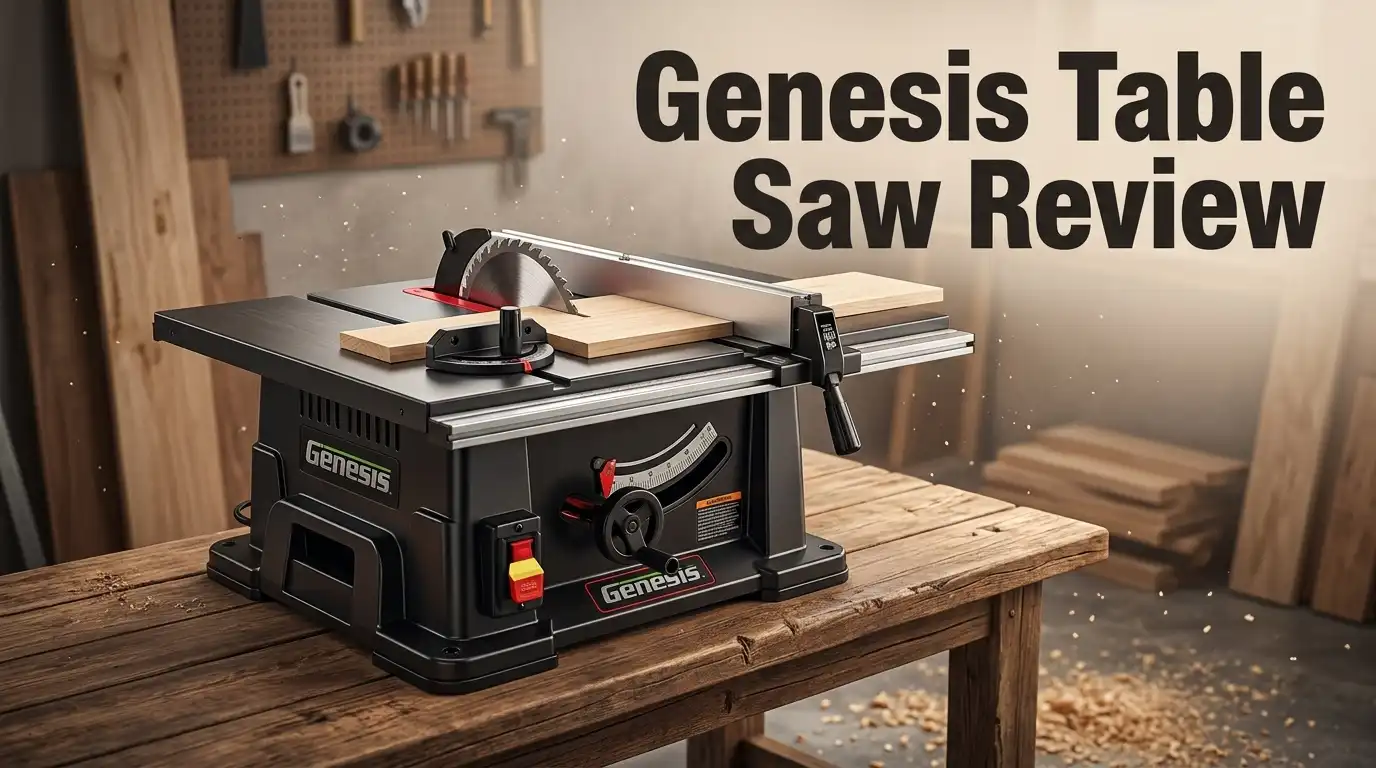
- 15 Amp motor operates at 4,800 RPM with a 10 in 40T Carbide Tipped Blade
- Extra Large 26 x 21-1/2 in. Die Cast Aluminum Table with Included Self Aligning Rip Fence...
Last update on 2026-08-30 / Affiliate links / Images from Amazon Product Advertising API Some of the links on this website are affiliate links, which means that at no additional cost to you, I earn a commission if you click through and make a purchase. I only recommend products and services that I believe will add value to my readers. Thank you for your support!
The Genesis GTS10SC is a benchtop table saw sold with a metal stand. Genesis Power Tools positions it as a value tool for home shops and light jobsite work.
The core numbers are simple. The motor pulls 120 volts at 15 amps and spins the blade at 4,800 RPM with no load. The arbor takes a standard 5/8 inch blade.
The table measures 26 inches long by 21.5 inches wide and uses die cast aluminum. That surface is lighter than cast iron and resists rust, though it also transmits more vibration.
Cutting depth reaches 3 inches with the blade fully raised. Bevel the blade to 45 degrees and you still get 2.5 inches, which covers stair stringers and mitered corners in construction lumber.
The whole saw weighs about 48 pounds without the stand. One person can carry it, and two people can load it into a truck bed easily.
Genesis includes a self aligning rip fence that locks at the front and rear at the same time. You also get an oversized sliding miter gauge that swings from 0 to 45 degrees in both directions.
Safety gear ships in the box. The blade guard and anti kickback pawls install without tools, and an overload reset button protects the motor. Genesis backs the saw with a 2 year warranty, which is generous at this price.
Unboxing Experience and First Impressions
The box arrives heavier than you expect and the cardboard takes a beating in shipping. Check the corners before you sign for it, because a dropped corner usually means a bent stand leg.
Inside, the saw sits in molded foam with the stand parts flat underneath. Everything is wrapped in thin plastic and lightly oiled to prevent rust in transit.
The first thing I noticed was the smell of machine oil on the table. A rag and a little mineral spirits cleaned it in two minutes. Skipping that step leaves oil streaks on your first boards.
Small parts come in a single bag. You get two wrenches, a push stick, the miter gauge, the aluminum guide bar, the fence, and the hardware for the stand.
The blade already sits on the arbor, which saves a step. It is a 40 tooth carbide tipped 10 inch blade, fine for framing lumber and rough rips.
Lifting the saw out alone is doable but awkward. The die cast table has no real handholds, so grab the base casting instead of the fence rails.
Fit and finish tell you the price honestly. Castings look clean, paint is even, but the plastic knobs feel light and the stand hardware is plain zinc plated.
My honest first impression: this looks like a lot of saw for the money, with corners cut in exactly the places you would guess.
Genesis Table Saw Pros and Cons
Here is the short version after real use. I tried to be blunt in both directions.
Pros
- Strong motor for the price. The 15 amp motor and 4,800 RPM blade speed rip 2×4 pine without bogging down.
- Metal stand included. You get a working height saw out of the box instead of hunting for a bench.
- Large aluminum table. The 26 by 21.5 inch surface supports longer boards better than tiny benchtop saws.
- Self aligning fence. It locks front and rear together, which helps keep cuts parallel.
- Tool free safety setup. Blade guard and anti kickback pawls snap on and off in seconds.
- Light and portable. At roughly 48 pounds, the saw travels easily.
- 2 year warranty. Longer coverage than many budget competitors offer.
- Onboard storage. The wrenches, push stick, and miter gauge have homes on the saw.
Cons
- Only 10 inches of rip capacity. Full sheets of plywood are out of reach.
- Blade height crank feels stiff. Raising and lowering the blade takes effort and never feels smooth.
- Stock blade is average. Expect burn marks and rough edges in hardwood until you upgrade.
- Vibration is noticeable. Low weight plus an aluminum table equals a buzzy saw.
- Fence needs verification. Self aligning does not mean perfectly square. Check it with a combination square.
- Overload breaker can trip. Push hard through thick stock and the reset button becomes familiar.
- Stand does not fold. Breaking it down means removing bolts.
- Dust port is weak. Fine dust escapes below the table.
Top 3 Alternative for Genesis GTS10SC Table Saw
If the 10 inch rip capacity is a deal breaker, these three saws solve it. Each one costs more, and each one earns that money in a different way.

- RACK AND PINION FENCE RAILS - Ensures fence stays parallel to blade for fast smooth, and accurate...
- INTEGRATED FOLDING STAND - Legs quickly fold in to provide portability and convenient storage

Last update on 2026-08-29 / Affiliate links / Images from Amazon Product Advertising API Some of the links on this website are affiliate links, which means that at no additional cost to you, I earn a commission if you click through and make a purchase. I only recommend products and services that I believe will add value to my readers. Thank you for your support!
SKIL 15 Amp 10 Inch Portable Jobsite Table Saw with Folding Stand

- 24.5 in. of rip capacity for ripping 4x8 plywood or OSB sheets
- Compact size for easy transportation and storage
Last update on 2026-08-29 / Affiliate links / Images from Amazon Product Advertising API Some of the links on this website are affiliate links, which means that at no additional cost to you, I earn a commission if you click through and make a purchase. I only recommend products and services that I believe will add value to my readers. Thank you for your support!
DEWALT 15 Amp 8.25 Inch Compact Portable Jobsite Table Saw

- POWERFUL AND PRECISE: This 10-inch table saw with stand features a 15-Amp motor delivering 4,500 RPM...
- USER-FRIENDLY DESIGN: The table saw includes blade height or angle adjustments conveniently located...
Last update on 2026-08-29 / Affiliate links / Images from Amazon Product Advertising API Some of the links on this website are affiliate links, which means that at no additional cost to you, I earn a commission if you click through and make a purchase. I only recommend products and services that I believe will add value to my readers. Thank you for your support!
Metabo HPT 10 Inch Jobsite Table Saw with Fold and Roll Stand
Motor Power and Real Cutting Performance
The motor is the best part of this saw. 15 amps at 4,800 RPM is the same headline spec you see on saws costing twice as much.
Ripping 2×4 studs felt easy. The blade held speed as long as I fed the board at a steady pace and did not rush.
Crosscutting 2×10 pine also went fine. Push too fast, though, and the motor pitch drops noticeably before the overload protection steps in.
Plywood cuts cleanly along the face but chips on the underside. That is normal with a 40 tooth blade, and a scoring pass or painters tape fixes most of it.
Hardwood is where the limits show. Ripping 1 inch thick oak worked, but I had to slow down and accept some burning from the stock blade.
Pressure treated lumber gave the motor the hardest time. Wet, dense boards make the saw work, so take shallower passes if you can.
The direct drive design means no belt to slip, which helps power transfer. It also means motor noise goes straight into the table.
There is no soft start. The saw jumps a little when you flip the rocker switch, so keep the stand feet planted.
Bottom line on power: this motor is honestly good for framing lumber, sheet goods, and hobby projects. It is not a cabinet shop motor and Genesis never claimed it was.
Table Surface, Rip Capacity, and Cutting Limits
The die cast aluminum table measures 26 by 21.5 inches. That is roomy for a benchtop saw and gives short boards decent support.
Aluminum brings real benefits. It resists rust, cleans up with a rag, and keeps the saw light enough to carry alone.
It also has drawbacks. Aluminum flexes more than cast iron and it amplifies vibration you can feel in your hands.
Check the table for flatness when it arrives. Lay a straightedge across the surface and across the insert plate, then note any dips before you cut anything important.
Rip capacity is the number that matters most, and Genesis lists 10 inches of rip width. Some sellers quote 24 inches on older models with extensions, so read listings carefully.
Ten inches handles a lot of practical work. Ripping studs, cutting cabinet parts to width, trimming shelving, and sizing trim all fit inside that range.
Ten inches does not handle plywood breakdown. A 4 by 8 sheet needs to be cut into rough pieces first with a circular saw or a track saw.
Outfeed support is also missing. Long boards tip once they pass the blade, so set up a roller stand or a helper table before you rip anything over 4 feet.
My workaround: I rough cut sheets outside, then bring the smaller pieces to the Genesis for accurate final cuts. That workflow suits this saw perfectly.
Rip Fence Accuracy and How to Set It
Genesis calls the fence self aligning because it clamps at the front and rear rails at the same time. That design does reduce fence drift compared to single point clamps.
Do not assume it arrives square. Mine sat slightly out of parallel with the blade, and five minutes with a combination square fixed it.
Here is the method that works. Measure from the front of the blade to the fence, then measure from the rear of the blade to the fence, and adjust until both numbers match.
Use a single blade tooth as your reference point. Mark it, measure at the front, rotate it to the rear, and measure again for a true reading.
The fence locks with a lever that needs a firm push. Once locked, it holds well through repeated cuts on lumber.
The scale printed on the rail is approximate. Trust your tape measure, not the printed scale, especially for joinery.
Fence height is modest, which limits tall workpiece support. Screwing a straight piece of plywood to the fence face gives you a taller reference surface and improves accuracy.
Deflection appears if you lean on the far end. Keep your hand pressure low and near the table for consistent cuts.
Honest assessment: the fence is usable and tunable, not precise out of the box. Budget saws almost always work this way, and a little setup time pays off.
Miter Gauge, Blade Guard, and Safety Features
The oversized sliding miter gauge swings from 0 to 45 degrees. It rides in the table slot and feels better than the flimsy stamped gauges on cheaper saws.
Detents at common angles are soft. I verified 90 degrees with a square and marked the gauge with a paint pen for repeat setups.
Adding a wooden fence face to the miter gauge improves it a lot. Longer support means less workpiece rotation and cleaner crosscuts.
Safety gear is more complete than the price suggests. The saw ships with a see through blade guard, anti kickback pawls, and a riving knife style bracket.
The tool free installation matters. When guards go on and off without hunting for a wrench, people actually use them.
Some owners report the guard assembly loosening during use. Check those screws before each session and add a drop of threadlocker if they keep backing out.
The rocker switch is large and easy to hit with a knee or palm. That is exactly what you want in an emergency.
An overload reset button protects the motor from stalls. It trips more often than on premium saws, which is a nuisance and also a form of protection.
Always use the push stick for narrow rips. Kickback happens fast on light saws, and the included stick keeps your fingers away from the blade path.
Dust Collection: The Honest Truth
The GTS10SC includes a dust port on the rear of the cabinet. Genesis does not include a dust collection system, and that distinction matters.
Attach a shop vacuum hose and you capture a fair amount of chips. Fine dust still escapes from the open bottom of the saw base.
Check your hose fit before buying adapters. The port sizing on budget saws often needs a rubber cuff or tape to seal properly.
Cutting plywood produces the worst dust. Melamine and MDF are even messier, so plan on wearing a respirator regardless of hookup.
Working outside solves most of the problem. I moved the saw to the driveway for sheet goods and cleanup took a broom instead of a vacuum.
Some owners build a simple plywood shroud under the base to funnel dust to the port. That project takes an hour and improves capture noticeably.
Blade guard dust collection does not exist here. Above table dust blows toward you, so eye protection is not optional.
Emptying happens often. A 4 gallon shop vacuum fills quickly during a long ripping session, so size up if you have the option.
Rating dust collection honestly: below average. Treat this saw as an open air tool and set up your workspace accordingly.
Assembly, the Metal Stand, and Setup Time
Assembly took me about 40 minutes working alone. Someone comfortable with tools might finish in 25 minutes.
The stand goes together first. Four legs, cross braces, and a set of bolts and nuts make up the whole structure.
Leave every bolt slightly loose until the frame is complete. Tightening in stages keeps the legs square and prevents a wobbling stand.
The saw then bolts to the top of the stand. This step is easier with a second person, since you are aligning holes while holding 48 pounds.
The manual is basic but usable. Diagrams show the right orientation for each leg, and getting one backward is the most common mistake.
The stand is not a folding design. Once assembled, it stays assembled, so measure your storage space first.
There are no wheels. Moving the saw across a garage means lifting or sliding, which is fine on concrete and rough on wood floors.
Working height lands comfortably for most adults. The saw sits at a level where you can see your cut line without hunching.
Check every bolt after your first few hours of cutting. Vibration loosens hardware on this saw, and a quick retighten keeps the stand solid for years.
What the Genesis Table Saw Does Not Do Well
Every review should name the weak spots clearly. Here are the areas where this saw disappoints.
Blade height adjustment is stiff. The crank requires real effort and never feels smooth. Multiple owners report the height mechanism wearing out, and a stripped adjuster is the most common failure story.
Vibration is constant. Light weight and an aluminum table mean the saw buzzes. Fine joinery suffers because small vibrations become small inaccuracies.
The stock blade underperforms. It cuts framing lumber acceptably and struggles with hardwood or clean plywood edges. A 60 tooth or 80 tooth blade transforms the results for around 30 dollars.
The miter slot is not standard T slot on all units. That limits your ability to use aftermarket crosscut sleds and jigs without modification.
No riving knife in the modern sense. The splitter arrangement helps, but it does not match the safety of a true rising riving knife.
Precision has a ceiling. You can dial this saw in, but you cannot make it a cabinet saw. Repeatable thousandth of an inch accuracy is not happening.
Support and parts can be slow. Replacement parts for budget brands take time to source, and forum posts show owners waiting weeks.
It is not a production tool. Daily professional use will wear this saw out fast. Occasional use is where it survives.
Who Should Buy It and Who Should Skip It
This saw fits specific people well and frustrates others. Knowing which group you belong to prevents buyers remorse.
Buy it if you are a beginner. Learning fence setup, blade alignment, and safe feeding on an affordable saw makes sense before spending 700 dollars.
Buy it for occasional home projects. Shelves, garden boxes, trim replacement, and small furniture all fall inside this saw’s abilities.
Buy it as a second saw. Contractors sometimes keep a cheap saw for rough cuts and dirty materials that would ruin a better tool.
Buy it if space is tight. The compact footprint and low weight suit small garages and shared workspaces.
Skip it if you cut sheet goods often. Ten inches of rip capacity will fight you every single session.
Skip it if you want fine furniture accuracy. Vibration and fence limits make tight joinery a struggle.
Skip it if you need daily jobsite reliability. Professional use demands stronger height mechanisms and folding rolling stands.
Skip it if you dislike setup work. This saw rewards patient tuning and punishes people who expect plug and play precision.
The honest framing is simple. This is a capable entry level saw, priced fairly, with predictable compromises. Buyers who understand that tend to be happy with it.
Final Verdict: Is the Genesis Table Saw Worth It in 2026?
- 15 Amp motor operates at 4,800 RPM with a 10 in 40T Carbide Tipped Blade
- Extra Large 26 x 21-1/2 in. Die Cast Aluminum Table with Included Self Aligning Rip Fence...
Last update on 2026-08-30 / Affiliate links / Images from Amazon Product Advertising API Some of the links on this website are affiliate links, which means that at no additional cost to you, I earn a commission if you click through and make a purchase. I only recommend products and services that I believe will add value to my readers. Thank you for your support!
After real use, my verdict is a qualified yes. The Genesis GTS10SC delivers genuine value at its price, provided you match it to the right work.
The motor is the star. A 15 amp direct drive motor at 4,800 RPM with 3 inches of cut depth is real capability, not marketing.
The included stand adds practical value. Many competitors at this price sell a bare benchtop unit that forces another purchase.
The compromises are real too. Stiff height adjustment, noticeable vibration, and 10 inches of rip capacity define what this saw can do.
Two upgrades change the experience dramatically. Buy a better blade and add a plywood auxiliary fence face, and cut quality improves immediately.
Compared to the SKIL TS6307 or the Metabo HPT C10RJS, the Genesis loses on rip capacity, stand design, and refinement. It wins clearly on price.
Compared to the cheapest no name benchtop saws, the Genesis wins on motor strength, table size, and the 2 year warranty.
My recommendation: buy it as a learning saw, a hobby saw, or a backup saw. Save toward a jobsite saw with 24 inches of rip capacity if woodworking becomes a serious habit.
For a few hundred dollars, this saw makes accurate cuts possible in a home garage. That is worth something real.
Frequently Asked Questions
How much can the Genesis GTS10SC rip?
Genesis rates the current GTS10SC at 10 inches of rip capacity to the right of the blade. Older listings sometimes mention 24 inches with table extensions, so confirm the model before ordering.
Does the Genesis table saw come with a blade?
Yes. It includes a 10 inch, 40 tooth carbide tipped blade with a 5/8 inch arbor. That blade suits framing lumber and rough cuts, and most owners upgrade for finish work.
Can it cut a full sheet of plywood?
Not safely or accurately. Break the sheet down with a circular saw or track saw first, then bring smaller pieces to the Genesis for precise final cuts.
How deep does it cut?
Maximum depth is 3 inches at 90 degrees and 2.5 inches at 45 degrees. That covers 2x lumber in a single pass.
Is the fence accurate out of the box?
Sometimes yes, often no. Check the fence against the blade at the front and rear with a square, then adjust. Plan on ten minutes of setup before your first project.
What warranty does Genesis offer?
Genesis provides a 2 year warranty on this saw. Keep your receipt and register the tool, since budget brand claims usually require proof of purchase.
Does it have a T slot miter track?
Not on all units. Verify your specific saw before buying aftermarket sleds or jigs, because some accessories will not fit without modification.
How loud is it?
Loud enough to require hearing protection. Direct drive motors and aluminum tables produce sharp noise, so wear ear protection every session along with safety glasses.

Hi, I’m Amelia Thornton, the founder of ElectroPro.blog.
I write about smart devices, gadgets, electronics, and tech essentials from Amazon.
My goal is to help you discover reliable and innovative tech that truly makes life easier.
From home automation to everyday gear, I test and share what’s worth your investment.
Join me as I explore the smartest tech trends—one gadget at a time.