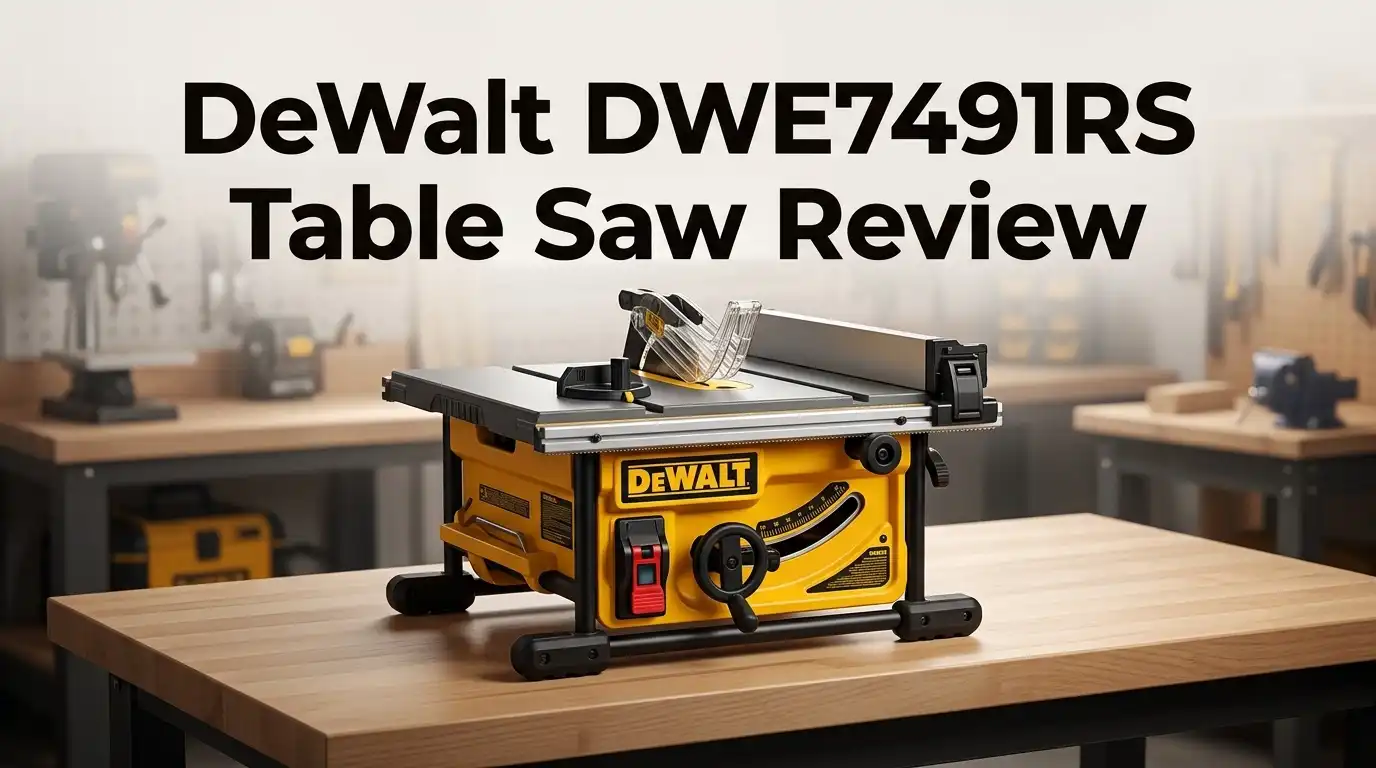
DeWalt DWE7491RS Table Saw Review: Worth It
Looking for a table saw that fits your job site and your garage? The DeWalt DWE7491RS might be the tool you need. This saw brings power and portability together in one package.
It features a 10 inch blade and a strong 15 Amp motor. You get a 32.5 inch rip capacity, which is huge for a jobsite saw. This means you can cut large sheets of plywood with ease.
The saw sits on a rolling stand, so you can move it around your shop or truck bed without much effort. Setup and breakdown become simple tasks.
In a Nutshell
- Rip Capacity: This saw offers a generous 32.5 inch rip capacity. You can handle large sheets of material with ease.
- Portability: The saw comes with a rolling stand. You can roll it around your workspace or lift it into a truck easily.
- Cutting Depth: It cuts up to 3.125 inches deep at 90 degrees. At a 45 degree angle, the depth adjusts to 2.25 inches.
- Table Size: The table measures 21.875 by 26.375 inches. This gives you enough room to support most workpieces.
- Reported Issues: Some users report the blade loosening during use. Others mention problems with the angle adjustment mechanism.
- Safety Notes: A few buyers raised safety concerns about the saw’s design. It helps to stay cautious when operating it.
Blade Capacity and Cutting Performance
The 10 inch blade on the DWE7491RS delivers solid cutting performance for most job site tasks. This blade size strikes a balance between power and control. You get enough cutting force to slice through hardwoods and thick materials without excessive vibration.
The 3.125 inch depth of cut at 90 degrees lets you handle standard lumber in a single pass. When you tilt the blade to 45 degrees, the depth drops to 2.25 inches. This angle capacity works well for beveled cuts on framing and trim work. Most users find these depths sufficient for typical construction and carpentry jobs.
Your rip capacity of 32.5 inches means you can cut wide boards without struggle. The fence stays parallel to the blade, which keeps your cuts straight and consistent. This generous capacity separates the DWE7491RS from smaller portable saws. You’ll spend less time repositioning materials or making multiple cuts to achieve your target width.
The table surface measures 21.875 by 26.375 inches. This provides adequate support for standard lumber without feeling cramped. The rolling stand keeps the saw at a comfortable working height. You can move it between job sites easily, which many contractors appreciate.
The 15 Amp motor powers through dense materials without stalling. Blade speed remains steady under load, so your cuts stay clean and accurate. Users report smooth operation when cutting pine, plywood, and hardwoods.
However, some owners mention concerns about blade stability during extended use. A few users reported the blade loosening after repeated cuts. Regular blade checks before starting work help prevent this issue. Tightening the arbor nut properly from the start makes a real difference in performance.
The angle adjustment mechanism has received mixed feedback. Some users find it responsive and easy to use. Others note stiffness or difficulty holding precise angles. This inconsistency suggests quality control variations between units.
Overall, the cutting performance meets expectations for a portable job site saw. The blade capacity handles most common cutting tasks. The table size and rip capacity give you flexibility with material placement.

- Rack & Pinion Telescoping Fence System Make fence adjustments fast, smooth and accurate
- Patented material support, can be used for narrow rip cuts.

Last update on 2026-08-29 / Affiliate links / Images from Amazon Product Advertising API Some of the links on this website are affiliate links, which means that at no additional cost to you, I earn a commission if you click through and make a purchase. I only recommend products and services that I believe will add value to my readers. Thank you for your support!
Portability and Stand Design
The rolling stand on the DWE7491RS transforms how you move this saw around your workspace. You can wheel it from your truck bed to the job site without strain. The stand folds for storage when you don’t need it, so your garage stays organized.
The table sits at a comfortable working height. You get 21.875 by 26.375 inches of cutting surface. This size gives you enough room to support larger pieces of material on both sides of the blade. Material doesn’t tip or shift as easily when you have adequate support space.
The stand itself uses heavy duty wheels that roll smoothly across most surfaces. Concrete floors, dirt, and gravel don’t slow it down much. The wheels lock in place when you’re ready to cut, keeping the saw stable during operation. This stability matters when you’re pushing material through the blade.
Weight distribution on the stand feels balanced. The saw doesn’t wobble or tip when you apply side pressure during cuts. Users appreciate that the stand doesn’t feel flimsy or cheap. It holds up to regular job site use without falling apart.
Setup takes just a few minutes. You unfold the stand, place the saw on top, and you’re ready to work. No complicated assembly or special tools needed. Breaking it down for transport is equally quick and simple.
One thing to note: the stand design means the saw sits lower than a stationary cabinet model. Some users with back problems find this tiring during long cutting sessions. You might want to add a riser if you cut for extended periods.
The portability really shines when you work multiple job sites in one day. You load the saw into your vehicle, drive to the next location, and unload it just as fast. This convenience makes the DWE7491RS a smart choice for contractors who move around frequently.
The compact footprint also helps if you work in tight spaces. You can position it in corners or against walls without taking up your entire work area. This flexibility makes it practical for both professional and home workshop settings.
Table Size and Material Support
The table surface on the DWE7491RS gives you a solid foundation for accurate cuts. Your work rests on a 21.875 by 26.375 inch table that provides adequate support for most materials you’ll encounter on job sites.
Material support matters when you’re ripping boards or making crosscuts. The table size lets you handle standard lumber without the material hanging off the edges. This keeps your cuts straight and your hands safer during operation.
The surface itself feels flat and stable when you place your stock down. You won’t experience wobbling that throws off your measurements. The cast iron construction resists warping, which keeps your cuts accurate over time.
One practical advantage emerges when you work with wider boards. Your 32.5 inch rip capacity means you can support material fully across the table width. The fence runs the entire length, so you get consistent support from start to finish.
The table height sits at a comfortable working position. You don’t strain your back or arms when feeding material through. This matters when you’re making dozens of cuts throughout the day.
For cross cutting, the miter slot runs perpendicular to the blade. You can use a miter gauge or build a sled to support your work. The slot alignment stays true, so your angles remain consistent.
The rolling stand design affects how the table functions in your workspace. The saw sits lower than a stationary cabinet model, which some users prefer. Others find they need to adjust their body position slightly when operating it.
Material support does have limits on a portable saw. Heavy sheets of plywood need careful handling since the table doesn’t extend as far as larger stationary models. You’ll want to support overhanging material with sawhorses or roller stands for safety.
The table surface resists rust and staining from typical job site conditions. You can wipe it clean with a dry cloth after each use. Keeping it dry prevents corrosion and maintains smooth operation.
Overall, the table and material support system works well for a portable job site saw. You get enough surface area for standard tasks without sacrificing portability. The design balances functionality with the need to move between locations.
Top 3 Alternatives
Makita 2705 Table Saw

- Left extension table with smooth sliding action
- Right and rear extension table enables greater cutting capacity
Last update on 2026-08-29 / Affiliate links / Images from Amazon Product Advertising API Some of the links on this website are affiliate links, which means that at no additional cost to you, I earn a commission if you click through and make a purchase. I only recommend products and services that I believe will add value to my readers. Thank you for your support!
Bosch 4100 Table Saw

- BOSCH TOOLS SAW: 15-Amp portable table saw with 3,800 rpm for rip-cutting and cross-cutting of fine...
- CONVENIENCE BRAKE: The brake on this tablesaw helps blade stop in approximately three seconds...
Last update on 2026-08-29 / Affiliate links / Images from Amazon Product Advertising API Some of the links on this website are affiliate links, which means that at no additional cost to you, I earn a commission if you click through and make a purchase. I only recommend products and services that I believe will add value to my readers. Thank you for your support!
Ryobi Portable Table Saw

- Steel Frame For fast and accurate cuts
- Lower and Adjustable Self-Aligning Fence For cutting thinner materials
Last update on 2026-08-29 / Affiliate links / Images from Amazon Product Advertising API Some of the links on this website are affiliate links, which means that at no additional cost to you, I earn a commission if you click through and make a purchase. I only recommend products and services that I believe will add value to my readers. Thank you for your support!
Angle Adjustment and Bevel Cuts
The angle adjustment mechanism on the DWE7491RS lets you tilt the blade for bevel cuts. You rotate a handle located at the front of the saw base to change the blade angle. The mechanism moves smoothly when it works properly, though some users report stiffness or resistance during adjustment.
Your depth of cut changes when you angle the blade. At 45 degrees, you get 2.25 inches of cutting depth compared to the full 3.125 inches at 90 degrees. This reduction is normal for any table saw and doesn’t limit your bevel cutting ability on standard materials.
The angle scale sits on the front of the saw where you can easily read it. You’ll find degree markings that help you set common angles like 45 degrees for picture frames or trim work. The scale itself is straightforward to understand, though some owners mention the pointer could be more precise.
Locking the blade angle is important for safety and accuracy. The DWE7491RS uses a locking lever that secures the angle once you’ve made your adjustment. Make sure this lever is tight before you start cutting. A loose angle lock can cause the blade to shift during the cut, creating dangerous kickback.
One concern that emerges from user feedback involves the angle adjustment mechanism becoming loose over time. Some owners report that their blade drifts from the set angle after multiple uses. Regular checks of your angle lock help catch this problem early and keep your cuts accurate.
Bevel cuts work well for edge joining, frame construction, and decorative work. The mechanism handles both left and right angle adjustments, giving you flexibility in your cutting options. For most job site applications, the angle adjustment performs adequately once you understand how to properly secure it.
Testing your angle setting before making your first cut is always a smart practice. Use a speed square or angle gauge to verify your blade sits at the exact angle you need. This simple step prevents wasted material and keeps your finished work looking professional.
Durability and Build Quality Concerns
The DWE7491RS shows solid construction in most areas, but some durability concerns deserve your attention. Users have reported blade loosening issues during operation, which affects both safety and cut accuracy. This problem typically emerges after extended use or when moving the saw between job sites.
The angle adjustment mechanism presents another durability challenge. Several users noted that this component becomes loose over time, making it harder to lock the blade at your desired angle. Checking the tightness of this mechanism regularly helps prevent problems down the road. You should inspect it before each work session to catch any looseness early.
The table surface itself holds up well to typical job site conditions. It resists rust and staining from dust, moisture, and material contact. The flat, stable design means the cutting surface remains reliable for extended periods. However, the overall frame and connection points show signs of wear faster on heavily used saws.
The rolling stand construction uses heavy duty wheels that perform well across most surfaces. The stand’s weight distribution feels balanced, which helps prevent tipping during operation. The stand design does mean the saw sits lower than a stationary cabinet model, which some users find affects long term comfort during extended cutting sessions.
The blade itself needs attention to maintain durability. Keeping it clean and sharp prevents the saw from working harder than necessary. Dull blades force the motor to strain, which can shorten the overall lifespan of the unit.
The motor assembly appears robust for a portable saw. The 15 Amp corded design delivers consistent power without the battery concerns that affect cordless models. This reliability makes the saw dependable for frequent job site use.
Overall, the DWE7491RS offers decent durability for a portable table saw, but you’ll need to stay on top of maintenance. Regular inspection of the blade tightness and angle adjustment mechanism helps avoid bigger problems. Users who perform routine upkeep report fewer issues than those who neglect these simple checks.
Pros and Cons
Pros
- Large 32.5″ rip capacity handles wider boards better than most portable saws
- Rolling stand makes moving the saw between job sites simple and quick
- 10″ blade with 15 Amp motor delivers enough power for general cutting tasks
- Flat and stable table surface supports your material without wobbling
- Miter slot runs true and helps you make consistent crosscuts
Cons
- Blade can loosen during use, requiring frequent tightening to stay safe
- Angle adjustment mechanism becomes loose over time and affects bevel cut accuracy
- Depth of cut drops significantly when you tilt the blade for bevel cuts (from 3.125″ to 2.25″ at 45°)
Who Should Buy It
The DWE7491RS works best for contractors and builders who move between job sites regularly. The rolling stand makes transport simple, and you can set up quickly without extra equipment.
If you cut wider boards often, this saw fits your needs well. The 32.5 inch rip capacity handles stock that smaller portable saws cannot. You get more room to work with materials like deck boards and trim pieces.
Framing crews benefit from this model because it delivers solid crosscutting performance. The miter slot runs true, so your cuts stay consistent across multiple pieces. This matters when you’re building walls or roof trusses where precision counts.
DIY homeowners doing renovation work find value here too. You can handle most general cutting tasks without professional-grade equipment. The 10 inch blade with 15 amp motor provides enough power for standard materials.
However, this saw is not ideal if you demand perfect bevel cuts regularly. The angle adjustment mechanism has durability issues that affect accuracy over time. If your work requires frequent angled cuts, consider whether maintenance headaches are worth it.
You should skip this model if you need a stationary saw for a permanent workshop. The portable design means it trades some stability for mobility. A heavier cabinet saw gives you better precision for detail work.
Avoid this saw if you cannot perform regular maintenance. The blade loosens during use, so you must check it frequently. This requires discipline and attention to keep the tool safe and accurate.
Buyers who want a reliable portable solution without complications might want to research alternatives. The reported quality control issues suggest you should inspect your unit carefully before taking it to the job site.
This DeWalt works best for crews who value portability and capacity over perfect accuracy. You need to accept that maintenance comes with the package. If you can handle regular upkeep and work within its limitations, this saw delivers solid performance for site work and general construction tasks.
Final Verdict
The DeWalt DWE7491RS earns its spot as a solid choice for anyone who needs a portable table saw. It delivers real cutting power and handles wide boards with ease. Job site professionals will appreciate how quickly it sets up and breaks down.
That said, this saw asks for your attention. You cannot treat it as a “set it and forget it” tool. Regular checks on the blade and angle mechanism keep it running safely and accurately.
Think of the DWE7491RS as a reliable partner that needs occasional check ins. It rewards users who stay proactive with maintenance. It frustrates those who expect a flawless experience straight out of the box.
Who should walk away with this saw? Contractors who value portability over perfection will feel right at home. Crews who prioritize speed and rip capacity over pinpoint bevel accuracy get real value here.
Who should look elsewhere? If precision bevel cuts matter every single time, this model may test your patience. Woodworkers who need set and forget reliability might find the maintenance demands tiresome.
The DWE7491RS is not a perfect saw. But few portable saws in this category are. It offers a fair trade off: strong core performance in exchange for some hands on upkeep.
For the right buyer, this trade off makes sense. A framer or renovator who already inspects tools between jobs won’t mind adding a quick blade check to the routine.
For the wrong buyer, these quirks could feel like dealbreakers. Someone expecting showroom perfection every time they power it on may walk away disappointed.
In the end, the DWE7491RS proves itself as a capable, no nonsense tool for people who need power and portability. It is not flawless, but it gets the job done when you treat it right.
If you match its ideal use case, you will likely find it a dependable addition to your toolkit for years to come.
Frequently Asked Questions
Can the DWE7491RS handle bevel cuts effectively?
Yes, it can make bevel cuts. However, your depth of cut drops from 3.125 inches at 90 degrees to just 2.25 inches when you tilt the blade to 45 degrees. This matters if you regularly cut thick material at angles.
The angle adjustment mechanism tends to loosen over time. Users report that bevel settings drift, so you may need to readjust frequently. If precision bevel cuts are critical to your work, consider this a limitation.
How portable is this saw really?
The rolling stand makes moving between job sites simple. You can wheel it from one location to another without breaking it down. The compact footprint fits in most truck beds and trailers.
Setup takes just a few minutes once you reach your destination. For contractors bouncing between multiple projects daily, this portability factor is huge. The 15 Amp motor doesn’t require special electrical circuits either.
What maintenance does this saw demand?
The blade loosens during use, so check it regularly before cutting. A loose blade creates safety hazards and cuts poorly. Tighten it as part of your routine check before each job.
Inspect the angle adjustment mechanism monthly. Catch looseness early before it affects your cuts. Regular attention keeps this saw running safely. These tasks take only minutes but matter for performance.
Is the work surface sturdy enough?
The 21.875 by 26.375 inch table stays flat and stable under normal use. Material sits without wobbling, which helps you make consistent cuts. The miter slot runs true for accurate crosscuts.
You get adequate support for most jobsite cutting tasks. Heavier boards rest securely on the surface.

Hi, I’m Amelia Thornton, the founder of ElectroPro.blog.
I write about smart devices, gadgets, electronics, and tech essentials from Amazon.
My goal is to help you discover reliable and innovative tech that truly makes life easier.
From home automation to everyday gear, I test and share what’s worth your investment.
Join me as I explore the smartest tech trends—one gadget at a time.