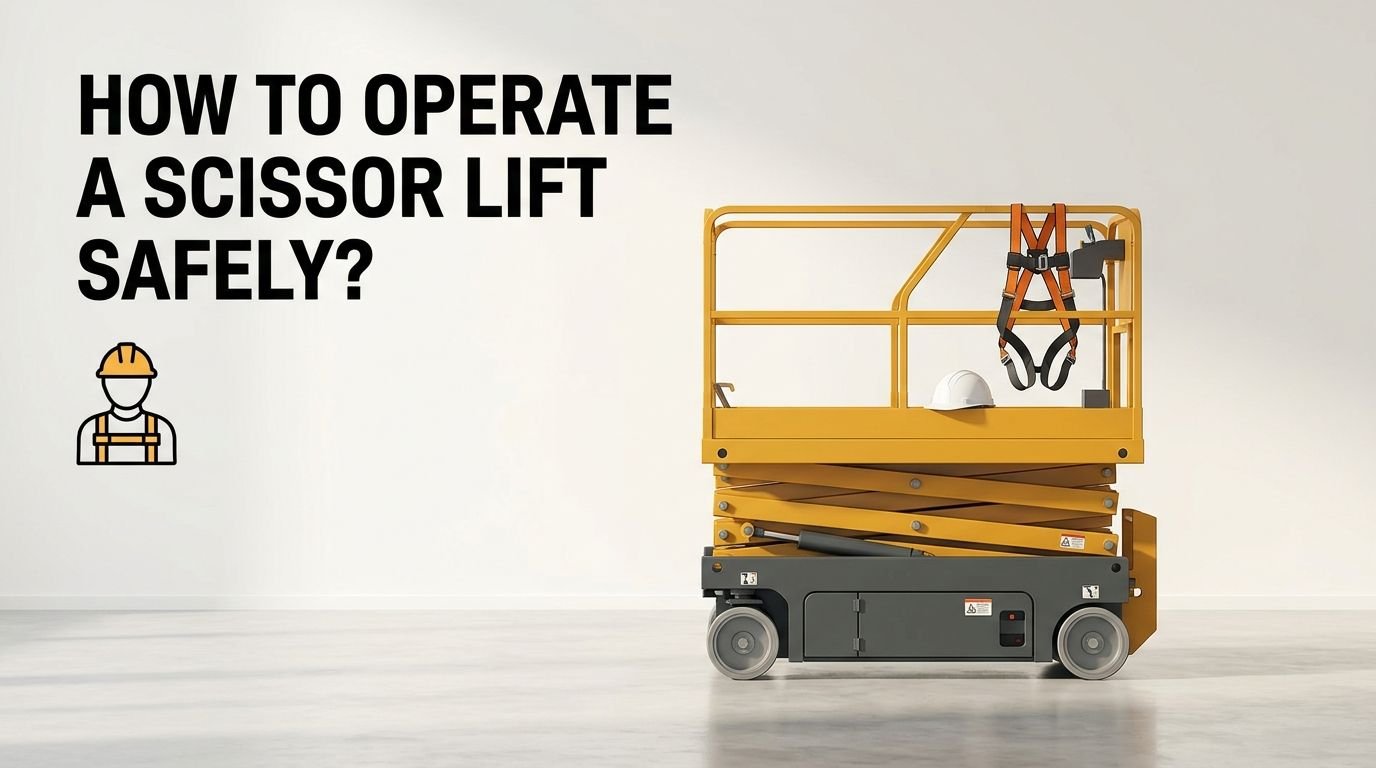
How to Operate a Scissor Lift Safely? Step by Step Guide
Have you ever stood at the base of a scissor lift and felt unsure about what to do next? You are not alone. Thousands of workers face this exact situation every year, and the stakes are high.
Falls, tip overs, and crushing injuries remain leading causes of scissor lift accidents on job sites across the country. OSHA reports that improper operation is a major factor in most of these incidents.
The good news is that learning how to operate a scissor lift is straightforward once you know the right steps. This guide breaks the entire process down into clear, simple actions you can follow from start to finish.
Key Takeaways
- Always complete a pre operation inspection before using any scissor lift. Check the tires, hydraulic hoses, guardrails, controls, and battery or fuel levels. A quick visual and functional check takes only a few minutes but can prevent serious accidents and equipment failures on the job site.
- Proper training and certification are required by OSHA before anyone operates a scissor lift. Employers must provide formal instruction, hands on practice, and a performance evaluation. Certification is valid for three years, after which renewal training is needed.
- Choose the right type of scissor lift for your job. Electric models work best indoors on flat, smooth surfaces. Rough terrain or diesel powered lifts handle outdoor sites with uneven ground. Picking the wrong lift creates unnecessary safety risks and reduces productivity.
- Never move a scissor lift while the platform is raised to full height. This is one of the most common mistakes operators make, and it dramatically increases the risk of a tip over. Always lower the platform before driving to a new location.
- Wear the correct personal protective equipment (PPE) every time you step onto the platform. This includes hard hats, non slip footwear, and a safety harness when required by your employer or local regulations.
- Know the emergency stop procedures. Every scissor lift has an emergency stop button at both the platform and base levels. Familiarize yourself with these controls before you begin work so you can react quickly if something goes wrong.
What Is a Scissor Lift and How Does It Work
A scissor lift is a type of mobile elevated work platform (MEWP). It raises workers and tools vertically using a set of linked, folding supports arranged in a crisscross “X” pattern. When the hydraulic system pushes these supports together, the platform rises. When it releases pressure, the platform lowers.
Scissor lifts are used in construction, maintenance, warehousing, and many other industries. They provide a stable, flat work surface at heights that would otherwise require scaffolding or ladders. Most models can reach working heights between 20 and 50 feet, depending on the size and type.
The platform sits on top of the scissor mechanism and includes guardrails on all sides. Operators control the lift from the platform itself, though most units also have base level controls for ground personnel. This dual control setup adds an extra layer of safety in case the operator on the platform is unable to bring it down.
Types of Scissor Lifts You Should Know About
Understanding the different scissor lift types helps you pick the right machine for your specific job. Each type has clear strengths and limitations, so choosing wisely matters for both safety and efficiency.
Electric scissor lifts are the most common choice for indoor work. They run on rechargeable batteries, produce zero emissions, and operate quietly. They roll on smooth, non marking tires that protect finished floors. Most electric models support loads between 500 and 1,500 pounds.
Pros of electric scissor lifts: quiet operation, zero emissions, lower maintenance costs, ideal for indoor use.
Cons of electric scissor lifts: limited battery life, cannot handle rough or uneven terrain, lower weight capacity.
Rough terrain scissor lifts run on diesel or dual fuel engines and feature large, knobby tires for traction. They handle outdoor job sites with slopes, gravel, mud, and uneven ground. Load capacities range from 1,000 to 2,500 pounds.
Pros of rough terrain lifts: strong traction, higher load limits, built for outdoor conditions.
Cons of rough terrain lifts: loud operation, produce emissions, not suitable for indoor use, higher fuel costs.
Training and Certification Requirements
OSHA requires every scissor lift operator to receive proper training and certification before operating the equipment. This is not optional. Employers who fail to provide training face fines and legal liability if an accident occurs.
Training programs must include three core components. First, formal classroom or online instruction covers the principles of scissor lift operation, load limits, fall protection, and hazard recognition. Second, hands on practical training gives operators direct experience with the controls and movements. Third, a performance evaluation confirms the operator can safely run the equipment on the actual job site.
Certification remains valid for 36 months. After that period, operators must complete renewal training to stay current. Employers should also provide refresher training if an operator is involved in an accident, observed operating unsafely, or assigned to a different type of scissor lift.
Pros of formal certification: meets legal requirements, reduces accident rates, builds operator confidence.
Cons of formal certification: requires time investment, may involve course fees, needs renewal every three years.
How to Perform a Pre Operation Inspection
A thorough pre operation inspection is the single most important safety step you can take before using a scissor lift. OSHA and equipment manufacturers both require this check before each work shift. It takes about 10 to 15 minutes and can save lives.
Start with a visual walk around inspection. Look for hydraulic fluid leaks under and around the base. Check that all four tires are properly inflated and free of damage. Inspect the guardrails for cracks, bends, or missing components. Confirm that the platform surface is clean, dry, and free of debris.
Next, move to the functional checks. Turn the lift on and test all controls at the platform level and the base level. Raise and lower the platform a short distance to confirm smooth operation. Test the emergency stop button. Check that the horn and any warning alarms work correctly.
Look for these specific items: battery charge level or fuel level, condition of hydraulic hoses, operation of the braking system, any unusual sounds during movement, and proper function of the tilt sensor or alarm. If anything fails inspection, do not operate the lift. Tag it out of service and report the issue to your supervisor.
Step by Step Guide to Operating a Scissor Lift
Follow these steps in order every time you operate a scissor lift. Skipping steps creates safety hazards that can lead to serious injury.
Step 1: Position the scissor lift on firm, level ground. Make sure the area is clear of holes, debris, slopes, and overhead obstructions like power lines or beams.
Step 2: Step onto the platform using the designated entry point. Close and latch the access gate behind you.
Step 3: Fasten your safety harness to the designated anchor point if your worksite requires fall protection.
Step 4: Pull out the emergency stop button to release it. Select the drive or lift mode using the toggle switch on the control panel.
Step 5: To raise the platform, hold the enable trigger and push the lift joystick or button upward. Release to stop. To lower, pull the control downward while holding the enable trigger.
Step 6: Once you reach your desired height, perform your work within easy reach. Never lean over the guardrails or stand on them.
Step 7: When finished, lower the platform completely before driving to a new location.
How to Drive and Steer a Scissor Lift
Driving a scissor lift feels different from operating a car or forklift. The controls are simple, but the machine responds slowly and requires patience and steady input.
Most scissor lifts use a joystick or toggle switch for directional control. Push the joystick forward to move forward. Pull it back to reverse. Push it left or right to steer. Some models use a separate steering switch that you hold down to turn the wheels while driving.
Keep the platform lowered as much as possible while driving. Many models restrict your maximum drive speed when the platform is raised. Some will not allow driving at all above a certain height. This is a safety feature designed to prevent tip overs.
Drive slowly and watch for pedestrians, obstacles, and changes in floor or ground conditions. Scissor lifts cannot turn at full lock while stationary on most models. You need to be moving slightly for the wheels to turn. Always look in the direction of travel and use a spotter in areas with limited visibility.
Pros of platform level driving controls: operator has full visibility, efficient repositioning.
Cons of platform level driving controls: limited speed, restricted turning radius, risk of tip over if platform is elevated.
Understanding Load Capacity and Weight Limits
Every scissor lift has a maximum rated load capacity printed on a placard near the controls. This number includes the combined weight of all workers, tools, materials, and equipment on the platform. Exceeding this limit is extremely dangerous.
Electric indoor lifts typically handle 500 to 1,500 pounds. Rough terrain models support 1,000 to 2,500 pounds. These figures are set by the manufacturer after extensive testing and must never be exceeded, even by a small margin.
Before you raise the platform, add up the total weight of everything and everyone on board. If you are close to the limit, remove unnecessary items. Wind load also affects stability at height, so factor in weather conditions during outdoor work.
Overloading a scissor lift causes the hydraulic system to strain, the structure to flex, and the center of gravity to shift. This dramatically increases the chance of a mechanical failure or tip over. Never allow extra workers to climb onto the platform to “help out” if doing so pushes you past the weight limit.
Essential Safety Gear and PPE
Personal protective equipment (PPE) is a critical part of safe scissor lift operation. The exact requirements vary by employer and job site, but certain items are standard across most workplaces.
A hard hat protects you from falling objects and overhead hazards. Non slip work boots with ankle support give you stable footing on the platform. Safety glasses shield your eyes from dust, debris, and sparks during work at height.
The question of harness use on scissor lifts generates some debate. OSHA does not universally require a full body harness on scissor lifts because the guardrail system serves as the primary fall protection. However, many employers, states, and specific job sites do require a harness and lanyard attached to an approved anchor point on the platform.
Pros of wearing a harness on a scissor lift: added fall protection, meets stricter employer policies, reduces injury severity.
Cons of wearing a harness on a scissor lift: can restrict movement, adds weight to the platform, may create a trip hazard if the lanyard is too long.
Always check your employer’s safety policy and follow the most protective standard that applies to your job site.
Common Mistakes Operators Make and How to Avoid Them
Even experienced operators fall into bad habits. Knowing the most frequent mistakes helps you stay alert and avoid them before they cause harm.
Skipping the pre operation inspection is the number one mistake. Operators often assume the lift is fine because “someone else used it yesterday.” Conditions change overnight. Hydraulic leaks develop. Batteries drain. Always inspect before every shift.
Moving while elevated ranks as the second most common error. The higher the platform, the less stable the lift becomes. Lower the platform before driving, even if it seems like a short distance.
Ignoring ground conditions puts operators at serious risk. Soft soil, uneven pavement, floor drains, and slope changes can all cause a tip over. Survey the entire path of travel before you begin.
Overloading the platform happens when workers add tools or materials mid job without recalculating total weight. Keep a running tally and respect the limit.
Finally, working without proper training remains a persistent problem on many sites. Even a quick task “just this once” on an unfamiliar lift can end badly. Never operate equipment you have not been trained on.
What to Do in an Emergency
Knowing the emergency procedures before an emergency happens is essential. Every second counts when something goes wrong at height.
If the platform controls stop working, stay calm and use the base level controls. Most scissor lifts have a secondary set of controls at the base that allows a ground worker to lower the platform. This is why having a spotter or coworker nearby is always a good practice.
If the lift begins to tip, do not jump off the platform. Crouch down low and hold onto the guardrails. Jumping from an elevated platform almost always results in worse injuries than staying on board.
In case of a hydraulic failure, the platform may descend slowly on its own due to gravity. Some models have a manual descent valve that a ground worker can activate. Know where this valve is located on the specific lift you are using.
If you smell smoke or see sparks, hit the emergency stop button immediately, lower the platform if possible, and evacuate. Report the issue and do not allow anyone to use the lift until it has been inspected and repaired by a qualified technician.
Outdoor Operation and Weather Considerations
Operating a scissor lift outdoors introduces additional hazards that indoor operators never face. Wind, rain, and temperature all affect how safely you can work at height.
Wind is the greatest outdoor threat to scissor lift stability. Most manufacturers set a maximum wind speed of 28 miles per hour for operation. At full height, even moderate gusts can cause the platform to sway significantly. Always check the weather forecast before starting outdoor work, and stop immediately if wind speeds increase beyond safe limits.
Rain and wet conditions make the platform surface slippery and reduce visibility. They also affect the ground underneath the lift, potentially softening soil and creating unstable conditions. If rain begins during your shift, lower the platform and wait for conditions to improve.
Extreme cold can affect battery performance on electric models and thicken hydraulic fluid, causing sluggish operation. Extreme heat can lead to overheating of engines and hydraulic systems on diesel models. Follow the manufacturer’s guidelines for operating temperature ranges.
Pros of outdoor capable lifts: access remote work areas, higher reach, greater load capacity.
Cons of outdoor operation: weather dependence, rougher terrain risks, increased tip over potential.
Maintenance Tips to Keep Your Scissor Lift Running Safely
Regular maintenance extends the life of a scissor lift and prevents breakdowns that could leave you stranded at height. While major repairs require a certified technician, operators play a key role in daily upkeep.
Check hydraulic fluid levels at the start of each week or according to the manufacturer’s schedule. Low fluid causes slow or jerky platform movement and can damage the pump over time. Inspect hydraulic hoses for wear, cracks, or soft spots and replace them before they fail.
Keep the battery charged on electric models. Deep discharging batteries repeatedly shortens their lifespan. Plug the lift in for charging at the end of every shift, and follow the manufacturer’s instructions for proper charge cycles.
Lubricate all pivot points and moving parts on the scissor mechanism according to the maintenance schedule. Clean the platform, controls, and sensors regularly. Dirt and debris can interfere with the tilt sensor and other safety systems, leading to false alarms or missed warnings.
Keep a written maintenance log for each lift. Record inspections, fluid top offs, repairs, and any issues observed during operation. This log protects both the operator and the employer if an incident occurs.
Frequently Asked Questions
Do you need a license to operate a scissor lift?
You do not need a government issued license in most states. However, OSHA requires all operators to complete formal training and certification provided by their employer. This training must include classroom instruction, hands on practice, and a performance evaluation. Without this certification, you are not legally permitted to operate a scissor lift on a job site.
Can you move a scissor lift while the platform is raised?
Some scissor lifts do allow limited driving with the platform partially raised. However, this significantly increases the risk of a tip over. Most safety experts and manufacturers recommend lowering the platform fully before driving. Always check the specific model’s operator manual for its restrictions on driving at height.
How high can a scissor lift go?
Most standard scissor lifts reach working heights between 20 and 50 feet. Some specialized models extend beyond 50 feet. The maximum height depends on the lift’s design, weight capacity, and intended use. Higher platforms require more careful attention to stability, wind conditions, and load limits.
Is a harness required on a scissor lift?
OSHA does not have a specific standard requiring harnesses on scissor lifts because the guardrail system is considered the primary fall protection. However, many employers and local regulations do require harness use. Always follow your employer’s safety policy, which may be stricter than the federal minimum.
How often should a scissor lift be inspected?
A pre operation inspection must be performed before every work shift. This includes both a visual walk around and functional testing of controls, safety systems, and structural components. Additionally, the lift should receive scheduled preventive maintenance according to the manufacturer’s recommendations, typically on a monthly or quarterly basis.
What should you do if a scissor lift starts tipping?
Do not jump. Crouch down low in the center of the platform and hold onto the guardrails. Jumping from an elevated platform almost always causes more severe injuries. After the incident, report it immediately and ensure the lift is removed from service until it has been fully inspected.

Hi, I’m Amelia Thornton, the founder of ElectroPro.blog.
I write about smart devices, gadgets, electronics, and tech essentials from Amazon.
My goal is to help you discover reliable and innovative tech that truly makes life easier.
From home automation to everyday gear, I test and share what’s worth your investment.
Join me as I explore the smartest tech trends—one gadget at a time.