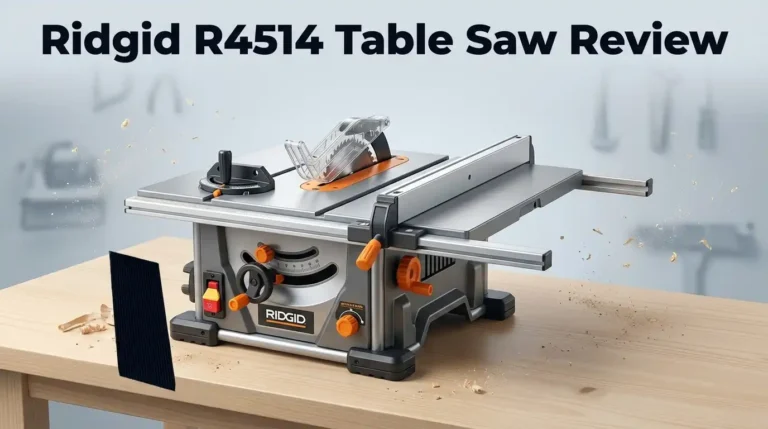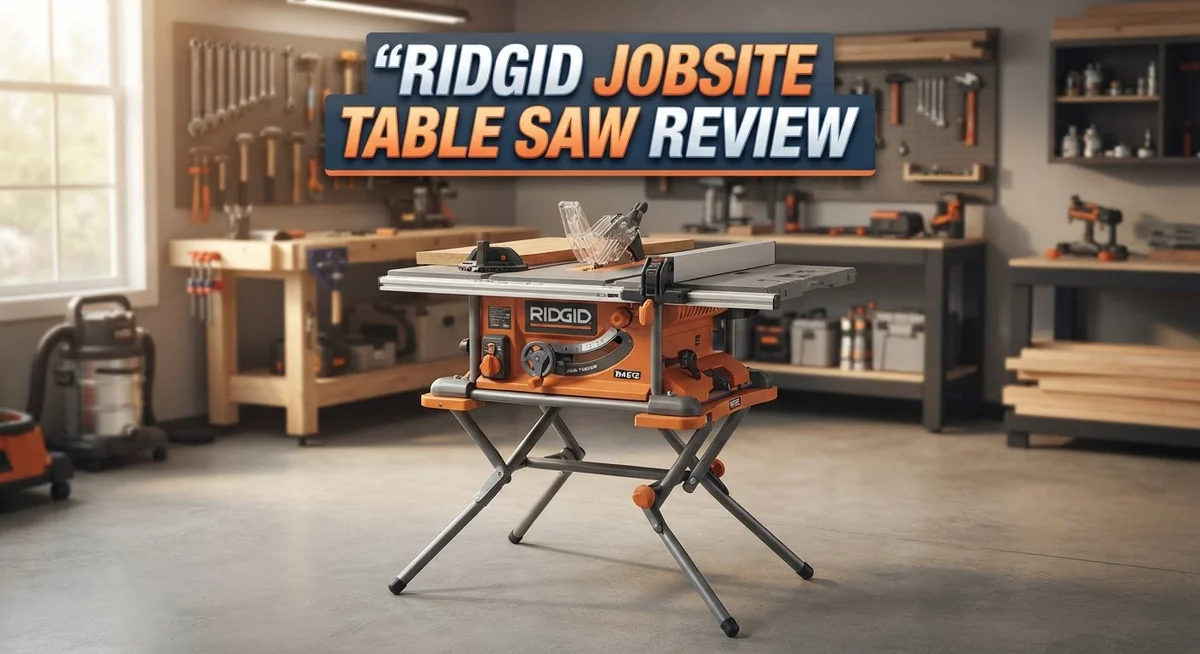
RIDGID Jobsite Table Saw R4514 Review: Worth It?
Looking for a reliable table saw for your job site? The RIDGID R4514 might catch your eye. This saw promises power, portability, and precision on paper.
It comes with a 15 Amp motor and a 10 inch blade. It can rip up to 30 inches and slice through 4×4 material in one pass. That sounds impressive for any contractor or DIY builder.
The stand folds up with a simple foot latch. You can move it around your site with ease. At 75 pounds, it stays portable but sturdy.
In a Nutshell
- Cutting Capacity: This saw handles a 30 inch rip cut with ease. It can even slice through 4×4 material in a single pass.
- Portability: At 75 lbs, it moves easily around any job site. The folding stand makes storage simple too.
- Fence Quality: The fence performs well for most cutting tasks. It stays steady during long rip cuts.
- Bevel Adjustments: Setting the blade to exact 90° or 45° angles takes patience. Some users find this step frustrating.
- Build Consistency: Newer units feel slightly different from older RIDGID models. Quality control seems less consistent now.
- Overall Usability: This saw scores low on ease of use. Beginners might need extra time to get comfortable with it.
Motor Power and Cutting Capacity
The RIDGID R4514 uses a 15 Amp motor that delivers consistent power for most job site cutting tasks. This motor size sits in the mid range for portable saws, meaning it handles standard ripping and crosscutting without strain.
The blade measures 10 inches in diameter. A 10 inch blade cuts through 4×4 inch material in a single pass, which matters for framing and rough carpentry work. You won’t need multiple passes for thick stock.
Rip capacity reaches 30 inches total. The right side of the fence gives you 26 inches, while the left side provides 8 inches. This split design works well if you mostly rip wider boards on the right side. Narrower cuts on the left side feel more cramped.
The motor pushes the blade fast enough for clean cuts in hardwoods and softwoods alike. Users report the motor rarely bogs down during normal cutting. Heavy-duty ripping or wet lumber might slow it slightly, but most job site materials cut smoothly.
Cutting depth stays consistent across the blade’s range. The saw reaches maximum depth when the blade stands fully upright. Angled cuts work too, though setting precise bevel angles requires extra attention.
One weak point emerges with blade adjustments. Getting the blade square to the table at exactly 90 degrees takes patience. The same applies to 45 degree bevels. Small vibrations or loose components can shift these settings over time. Users mention this frustration repeatedly in reviews.
The fence itself performs adequately for general work. It locks firmly in place and doesn’t drift during cutting. However, the fence alignment mechanism feels less refined than premium models.
Power delivery remains steady across different cutting speeds. The motor doesn’t require warm up time and starts reliably on job sites. Dust collection works reasonably well with the standard port, though aftermarket upgrades help capture more sawdust.
For users who prioritize motor power and cutting capacity over precision adjustments, this saw delivers solid performance. The cutting range handles most common job site scenarios without requiring special workarounds or modifications.

- RACK AND PINION FENCE RAILS - Ensures fence stays parallel to blade for fast smooth, and accurate...
- INTEGRATED FOLDING STAND - Legs quickly fold in to provide portability and convenient storage

Last update on 2026-10-21 / Affiliate links / Images from Amazon Product Advertising API Some of the links on this website are affiliate links, which means that at no additional cost to you, I earn a commission if you click through and make a purchase. I only recommend products and services that I believe will add value to my readers. Thank you for your support!
Portability and Stand Design
The RIDGID R4514 stands out for its thoughtful approach to moving a heavy tool around the job site. The stand uses a foot latch folding mechanism that feels intuitive once you get the hang of it. You simply press down with your foot, and the legs collapse inward smoothly.
At 75 pounds, this saw sits in a sweet spot for portability. You can carry it one-handed if needed, though a two-handed grip works better for stability. The weight distributes evenly across the frame, so moving it from your truck to the work area doesn’t strain your back.
The stand itself deserves attention. The base feels rock solid when you’re cutting. It doesn’t wobble or shift during operation, which matters when you’re making precision cuts. The legs lock firmly into place with minimal flex. This stability helps reduce vibration, leading to cleaner cuts across different materials.
One thing to note: the stand design prioritizes function over adjustability. You get a fixed height that works for most users, but tall or short operators might find themselves bending awkwardly. The work surface stays level, which keeps your material from sliding during cuts.
The folding mechanism works without tools. No pins to lose or complicated steps. Just press the foot latch and fold. When folded, the saw takes up minimal space in your truck bed or storage area. This makes it genuinely portable for contractors who move between job sites daily.
The overall build feels sturdy during transport. Handles are positioned at the saw’s center of gravity, making it easier to carry. The wheels on some models roll smoothly, though not all versions include them as standard.
For users who move their tools frequently, the RIDGID R4514 delivers solid portability without sacrificing stability. The stand won’t impress you with fancy features, but it gets the job done reliably. You spend less time fussing with setup and more time cutting.
Fence System and Rip Capacity
The fence system on the RIDGID R4514 strikes a balance between function and simplicity. It locks securely into position and holds tight during cutting operations. You won’t experience fence drift during repetitive cuts, which matters when you’re ripping multiple boards to the same width.
The fence design keeps things straightforward. It mounts parallel to the blade with minimal wiggle. Adjustments happen quickly without special tools or complicated procedures. This matters on job sites where you need to make cuts fast.
Rip capacity reaches an impressive 30 inches total. You get 26 inches to the right of the blade and 8 inches to the left. This means you can rip full width 4×4 lumber in a single pass. Many portable saws force you to make multiple cuts or flip material around. The RIDGID avoids that hassle.
The fence scales accurately across its range. You can trust measurements at 3 inches, 10 inches, or 24 inches without constant rechecks. The scale markings are clear and easy to read from your working position. This reduces setup time between cuts.
One consideration emerges with fence alignment. Getting the fence perfectly parallel to the blade takes attention during initial setup. Once locked in, it stays put. Some users report needing to check alignment after moving the saw between locations.
The fence handles ripping tasks from thin strips to wide boards. You won’t strain the mechanism pushing material through. The locking lever engages with firm pressure but not excessive force. This keeps the fence secure without causing hand fatigue.
For general job site work, the fence performs its job well. It won’t match cabinet shop precision, but it delivers consistency for framing, decking, and general construction cuts. The system prioritizes reliability over complexity. You get a fence that works predictably day after day without demanding constant maintenance or adjustment.
The 30 inch rip capacity combined with a stable fence makes this saw practical for most on site cutting needs.
Top 3 Alternatives
DeWalt DWE7491RS Table Saw

- Rack & Pinion Telescoping Fence System Make fence adjustments fast, smooth and accurate
- Patented material support, can be used for narrow rip cuts.
Last update on 2026-10-21 / Affiliate links / Images from Amazon Product Advertising API Some of the links on this website are affiliate links, which means that at no additional cost to you, I earn a commission if you click through and make a purchase. I only recommend products and services that I believe will add value to my readers. Thank you for your support!
Makita 2705 Table Saw

- Left extension table with smooth sliding action
- Right and rear extension table enables greater cutting capacity
Last update on 2026-10-21 / Affiliate links / Images from Amazon Product Advertising API Some of the links on this website are affiliate links, which means that at no additional cost to you, I earn a commission if you click through and make a purchase. I only recommend products and services that I believe will add value to my readers. Thank you for your support!
Bosch 4100-09 Table Saw

- RACK AND PINION RIP FENCE: This BOSCH table saw 10 inch size features color-coded index pins that...
- BOSCH TOOLS SAW: 15-Amp portable table saw with 3,800 rpm for rip-cutting and cross-cutting of fine...
Last update on 2026-10-21 / Affiliate links / Images from Amazon Product Advertising API Some of the links on this website are affiliate links, which means that at no additional cost to you, I earn a commission if you click through and make a purchase. I only recommend products and services that I believe will add value to my readers. Thank you for your support!
Blade Bevel Adjustment and Accuracy Issues
Blade bevel adjustment stands as one of the most frustrating aspects of the RIDGID R4514. Users consistently report difficulty locking the blade at both 90 degrees and 45 degrees. The mechanism feels loose and imprecise during setup.
Setting a square cut requires patience. The bevel knob turns smoothly enough, but holding the blade at exactly 90 degrees proves challenging. You’ll likely need to make several adjustments before the blade sits perfectly square to the table. This back and forth process wastes time on the job site.
The 45 degree angle presents similar headaches. Many users find the detent that should lock at 45 degrees either doesn’t engage properly or feels unreliable once set. Vibration during cutting can shift the blade angle, forcing you to stop and readjust mid job.
Accuracy suffers when bevel angles drift. A blade that’s even slightly off square produces angled cuts instead of perpendicular ones. This becomes especially problematic when you’re framing or building cabinets where square edges matter. You’ll need to check your angles frequently with a square or angle gauge.
The root cause appears to be the bevel adjustment design itself. The mechanism lacks the rigidity found on higher end saws. Wear and looseness develop fairly quickly with regular use. Some users report the problem worsens after just a few months of job site work.
Workarounds exist but add extra steps. You can use shims or carefully tighten the locking mechanism with extra force. Some owners apply thread locker to prevent slippage. These solutions help but feel like band aids rather than fixes.
For users who make occasional angled cuts, this issue may not derail your purchase. For professionals who need consistent 45 degree bevels or perfectly square cuts daily, this weakness becomes a real limitation. You’ll spend more time fiddling with adjustments than actually cutting.
The blade bevel system represents a clear trade off. The RIDGID R4514 excels in power and cutting capacity but stumbles when precision adjustments matter most.
Build Quality and Durability
The RIDGID R4514 features a cast iron top and aluminum components that create a solid foundation for job site work. The materials resist rust and hold up well under typical shop conditions. You’ll notice the construction feels substantial when you move it around.
The motor itself demonstrates real durability. A 15 amp powerhouse runs consistently through extended cutting sessions without overheating. Many users report the motor stays reliable even after years of heavy use. This speaks volumes about the engineering behind the device.
However, build quality has declined compared to earlier RIDGID generations. Newer models show looser tolerances in certain areas. The fence assembly doesn’t lock down quite as firmly as older versions. Some users experience minor play in the table surface after a few months of use.
The stand construction remains genuinely impressive. Heavy gauge steel tubing resists bending under load. The foot latch folding mechanism operates smoothly without developing play over time. Transport won’t damage the support structure because it’s engineered for repeated folding and unfolding.
One durability concern involves the blade bevel system. The adjustment mechanism loosens gradually with use. You’ll find yourself retightening it more often than ideal. This design flaw accelerates wear on the locking handle and adjustment knob.
The table surface itself maintains flatness reasonably well. Cast iron doesn’t warp easily, so you won’t see significant degradation after regular use. Dust collection ports stay intact and functional throughout the tool’s life.
Routine maintenance keeps this saw performing for years. Light oil on moving parts prevents corrosion. The fence slides smoothly if you keep dirt away from the rails. The motor requires minimal upkeep beyond standard safety checks.
Overall, the RIDGID R4514 offers decent durability for a portable job site tool. The motor and stand will outlast most job site demands. The table and main structure resist wear effectively. The blade bevel system represents the main durability weak point. For users accepting this limitation and performing basic maintenance, this saw delivers solid long term performance.
Pros and Cons
Pros
- Powerful 15 amp motor handles thick material like 4×4″ lumber in a single pass
- Stable stand with foot-latch folding mechanism makes setup and storage quick
- Lightweight at 75 lbs so you can move it between job sites without strain
- Impressive 30 inch rip capacity lets you cut everything from thin strips to wide boards
- Solid cast iron top and aluminum components create a dependable work surface
Cons
- Blade bevel adjustment frustrates users when setting 90 degree and 45 degree angles
- Bevel angles drift during use, causing cuts to come out angled instead of square
- Build quality has declined compared to earlier RIDGID generations
- Ease of use ratings sit at just 2 out of 5 due to accuracy and adjustment headaches
Who Should Buy It
The RIDGID R4514 works best for specific types of woodworkers and job site professionals. If you run a construction crew that moves between locations daily, this saw fits your needs perfectly. The 75 pound weight and folding stand mean you load it into a truck without breaking your back.
Contractors who cut 4×4 lumber regularly will appreciate the power here. The 15 amp motor handles thick material in a single pass. You get real cutting capacity without dragging around a massive stationary saw. The 30 inch rip capacity lets you crosscut wide boards and rip long strips on the same machine.
Carpenters who value speed over precision should consider this model. If your work tolerates minor angle variations, the bevel adjustment headaches won’t slow you down. You make quick cuts and move forward. The solid stand keeps the blade stable enough for rough framing and demolition work.
This saw is NOT for detail oriented woodworkers. If you build fine furniture or need perfect 45 degree angles consistently, look elsewhere. The bevel system drifts during use. Setting square cuts requires patience and workarounds. Your frustration level will spike fast if accuracy matters to every project.
Hobbyists with limited workshop space find value here too. You can store it in a garage corner or shed. Unfold the stand when you need it, fold it away after. The portable design beats owning a full size cabinet saw if you only cut occasionally.
Budget conscious DIYers tackling home renovation projects work well with this tool. You get a functional saw for deck building, shed construction, or fence work. The motor won’t quit on you mid project. Just accept that some cuts may need light sanding to true them up.
Skip this saw if you demand the best build quality. Earlier RIDGID generations outperform this model. If you can invest more, competitors offer better ease of use and fewer adjustment headaches. The R4514 serves practical workers who prioritize portability and power over precision and simplicity.
Final Verdict
The RIDGID R4514 earns its place as a strong contender in the jobsite table saw category. It delivers real cutting power and a stable platform for everyday tasks. Yet it also asks you to accept some real tradeoffs.
Compared to rivals like the Bosch 4100XC-10 or DeWalt models, the RIDGID holds its own on raw power and portability. It falls behind when it comes to fine tuned accuracy and long term bevel reliability. Delta and Ryobi options offer different strengths, but neither fully outshines the RIDGID’s rip capacity.
This saw shines brightest as a workhorse for rough framing and general construction. Contractors who prioritize speed and muscle over pinpoint precision will feel right at home. Anyone hauling a saw between multiple sites will appreciate how easy it folds and moves.
Woodworkers chasing perfect joinery should look elsewhere. The bevel adjustment issues make this a poor match for cabinet work or trim carpentry. If precision drives your projects, this saw will frustrate you more than it helps.
For everyone else, the RIDGID R4514 remains a practical and dependable choice. It handles thick lumber without hesitation and keeps up with demanding jobsite schedules. The stand alone makes daily setup and breakdown painless.
Think of this saw as a tool built for function first. It won’t win awards for elegance or flawless engineering. It will, however, get tough jobs done reliably day after day.
Before buying, ask yourself what your projects truly demand. Rough cutting power and portability point you toward the RIDGID. Fine detail and consistent bevel accuracy point you toward a different saw entirely.
In the end, the RIDGID R4514 delivers solid value for the right audience. It rewards users who value muscle and mobility over exacting precision. Choose it with clear eyes about what it does well and where it struggles.
Frequently Asked Questions
Is the RIDGID R4514 good for beginners?
Yes, if you want a straightforward saw that cuts through thick material easily. The motor delivers solid power, and the stand setup is simple. However, beginners should know that bevel angle adjustments feel clunky. You’ll need patience to dial in 45 degree cuts correctly.
Can this saw handle 4×4 lumber?
Absolutely. The 15 amp motor cuts 4×4 material in a single pass without bogging down. This is one of the R4514’s strongest features. Contractors who work with thick stock regularly will appreciate this capability.
How portable is this table saw?
Very portable for a jobsite tool. At 75 lbs, one person can move it between locations without exhaustion. The foot latch folding stand makes transport quick. You won’t struggle to load it onto a truck or van.
Should I buy this if I need precision cuts?
Not if precision matters most to you. The blade bevel tends to drift during use, meaning your 45 degree angles may not stay accurate. Fine furniture builders and detail oriented woodworkers should look at other options. This saw works best for rough framing and general construction where tight tolerances aren’t critical.
How does the RIDGID compare to the Bosch 4100XC-10?
Both are strong jobsite performers. The RIDGID matches the Bosch on raw power and portability. The main difference is build quality. Some users report the RIDGID’s quality has declined over time, while the Bosch maintains consistent construction standards.

Hi, I’m Amelia Thornton, the founder of ElectroPro.blog.
I write about smart devices, gadgets, electronics, and tech essentials from Amazon.
My goal is to help you discover reliable and innovative tech that truly makes life easier.
From home automation to everyday gear, I test and share what’s worth your investment.
Join me as I explore the smartest tech trends—one gadget at a time.