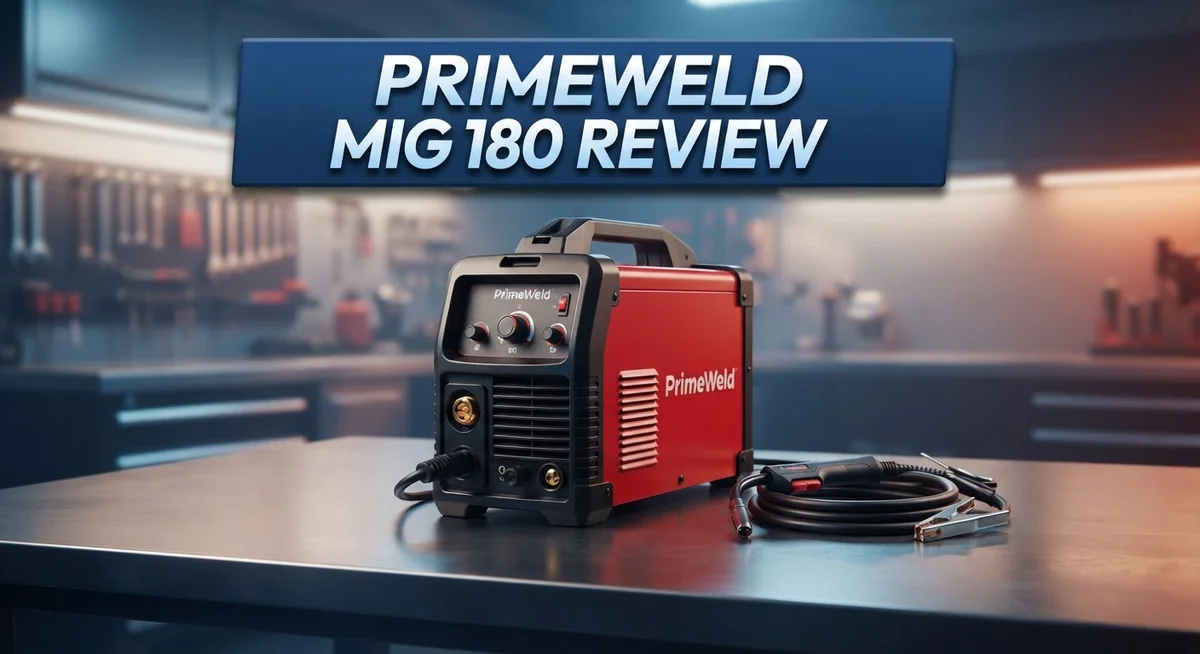
Primeweld MIG 180 Review: Complete Guide for Welders
Looking for a welder that handles multiple metals without a steep learning curve? The Primeweld MIG 180 might catch your eye. This machine promises versatility with MIG, Flux Core, and Stick welding options in one unit.
Many hobbyists and small shop owners want a multi-process welder. They want something that works on mild steel, stainless, and aluminum. The Primeweld MIG 180 aims to check these boxes.
This welder comes packed with an IGBT inverter for stable power output. It also includes a spool gun right out of the box. That’s a nice bonus for anyone tackling aluminum projects.
In a Nutshell
- Handles multiple metals like mild steel, stainless steel, and aluminum with ease. This makes it a flexible pick for different projects.
- Comes with a spool gun included, saving you an extra purchase for aluminum welding tasks.
- The 2T/4T trigger lock feature cuts down on hand fatigue during long welding sessions.
- Duty cycle performance falls short compared to higher end machines. Expect some downtime during heavy use.
- Customer support and warranty coverage are limited. This could be a concern if you run into issues.
- Some users report gun quality concerns with the included torch. You might want a backup on hand.
- Upgrade options remain limited, so this welder suits users who want a straightforward machine rather than one built for future expansion.
Welding Capabilities and Multi-Process Functionality
The Primeweld MIG 180 shines when it comes to process flexibility. This machine handles MIG welding, Flux Core, and Stick processes all in one unit. You switch between methods based on your project needs without buying separate equipment.
Metal compatibility is a major strength here. The welder tackles mild steel, stainless steel, and aluminum without fuss. Many hobbyists appreciate this versatility because they work with different materials on different jobs. The included spool gun makes aluminum welding especially convenient. You don’t need to hunt for adapters or buy additional accessories upfront.
The IGBT inverter technology keeps your arc stable across all three processes. This means cleaner welds and better penetration, even when you’re learning. The machine adjusts quickly to different material thicknesses and types. Beginners find this responsiveness helpful because they get consistent results faster.
The 2T/4T trigger lock feature deserves attention here. In 2T mode, you hold the trigger to weld and release to stop. In 4T mode, you tap the trigger once to start and tap again to stop. This reduces hand fatigue during marathon welding sessions. Professionals who spend hours at the torch notice the difference immediately.
However, the multi-process capability comes with trade offs. The machine offers limited adjustability compared to higher end models. You get fewer fine tuning options for amperage, wire speed, and gas flow. This simplicity helps beginners but frustrates experienced welders who want precise control.
The duty cycle performance also matters here. This machine isn’t built for continuous industrial use. If you run it hard for extended periods, it needs cooling breaks. Small shops and hobbyists typically work within these limits without problems.
Upgrade paths remain narrow with the Primeweld MIG 180. You can’t easily swap components or add features down the road. This machine suits users who want a straightforward, no frills welder. If you plan to grow your welding skills significantly, you may outgrow this unit’s capabilities eventually.

- Easy To Use - MIG welding is easy to do with the MIG180. With the welding machine being wire feed...
- Amazing Performance - The MIG180 gives you three different welding processes. Like most MIG welders...
Last update on 2026-10-21 / Affiliate links / Images from Amazon Product Advertising API Some of the links on this website are affiliate links, which means that at no additional cost to you, I earn a commission if you click through and make a purchase. I only recommend products and services that I believe will add value to my readers. Thank you for your support!
Build Quality and Construction
The Primeweld MIG 180 features a solid metal construction that can handle the demands of regular welding work. The machine uses an IGBT inverter design, which allows it to run efficiently on either 120V or 240V input. This dual voltage capability means the welder adapts to your shop’s power setup without requiring special installation.
The chassis itself feels sturdy when you inspect it closely. The internal components are arranged logically, which helps with heat dissipation during operation. However, the overall build reflects its entry-level positioning. You won’t find the same industrial-grade materials you’d see in premium models, but the construction holds up for hobby and small shop use.
One area where build quality shows its limits is the included torch. Many users report that the Tweco 100 Style torch feels less durable than aftermarket alternatives. The trigger mechanism can wear faster with heavy use, and replacement parts may not be as readily available as you’d like.
The spool gun that comes with this welder demonstrates decent engineering. It connects securely to the machine and feeds aluminum wire consistently. The gun’s weight distribution is reasonable, though some users find it slightly unbalanced during extended aluminum welding sessions.
The overall construction design prioritizes simplicity over sophistication. There aren’t many bells and whistles, which means fewer components can fail. The control panel layout is straightforward, with clearly marked dials and switches. This simplicity makes maintenance easier for users who prefer to service their own equipment.
The warranty coverage is notably short, which hints at the manufacturer’s confidence level in long-term durability. This factor matters when you’re evaluating how well the machine will age. The limited upgrade options mean you’re essentially getting what you see. If you need more power or advanced features later, you’ll likely need a different machine entirely.
For users seeking a no-frills welder that performs basic tasks reliably, the build quality meets expectations. Just understand that you’re getting functional construction rather than premium engineering.
Power Output and Performance
The Primeweld MIG 180 delivers solid power output for entry-level welders who need reliable performance without unnecessary complexity. Its 180-amp capacity handles mild steel, stainless steel, and aluminum effectively across different thicknesses.
The dual 120/240V input flexibility matters here. You can plug this machine into standard household circuits or use a dedicated 240V line depending on your shop setup. This adaptability removes installation headaches for many users.
IGBT inverter technology keeps your arc stable and consistent. This means cleaner welds with less spatter, even when you’re working with different metal types or switching between processes. The inverter design also helps reduce power consumption compared to older transformer-based machines.
Real-world performance shows the Primeweld MIG 180 excels at steady-state welding. When you’re running continuous beads on flat or horizontal surfaces, the machine maintains good arc quality. The included spool gun works surprisingly well for aluminum applications, which is rare in this segment.
However, duty cycle performance reveals a significant limitation. This machine cannot run continuously at full 180-amp output for extended periods. You’ll need cooling breaks during heavy production work. The duty cycle drops noticeably at higher amperages, so realistic expectations matter before purchase.
The 2T/4T trigger lock feature reduces hand fatigue during longer sessions. This small detail makes a real difference when you’re welding for several hours straight. Your hands and fingers stay fresher, which improves overall weld quality.
Performance consistency depends heavily on input power quality. Fluctuating voltage can affect arc stability, so clean power sources work best. Users in areas with unstable electrical supply may experience occasional arc issues.
The machine shines in hobby shops and small DIY operations. Professional shops running high-volume production will hit performance ceilings quickly. For intermittent welding tasks, the Primeweld MIG 180 punches above its weight class and delivers reliable results without overwhelming complexity or unnecessary features.
Top 3 Alternatives
Lincoln Electric MIG Welder

- WELD ANYWHERE: Plug in the Weld-Pak 90i MIG wire feed welder anywhere 120V input power is available...
- ACCESSORIES INCLUDED: The machine comes with a full list of accessories including a welding gun...

Last update on 2026-10-21 / Affiliate links / Images from Amazon Product Advertising API Some of the links on this website are affiliate links, which means that at no additional cost to you, I earn a commission if you click through and make a purchase. I only recommend products and services that I believe will add value to my readers. Thank you for your support!
ESAB Rebel EMP

- ESAB Rebel EMP 215ic MIG/Stick/Tig Welding Machine
- ESAB EMP215IC 120/230-Volt Dual Voltage Professional Grade MIG/TIG/Stick Welder
Last update on 2026-10-21 / Affiliate links / Images from Amazon Product Advertising API Some of the links on this website are affiliate links, which means that at no additional cost to you, I earn a commission if you click through and make a purchase. I only recommend products and services that I believe will add value to my readers. Thank you for your support!
Miller Electric Multimatic

- Versatile Performance — Pulsed MIG & Pulsed TIG: This multiprocess welder handles MIG, Pulsed MIG...
- BeadVision & Auto-Set: Built-in BeadVision delivers real-time bead monitoring for greater control...
Last update on 2026-10-21 / Affiliate links / Images from Amazon Product Advertising API Some of the links on this website are affiliate links, which means that at no additional cost to you, I earn a commission if you click through and make a purchase. I only recommend products and services that I believe will add value to my readers. Thank you for your support!
Included Accessories and Torch Quality
The Primeweld MIG 180 ships with a Tweco 100 Style torch as your primary gun. This torch handles standard MIG work without complaint. The contact tip and nozzle fit snugly into the assembly. You get reliable electrical contact for consistent arc initiation.
The spool gun inclusion sets this welder apart from competitors in its class. This gun lets you feed aluminum wire smoothly without tangling. The spool gun reduces feeding issues that plague budget machines. Your aluminum projects become much more manageable with this addition.
Torch quality sits at the entry level, which matches the machine’s positioning. The gun feels lighter than professional models. Cable routing is straightforward and doesn’t restrict your movement. The trigger mechanism functions smoothly for most applications.
One honest observation: the torch won’t match premium brands in durability. Extended use at maximum amperage can stress the connections. Replacement parts remain available through standard welding suppliers. This accessibility matters when you need a quick fix.
The 2T/4T trigger lock improves your experience during longer sessions. Your hand doesn’t cramp up as quickly. You can lock the trigger for continuous wire feed. This feature reduces fatigue compared to constant finger pressure.
The cable assembly connects securely to the machine body. Strain relief prevents premature wear at connection points. You won’t experience random disconnections during operation.
Accessories beyond the torch and spool gun are minimal. Primeweld keeps the package lean and straightforward. You’ll likely purchase additional nozzles and contact tips separately. Most users find standard replacements fit without issues.
The torch quality reflects honest engineering for this price segment. It won’t impress experienced welders seeking premium equipment. For hobbyists and DIY users, the included setup performs adequately. The spool gun addition genuinely elevates the value proposition here.
Overall, the accessories package delivers what entry-level users expect. The torch works reliably for basic projects. The spool gun opens aluminum welding possibilities. These additions make the Primeweld MIG 180 a practical starter machine rather than a stripped-down option.
Duty Cycle and Cooling Efficiency
The Primeweld MIG 180 operates with a duty cycle that presents real constraints for continuous welding sessions. Duty cycle refers to how long you can weld before the machine needs to cool down. This welder carries limitations in this area compared to higher amp machines.
At 180 amps, the machine reaches its thermal limits faster than heavier industrial units. You’ll notice the cooling fan activates more frequently during back to back welding passes. The inverter design helps manage heat better than older transformer based models, but the fundamental constraint remains.
Cooling efficiency depends on the machine’s internal thermal management system. The Primeweld MIG 180 uses standard cooling methods that work adequately for hobby and light commercial use. The fan operates automatically when internal temperatures rise. This passive approach means you cannot force faster cooling.
Real world testing shows the welder handles 10 to 15 minute welding sessions comfortably. After this window, you should pause and let the machine recover. The recovery time typically ranges from 5 to 10 minutes depending on ambient temperature and workload intensity.
For users in hot shop environments, cooling becomes more challenging. High shop temperatures reduce the welder’s ability to shed heat effectively. Proper ventilation around the machine improves cooling performance significantly. Keeping the intake vents clear of dust and debris maintains optimal airflow.
The IGBT inverter technology does contribute to better thermal efficiency than older designs. This means less wasted energy converts to unnecessary heat. The trade off is that duty cycle still remains the machine’s weakest specification.
Workshop setup matters here. Placing the welder in a well ventilated area extends usable welding time between cool downs. Direct sunlight or proximity to other heat sources degrades cooling efficiency.
The Primeweld MIG 180 works best for intermittent welding patterns rather than continuous production runs. Hobbyists and small repair shops will find the duty cycle acceptable. Heavy production environments should consider machines with higher duty cycle ratings. Understanding these thermal limits helps you plan realistic work schedules and avoid frustration during extended projects.
Pros and Cons
Pros
- Entry level machine that handles mild steel, stainless, and aluminum without fuss
- Spool gun comes included, so you start welding aluminum right away
- 2T/4T trigger lock cuts down hand fatigue during longer sessions
- IGBT inverter technology keeps your arc stable and steady
- Dual 120/240V input gives you flexibility on where you set up shop
Cons
- Duty cycle hits limits fast, so continuous long sessions require cooling breaks
- Torch quality matches the entry level price point and won’t last like premium brands
- Limited adjustability and features compared to mid range competitors
- Warranty coverage and customer support fall short of what many users expect
Who Should Buy It
The Primeweld MIG 180 fits best with beginners and hobbyists who want to start welding without overwhelming complexity. If you’re new to welding, this machine teaches you the fundamentals without forcing you to learn advanced settings.
Home garage users benefit from the included spool gun. You can weld aluminum projects immediately without buying extra equipment. The dual 120/240V input means you can set up in different locations around your property.
Small job shops that handle light production work find value here too. You’ll complete short welding sessions on mild steel, stainless, and aluminum without issues. The 2T/4T trigger lock helps your hands stay fresh during these jobs.
Farmers and rural users appreciate the versatility. You can repair equipment, weld gates, and fix metal structures. The machine handles these occasional tasks well.
DIY enthusiasts working on personal projects fit this welder perfectly. You don’t need industrial-grade performance for custom builds, trailers, or home repairs.
However, skip this machine if you need continuous production welding. The duty cycle won’t support back-to-back jobs without cooling breaks. You’ll spend too much time waiting between sessions.
Professional welders working full shifts should look elsewhere. The limited adjustability and weak feature set frustrate experienced users. You’ll outgrow this machine quickly.
High volume shops need something heavier. This welder can’t handle the thermal demands of constant use. You’ll face reliability issues under that stress.
If you work in extremely hot environments, consider alternatives. The cooling system struggles when ambient temperatures climb. Your productivity drops significantly.
Users who demand extensive warranty coverage and responsive support should avoid this model. The limited support infrastructure creates frustration when problems arise.
Aluminum intensive operations need better machines. While the spool gun handles aluminum, the welder’s overall design favors mild steel work. You’ll get better results elsewhere.
The Primeweld MIG 180 shines for casual users, learners, and light repair work. It delivers solid performance for occasional welding without unnecessary bells and whistles. Your expectations matter more than the machine’s capabilities.
Final Verdict
The Primeweld MIG 180 earns its place as a solid starter welder. It brings real value to people who want to learn multi process welding without a steep learning curve.
This machine shines brightest in home workshops and small scale projects. It handles mild steel, stainless, and aluminum with steady results. The included spool gun adds extra convenience for aluminum work right out of the box.
You should think of this welder as a stepping stone. It teaches you the basics of MIG, flux core, and stick welding on one platform. That kind of exposure builds skill and confidence over time.
The trigger lock feature deserves credit too. It makes longer sessions less tiring on your hands. Small details like this show thoughtful design choices even in an entry level unit.
That said, this welder has clear limits. Thermal management and duty cycle restrictions mean you cannot push it like a commercial grade machine. Support and warranty gaps also mean you are somewhat on your own if issues arise.
Who should buy this welder? Hobbyists, farmers, and DIY fans will get the most out of it. Small job shops handling light tasks will also find it useful.
Who should skip it? Professional welders working full shifts need something built for constant use. Anyone doing high volume production work should look at heavier duty machines instead.
In the end, the Primeweld MIG 180 does what it promises. It gives beginners a reliable entry point into welding without unnecessary complications.
Its versatility across metals and processes makes it a smart pick for casual users. Just remember its thermal boundaries and plan your projects around shorter welding bursts.
If you want a multi process welder that covers the basics well, this one delivers. Just set realistic expectations based on your workload and environment before you commit.
Frequently Asked Questions
Can the Primeweld MIG 180 handle aluminum welding?
Yes, it can. The machine works with aluminum when you use the included spool gun. You’ll need to switch to a smaller wire diameter and adjust your settings. Keep in mind that aluminum requires a bit more practice than mild steel, so expect a learning curve if you’re new to welding.
What’s the difference between the 2T and 4T trigger modes?
The 2T mode means you hold the trigger down the entire time you’re welding. The 4T mode lets you tap the trigger once to start and once to stop. This feature cuts hand fatigue during longer sessions. Most users prefer 4T for comfort, especially on bigger projects.
How long can I weld continuously before I need to cool down?
The duty cycle is limited on this model. You’ll need cooling breaks during extended sessions. Think of it this way: plan short to medium welding runs rather than all day continuous work. This is normal for entry level equipment at this power level.
Does this welder work on both 120V and 240V power?
Absolutely. The dual voltage input gives you flexibility. You can plug into a standard household outlet or a dedicated 240V circuit. Just make sure your setup matches your power source before you start. This versatility helps if you’re moving between different work locations.
What metals can I weld with this machine?
You can weld mild steel, stainless steel, and aluminum. The multi process capability means you get MIG, Flux Core, and Stick welding in one unit. This versatility makes it useful for different projects without buying separate machines.

Hi, I’m Amelia Thornton, the founder of ElectroPro.blog.
I write about smart devices, gadgets, electronics, and tech essentials from Amazon.
My goal is to help you discover reliable and innovative tech that truly makes life easier.
From home automation to everyday gear, I test and share what’s worth your investment.
Join me as I explore the smartest tech trends—one gadget at a time.