Yarbo Snow Blower vs Toro Snow Blower: Who Wins?
Winter is coming, and your back is already dreading the thought of shoveling snow. You have two strong options sitting on the table right now.
The Yarbo robotic snow blower and the Toro snow blower represent two very different approaches to clearing snow. One is a futuristic robot that does the work while you sleep. The other is a trusted brand that has dominated driveways for decades.
But which one is actually worth your money? That is the question thousands of homeowners ask every winter season. Yarbo brings cutting-edge autonomous technology to snow removal.
Key Takeaways
- Yarbo is a robotic, autonomous snow blower that operates on its own using GPS and RTK technology. You can schedule it, control it from your phone, and let it clear snow without lifting a finger. It is best for homeowners who want a hands-free, smart home experience.
- Toro offers a massive lineup of snow blowers ranging from small electric models to powerful two-stage gas machines. Toro gives you more choices at more price points. It is a solid pick for people who want proven performance and flexibility.
- Yarbo costs significantly more upfront than most Toro models. The Yarbo S1 platform plus the snow blower module can exceed $5,000. Most Toro snow blowers fall between $400 and $2,000. Budget matters here.
- Toro requires manual operation for every snowfall. You must be present, push or guide the machine, and handle maintenance yourself. Yarbo removes that physical effort entirely.
- Toro has a much longer track record and a well-established dealer and service network. Yarbo is a newer company, and long-term reliability data is still limited.
- Both options handle moderate snowfall well, but heavy, wet snow and extreme conditions may still favor a powerful Toro two-stage gas model over the Yarbo’s electric robotic system.
What Is the Yarbo Snow Blower?

- YARBO Snow Blower Module
- 2-stage design
Last update on 2026-09-13 / Affiliate links / Images from Amazon Product Advertising API Some of the links on this website are affiliate links, which means that at no additional cost to you, I earn a commission if you click through and make a purchase. I only recommend products and services that I believe will add value to my readers. Thank you for your support!
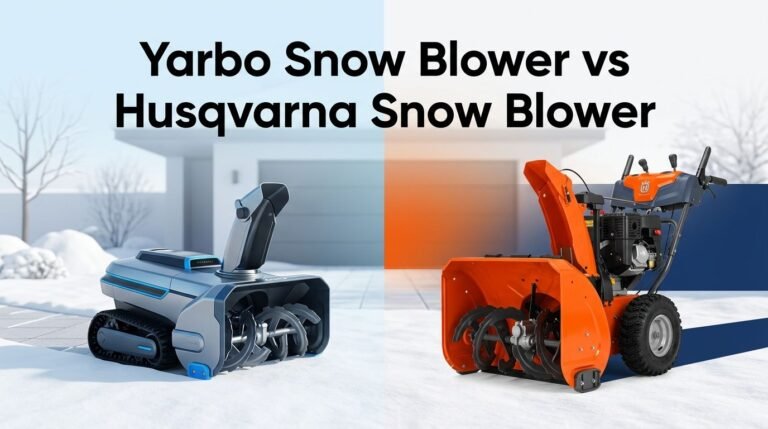
The Yarbo snow blower is part of the Yarbo S1 modular yard robot platform. This is not a traditional snow blower. It is a fully autonomous machine that uses GPS, RTK positioning, and smart sensors to clear your driveway and walkways on its own.
You set up a boundary map using the Yarbo app on your phone. The robot learns your property layout. Then, you can schedule it to run at specific times or trigger it remotely. The snow blower module attaches to the Yarbo S1 base unit. This same base unit can also accept a lawn mower module and a leaf blower module throughout the year.
The Yarbo snow blower module can throw snow up to 30 feet and handle accumulations of several inches per pass. It runs on a rechargeable battery and operates quietly compared to gas-powered machines. The machine works best on flat or gently sloped surfaces. Steep driveways may present challenges.
Yarbo targets homeowners who want a completely automated yard care system. If you already dislike shoveling or have physical limitations, this robot offers a genuine solution. However, it does require an initial setup process that involves mapping your property boundaries.
What Is the Toro Snow Blower?

- ➤【3500W High-Power Core: Efficient Large-Area Clearing】This Snow Blower features a robust...
- 【Dual 20V 4.0Ah Batteries: Long-Lasting Performance】This snow removal tool features dual...
Last update on 2026-09-13 / Affiliate links / Images from Amazon Product Advertising API Some of the links on this website are affiliate links, which means that at no additional cost to you, I earn a commission if you click through and make a purchase. I only recommend products and services that I believe will add value to my readers. Thank you for your support!
Toro has been making snow blowers for over 70 years. The company produces single-stage, two-stage, and three-stage snow blowers in both gas and electric versions. Toro is one of the most recognized names in outdoor power equipment across North America.
Single-stage Toro models work well for light to moderate snow on paved surfaces. Two-stage models handle heavier snow and gravel driveways with ease. Three-stage Toro Power Max HD models are built for the worst winter conditions. Each tier offers more clearing width, more throwing distance, and more engine power.
Toro also makes battery-powered electric snow blowers for homeowners who want quieter, emission-free operation. These electric models suit smaller driveways and moderate snowfall areas. The gas models remain the go-to choice for heavy-duty snow removal.
Toro snow blowers are available at major retailers like Home Depot, Lowe’s, and Amazon. Parts and service centers are easy to find. This widespread availability makes Toro a practical and accessible choice for most homeowners. You can walk into a store, buy one, and start clearing snow the same day.
Yarbo S1 Snow Blower Module: A Closer Look
The Yarbo S1 snow blower module is the star of Yarbo’s winter lineup. It connects to the S1 base robot and transforms it into an autonomous snow-clearing machine. The module features a 21-inch clearing width and an adjustable chute that directs snow where you want it.
This machine uses brushless motors for efficient power delivery. It can handle snow depths of up to 12 inches in a single pass under ideal conditions. The battery provides enough runtime to clear a standard two-car driveway multiple times on a single charge.
Setup involves placing RTK base stations and mapping your property through the app. Once configured, the Yarbo remembers your layout. You never need to map it again unless you change your property boundaries. The app also sends you notifications about cleaning progress and battery status.
The Yarbo S1 operates in temperatures as low as -4°F (-20°C). It has built-in obstacle detection sensors that help it avoid cars, pets, and other objects. The robot returns to its charging dock automatically when finished or low on battery.
Pros:
- Fully autonomous snow removal
- App-controlled scheduling and monitoring
- Quiet electric operation
- Multi-season use with other Yarbo modules
Cons:
- High upfront cost exceeding $5,000 for the full system
- Requires initial setup and property mapping
- Limited effectiveness on steep inclines
- Newer brand with less long-term reliability data
Toro Power Max 826 OHAE Two-Stage Snow Blower
The Toro Power Max 826 OHAE is one of Toro’s most popular two-stage gas snow blowers. It features a 26-inch clearing width and a powerful 252cc engine. This model can handle heavy, wet snow that would challenge smaller machines.
Toro’s Anti-Clogging System keeps the impeller spinning faster than the auger. This prevents snow from jamming inside the chute. The result is continuous, uninterrupted snow throwing even in tough conditions. The Power Max 826 throws snow up to 40 feet.
The machine includes Quick Stick chute control for easy one-hand direction changes. You can adjust where the snow lands without stopping. The self-propelled drive system reduces the physical effort needed to push the machine through deep snow.
This model also features electric start for cold-morning convenience. You plug it in, press a button, and the engine fires up. No more pulling a recoil cord with frozen fingers. The headlight lets you clear snow safely in the dark, early morning hours.
Pros:
- Powerful 252cc engine handles heavy snow
- 26-inch clearing width covers large areas fast
- Anti-Clogging System prevents jams
- Electric start for easy cold-weather ignition
Cons:
- Requires gasoline and regular engine maintenance
- Louder than electric or robotic options
- Manual operation needed for every snowfall
- Heavier and harder to store than smaller models
Toro 60V SnowMaster Electric Snow Blower

- Efficient Snow Clearing: Engineered with a robust Insert 15-amp motor, can quickly clear wet, thick...
- Widespread Snow Removal Route: Equipped with a 2 blade steel auger, which has a powerful throwing...
Last update on 2026-09-13 / Affiliate links / Images from Amazon Product Advertising API Some of the links on this website are affiliate links, which means that at no additional cost to you, I earn a commission if you click through and make a purchase. I only recommend products and services that I believe will add value to my readers. Thank you for your support!
For homeowners who want a battery-powered Toro option, the Toro 60V SnowMaster series delivers solid performance without gas. This model uses Toro’s 60-volt Flex-Force battery system. It shares batteries with other Toro 60V yard tools.
The SnowMaster design combines an auger and a paddle system. This Personal Pace self-propel technology matches the machine’s speed to your walking pace. You walk faster, it moves faster. You slow down, it slows down. This makes clearing snow feel natural and effortless.
The 60V model produces zero emissions and much less noise than gas equivalents. It starts instantly with the push of a button. There is no engine oil to change, no spark plugs to replace, and no fuel to store.
This electric model works best for light to moderate snowfall on paved driveways and sidewalks. It may struggle with very heavy or deep snow compared to Toro’s gas two-stage models. However, for many suburban homeowners, it offers the perfect balance of convenience and performance.
Pros:
- Zero emissions and quiet operation
- Personal Pace self-propel system
- Shares batteries with other Toro 60V tools
- No gas, oil, or engine maintenance required
Cons:
- Limited runtime per battery charge
- Less powerful than gas models for heavy snow
- Battery and charger may add to total cost
- Not ideal for very large driveways or deep snow
Performance Comparison: Clearing Power and Speed
Performance is where these two brands show their biggest differences. Toro gas models win on raw clearing power. A two-stage Toro can chew through 18+ inches of heavy, packed snow. The Yarbo handles moderate accumulations well but may need multiple passes for heavy storms.
The Yarbo compensates with automation. It can run before, during, and after a storm on a schedule. This means it clears snow in thin layers throughout the event. By making frequent passes, it avoids dealing with deep accumulations all at once. This strategy works well for consistent, moderate snowfall regions.
Toro’s throwing distance typically exceeds Yarbo’s. A Toro Power Max can launch snow 40+ feet. The Yarbo throws snow about 30 feet. For narrow driveways, both distances are more than enough. For wide properties, Toro has the edge.
Speed also differs. Toro lets you clear a driveway in one focused session. You go out, finish the job, and come back inside. Yarbo may take longer per session since it moves methodically. But you are inside drinking coffee while it works, so the time difference matters less.
Ease of Use: Hands-Free vs Hands-On
This category creates the sharpest divide between these two brands. Yarbo is hands-free. You set it up once, create your schedule, and the robot handles everything. You can start a snow-clearing session from your couch using the app. You can even trigger it while traveling.
Toro requires your physical presence for every single snowfall. You must dress for the cold, start the machine, guide it across your property, and store it afterward. For young, healthy homeowners, this is fine. For older adults or people with mobility issues, this physical demand is a major consideration.
Toro does offer features that reduce effort. Self-propelled models pull themselves forward. Electric start eliminates cord pulling. Quick Stick chute controls simplify direction changes. But you are still outside operating the machine.
Yarbo’s app interface is intuitive and well-designed. You see a map of your property, set boundaries, schedule sessions, and monitor progress in real time. The learning curve mainly involves the initial setup. After that, daily use is almost effortless.
Price and Value: What Are You Really Paying For?
Price is often the deciding factor. The Yarbo S1 system with the snow blower module costs $5,000 or more. This includes the base robot, the snow module, the charging dock, and RTK stations. Additional modules for mowing and leaf blowing add more cost but also more year-round value.
Toro snow blowers range from about $350 to $2,500 depending on the model. A solid two-stage gas model costs around $900 to $1,500. Electric models start lower. You get a dedicated, proven snow-clearing machine at a fraction of Yarbo’s price.
However, value goes beyond the sticker price. Yarbo saves you time and physical effort every single snowfall. Over a 10-year span, that adds up. If you hire a snow removal service at $50 to $100 per visit, Yarbo could pay for itself in a few seasons.
Toro offers excellent value for people who do not mind the manual work. The machines last for many years with proper maintenance. Replacement parts are cheap and widely available. A well-maintained Toro can serve you for a decade or longer.
Durability and Maintenance
Toro snow blowers have a proven durability record. Gas models require seasonal oil changes, spark plug replacements, and fuel stabilizer. These tasks are simple and inexpensive. The auger, belts, and skid shoes may need replacement after several years of heavy use.
Yarbo’s electric system requires less routine maintenance. There is no engine oil, no spark plugs, and no fuel system to winterize. The battery needs proper storage during the off-season. The brushless motors have fewer moving parts than a gas engine.
However, Yarbo is a newer product. Long-term durability data over 5 to 10 years does not exist yet. If something breaks, you rely on Yarbo’s customer support and parts availability. Toro’s parts can be found at almost any hardware store.
Warranty coverage matters too. Toro typically offers a two-year warranty on residential snow blowers. Yarbo offers warranty coverage as well, but service logistics may vary depending on your location. Check both warranties carefully before buying.
Noise Levels and Neighbor Friendliness
Nobody wants to be the neighbor running a loud machine at 6 AM. Toro gas snow blowers produce significant noise. A two-stage gas model can reach 85 to 100 decibels. That is loud enough to require hearing protection and will definitely wake your neighbors.
Yarbo operates on electric power and runs much quieter. It produces noise levels closer to 70 decibels. This means you can schedule it to run early in the morning or late at night without disturbing the neighborhood. For homes in close proximity, this is a big advantage.
Toro’s electric 60V models also run quieter than their gas counterparts. If noise is a major concern but you prefer Toro, the electric lineup offers a good middle ground. You get Toro reliability with reduced noise output.
Local noise ordinances may also influence your decision. Some neighborhoods restrict power equipment use during certain hours. A quieter machine gives you more flexibility in when you clear snow. This is especially helpful during overnight storms when you need a clean driveway by morning.
Smart Features and Technology
Yarbo leads this category by a wide margin. The robot uses RTK GPS for centimeter-level positioning accuracy. It has obstacle detection sensors, app-based controls, and over-the-air software updates. Yarbo can receive feature improvements and performance boosts without any hardware changes.
The Yarbo app lets you draw custom clearing paths. You can prioritize certain areas like your front walkway or garage entrance. You can also set the machine to avoid specific zones. This level of customization is impossible with a traditional snow blower.
Toro snow blowers have limited smart features. Some models include electric start and headlights. The Quick Stick chute control is a mechanical convenience, not a digital feature. Toro focuses on mechanical reliability rather than digital innovation.
If you value smart home integration and cutting-edge technology, Yarbo is the clear winner. If you prefer simple, proven machines that just work without apps or Wi-Fi, Toro fits that philosophy perfectly. Your comfort with technology should influence this decision.
Best Use Cases for Each Brand
Choose Yarbo if you have a flat or gently sloped driveway, live in a region with regular but moderate snowfall, value automation, and have the budget for a premium system. Yarbo also makes sense if you want multi-season yard automation with mowing and leaf blowing modules.
Choose Toro if you deal with heavy, deep snowfall, have a steep or uneven driveway, want a lower upfront cost, or prefer a machine with decades of proven reliability. Toro also wins if you have limited Wi-Fi connectivity or prefer not to rely on technology for snow removal.
Homeowners with very large properties may find that Toro’s wider, more powerful models clear snow faster than the Yarbo robot. On the other hand, homeowners with physical limitations will benefit greatly from Yarbo’s fully autonomous operation.
Rental properties and commercial settings still favor Toro. The machines are simple to hand off to tenants or employees. Yarbo’s setup process and app-based control make it more suited to owner-occupied homes where one person manages the system.
Final Verdict: Yarbo vs Toro Snow Blower
Both brands solve the same problem in very different ways. Yarbo is the future of snow removal. It offers hands-free, app-controlled, quiet operation that fits perfectly into a modern smart home setup. The premium price tag is its biggest barrier.
Toro is the reliable present. It offers powerful, affordable, and proven snow-clearing performance across a huge range of models. You sacrifice convenience but gain raw power and dependability.
If your budget allows and you want the ultimate convenience, go with Yarbo. If you want a dependable workhorse that handles anything winter throws at you, go with Toro. Either way, you will be in much better shape than the neighbor with a shovel.
Frequently Asked Questions
Can the Yarbo snow blower handle heavy, wet snow?
The Yarbo handles moderate snow well. For very heavy, wet snow, it may need multiple passes. Scheduling frequent runs during a storm helps it manage accumulations. A powerful Toro two-stage model handles heavy, wet snow more effectively in a single pass.
Is the Yarbo snow blower worth the high price?
It depends on your priorities. If you value time savings, automation, and hands-free operation, Yarbo delivers real value over time. If you are comfortable with manual snow removal, a Toro offers similar clearing power at a much lower cost.
Do Toro snow blowers work on gravel driveways?
Yes. Toro two-stage and three-stage models have adjustable skid shoes that let the auger ride above the gravel surface. Single-stage models sit closer to the ground and are better suited for paved surfaces only.
How long does the Yarbo battery last during snow removal?
The Yarbo battery provides enough charge to clear a standard two-car driveway multiple times. Actual runtime depends on snow depth, temperature, and property size. The robot returns to its dock automatically to recharge when the battery gets low.
Can I use a Toro snow blower at night?
Yes. Many Toro models come with built-in headlights for nighttime use. However, gas models are loud and may violate local noise ordinances during early morning or late night hours. Toro’s electric models are a quieter option for nighttime clearing.
Does the Yarbo robot work in extremely cold temperatures?
The Yarbo S1 is rated to operate in temperatures as low as -4°F (-20°C). Battery performance may decrease in extreme cold, which could reduce runtime per charge. Keeping the dock in a sheltered area can help preserve battery efficiency.

Hi, I’m Amelia Thornton, the founder of ElectroPro.blog.
I write about smart devices, gadgets, electronics, and tech essentials from Amazon.
My goal is to help you discover reliable and innovative tech that truly makes life easier.
From home automation to everyday gear, I test and share what’s worth your investment.
Join me as I explore the smartest tech trends—one gadget at a time.