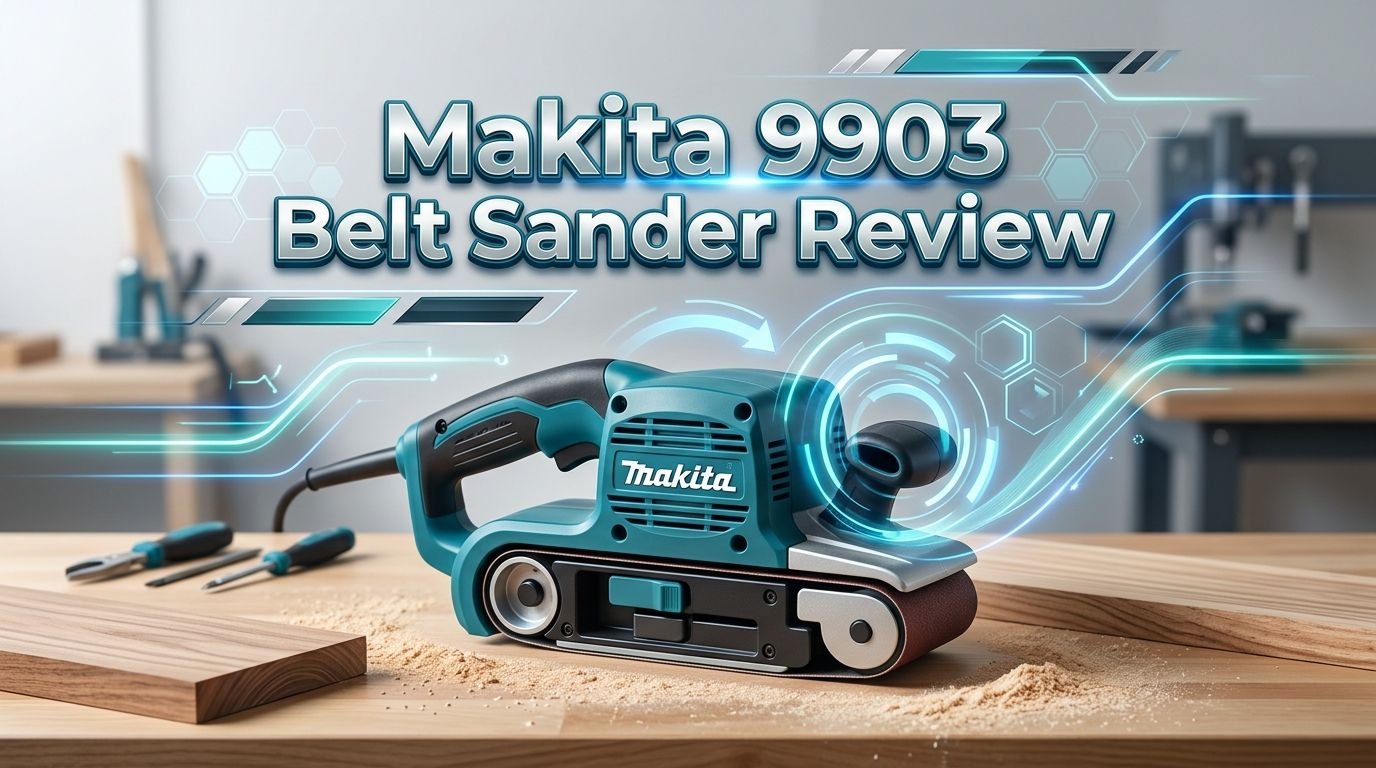
Makita 9903 Belt Sander Review 2026: Is It Worth Buying?
Makita 9903 Belt Sander: If you are shopping for a belt sander that balances raw power with quiet operation, the Makita 9903 has likely caught your eye.
This 3×21 inch belt sander has earned a rock solid reputation among woodworkers, contractors, and DIY enthusiasts. But does it still hold up in 2026 against newer competitors?
I spent time putting this sander through real world tests. I sanded hardwood, stripped old paint, and flattened rough lumber. The results were impressive.
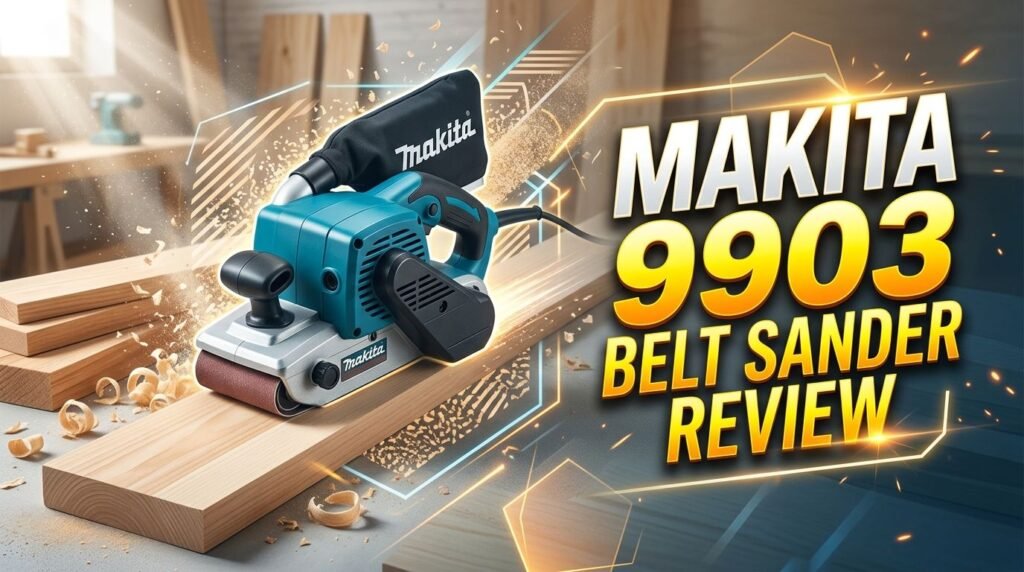
Key Takeaways:
- The Makita 9903 packs an 8.8 amp motor that delivers belt speeds between 690 and 1,440 feet per minute. This gives you serious stock removal power for hardwood, softwood, and even metal surfaces.
- Variable speed control lets you dial in the exact belt speed for each task. Slow speeds work well for finishing. Fast speeds handle heavy material removal with ease.
- The auto tracking belt system keeps the belt aligned without manual adjustments. This saves time and reduces frustration during long sanding sessions.
- Noise output sits at just 85 dB, making this one of the quietest belt sanders in its class. Your ears will thank you during extended use.
- The front nose and side design allow flush sanding against walls and into corners. This is a standout feature that many competing models lack.
- A cloth dust bag comes included, and the sander also connects to a vacuum for better dust management. Clean work areas mean better visibility and healthier lungs.

- Powerful 8.8 AMP motor; only 85dB
- Variable speed control dial (690 -1,440 ft./min.) to match the speed to the application
Last update on 2026-10-21 / Affiliate links / Images from Amazon Product Advertising API Some of the links on this website are affiliate links, which means that at no additional cost to you, I earn a commission if you click through and make a purchase. I only recommend products and services that I believe will add value to my readers. Thank you for your support!
Makita 9903 3″ x 21″ Belt Sander: Full Product Overview
The Makita 9903 is a corded electric belt sander built for professional and home workshop use. It uses a 3 inch by 21 inch belt size, which is the most popular format for handheld belt sanders. This size gives you a good balance between coverage area and control.
Makita designed this sander with a transverse motor layout. This positions the motor across the body of the sander. The result is a lower center of gravity and better balance during use. You feel this difference the moment you pick it up.
The overall length is just 11 and 5/8 inches. The compact body makes it easier to control than many competitors. It weighs around 7.3 pounds, which is light enough for extended use but heavy enough to provide downward sanding pressure.
Motor Power and Performance
The heart of the Makita 9903 is its 8.8 amp motor. This motor delivers consistent power across a wide range of sanding tasks. Whether you are leveling a glued panel or stripping paint off a door, the motor does not bog down.
Electronic speed control maintains constant belt speed under load. This is a critical feature. Without it, the sander would slow down each time you press harder. The speed control keeps the belt moving at your chosen pace.
The variable speed dial lets you select belt speeds from 690 feet per minute up to 1,440 feet per minute. Low speeds are perfect for delicate sanding on thin veneers or final finishing passes. High speeds tear through rough stock and old finishes quickly.
In real world use, the motor handles oak, maple, and walnut without hesitation. It also performs well on softer woods like pine and cedar. Many users report that the 9903 outperforms sanders with higher amp ratings because of its efficient motor design.
Variable Speed Control and Versatility
The speed control dial on the Makita 9903 sits on the top of the sander body. It is easy to reach and adjust while the sander is running. You get a full range of speeds from one dial, which makes switching between tasks quick and simple.
Why does variable speed matter? Different materials need different belt speeds. Sanding softwood at maximum speed can create burn marks and gouges. Sanding hardwood at low speed wastes time and effort. The variable speed dial lets you match the belt speed to each material and task.
This feature also extends the life of your sanding belts. Running a belt at the correct speed reduces heat buildup. Less heat means the abrasive grains last longer before they wear out.
Professionals particularly appreciate this feature for finishing work. A slow belt speed with a fine grit belt produces glass smooth surfaces. Many users say the Makita 9903 can produce finishes that rival random orbital sanders on flat surfaces.
Top 3 Alternatives for Makita 9903 Belt Sander
If you want to explore other options before committing to the Makita 9903, here are three strong competitors worth your attention.

- INCLUDES: SB8V2 Belt Sander, Sanding Belt, Dust Bag
- MOTOR: 9 amp 1,020-watt motor, forcible power for the toughest sanding jobs

Last update on 2026-10-21 / Affiliate links / Images from Amazon Product Advertising API Some of the links on this website are affiliate links, which means that at no additional cost to you, I earn a commission if you click through and make a purchase. I only recommend products and services that I believe will add value to my readers. Thank you for your support!
The Metabo HPT SB8V2 is a 9.0 amp belt sander with a 3×21 inch belt. It offers slightly more power than the Makita and has a soft grip handle. It is a strong choice for heavy stock removal. The 5 year warranty from Metabo HPT is also a nice bonus.

- Low noise (84dB) for operator comfort
- 4" wide belt with a speed of 1,640 ft./min. for fast material removal
Last update on 2026-10-21 / Affiliate links / Images from Amazon Product Advertising API Some of the links on this website are affiliate links, which means that at no additional cost to you, I earn a commission if you click through and make a purchase. I only recommend products and services that I believe will add value to my readers. Thank you for your support!
The Makita 9403 is a 4×24 inch belt sander. It is a bigger, more aggressive option for large surface sanding. If you frequently work on tabletops, decks, or large panels, this model covers more area per pass. It draws 11 amps and moves fast.

- Closer sand: angled belt design to sand closer to adjoining surfaces
- Fast material removal: max 800 fpm for fast material removal
Last update on 2026-10-21 / Affiliate links / Images from Amazon Product Advertising API Some of the links on this website are affiliate links, which means that at no additional cost to you, I earn a commission if you click through and make a purchase. I only recommend products and services that I believe will add value to my readers. Thank you for your support!
The Craftsman CMEW213 is a budget friendly 3×21 inch belt sander with a 7 amp motor. It offers 800 FPM for quick material removal and has an angled belt design for flush sanding. This is a solid pick for occasional DIY use without spending a lot.
Auto Tracking Belt System Explained
One of the most useful features on the Makita 9903 is the auto tracking belt system. This system keeps the sanding belt centered on the rollers without any manual adjustment from you.
On many older or cheaper belt sanders, the belt drifts to one side during use. You have to stop, adjust a knob, and restart. This wastes time and interrupts your workflow. The Makita 9903 eliminates this problem entirely.
The auto tracking system uses spring loaded guides that respond to belt movement in real time. The belt stays centered even during aggressive sanding or direction changes. This means you can focus on the work surface instead of watching the belt alignment.
Changing belts is also straightforward. A belt release lever lets you remove and install new belts in seconds. This is a big advantage during long projects where you switch between grit sizes frequently.
Flush Sanding Capability
The Makita 9903 has a unique body design that allows flush sanding on both the nose and the side of the sander. This means you can sand right up to walls, cabinets, and other vertical surfaces.
Most belt sanders have a housing that extends past the belt on both sides. This prevents you from getting close to edges and corners. The 9903 solves this problem with a flat side and a narrow nose profile.
Trim carpenters and cabinet makers love this feature. You can sand door frames flush to walls. You can smooth countertops right up to a backsplash. You can level filler and patches in tight spots.
This flush sanding design is one of the main reasons the Makita 9903 remains a top seller years after its release. Few competitors offer this level of access in a standard belt sander.
Dust Collection Performance
The Makita 9903 comes with a cloth dust bag that attaches to the rear of the sander. This bag captures a good portion of the dust during use. It is easy to remove, empty, and reattach.
For better dust management, the sander has a vacuum port that accepts standard shop vacuum hoses. Connecting a vacuum improves dust collection significantly. You can see the surface clearly while sanding, and you keep your workspace much cleaner.
Good dust collection is not just about cleanliness. Fine wood dust is a health hazard. Breathing in dust particles can cause respiratory problems over time. The 9903 gives you two options for managing dust, which is more than some competitors offer at this price.
The cloth bag works well for quick jobs and portable use. The vacuum hookup is the better choice for extended indoor sanding sessions. Many professionals keep a dedicated vacuum line attached to their 9903 at all times.
Comfort and Ergonomics
Comfort matters during long sanding sessions. The Makita 9903 excels in this area. The large front grip provides a comfortable holding surface. It lets you guide the sander with precision and control.
The rear handle has a natural grip angle. Your wrist stays in a neutral position during use. This reduces fatigue and strain over hours of sanding.
Vibration is low compared to other belt sanders in this class. The transverse motor design and balanced weight distribution keep vibrations to a minimum. Less vibration means less hand fatigue and more accurate sanding.
The noise level is another comfort factor. At 85 dB, the 9903 is one of the quietest belt sanders available. You should still wear hearing protection. But the lower noise output makes it more pleasant to work around, especially in shared shop spaces.
The 7.3 pound weight feels balanced in your hands. The sander does not pull forward or to the side during use. This balance is a direct result of the transverse motor placement.
Build Quality and Durability
Makita built the 9903 to last. The housing is made from durable engineering grade materials that withstand drops and job site abuse. The motor is protected by internal components that resist dust and debris.
The rollers, bearings, and belt tracking components are built for long service life. Many users report years of heavy use without any mechanical failures. Replacement parts are readily available if something does eventually wear out.
The power cord is 16.4 feet long. This gives you good working range without an extension cord in most situations. The cord is also positioned at the top of the handle to keep it out of your way during use.
Makita has a strong reputation for tool durability. The 9903 continues that tradition. It feels solid and well assembled right out of the box. There are no rattles, loose parts, or cheap feeling components.
Makita 9903 Specifications at a Glance
Here are the detailed specifications for the Makita 9903 belt sander. Understanding these numbers helps you compare this model with other options on the market.
The belt size is 3 inches by 21 inches. The motor draws 8.8 amps. Belt speed ranges from 690 to 1,440 feet per minute with the variable speed dial. The overall length is 11 and 5/8 inches. The tool weighs 7.3 pounds.
The noise rating is 85 dB, which is the lowest in this belt sander category. The sander runs on standard 120V household current. It comes with one 80 grit sanding belt and one cloth dust bag.
These specs place the 9903 firmly in the mid to high performance range. It competes well against sanders from DeWalt, Metabo HPT, and Porter Cable. The compact size and light weight give it an edge for jobs that require precision and mobility.
Who Should Buy the Makita 9903?
The Makita 9903 is a great fit for several types of users. Woodworkers will appreciate the variable speed control and smooth operation. It handles everything from rough stock removal to fine finish sanding.
Contractors and carpenters benefit from the flush sanding design and portable size. You can bring this sander to any job site. It fits easily in a tool bag or toolbox.
DIY homeowners will find this sander easy to use and control. The auto tracking belt system removes the learning curve. You can start sanding effectively within minutes of opening the box.
Furniture makers and restorers will love the quiet operation and precise speed control. Stripping old finishes and smoothing repairs are everyday tasks that the 9903 handles well.
The only users who might want something different are those who need to sand very large surfaces quickly. In that case, a 4×24 inch belt sander like the Makita 9403 would be a better choice.
Pros and Cons of the Makita 9903
Every tool has strengths and weaknesses. Here is an honest look at what the Makita 9903 does well and where it falls short.
The biggest strengths are the quiet 85 dB operation, the auto tracking belt system, and the flush sanding ability. The variable speed control adds versatility. The build quality inspires confidence. The compact size and balanced weight make it comfortable for extended sessions.
On the downside, the Makita 9903 does not include a carrying case. You need to buy one separately or store it in your own bag. The cloth dust bag works but is not as effective as a hard canister system. Some users wish the cord were even longer than 16.4 feet.
The price sits in the mid to upper range for 3×21 inch belt sanders. You pay more than budget options. But you get significantly better performance, durability, and features for that extra investment.
Overall, the strengths far outweigh the weaknesses. The few shortcomings are minor and easy to work around.
How the Makita 9903 Compares to Competitors
The 3×21 inch belt sander market has several strong options. The Makita 9903 holds its own against all of them.
Compared to the Metabo HPT SB8V2, the Makita is quieter and more compact. The Metabo has a slightly more powerful 9 amp motor. Both offer variable speed. The Makita wins on noise and flush sanding ability.
Against the DeWalt DW433, the Makita offers similar power but better belt tracking. The DeWalt has a three wheel design and a hard dust canister. The DeWalt is heavier and bulkier. The Makita is easier to maneuver.
The Craftsman CMEW213 costs less but offers only a single speed and less motor power. It is a good budget option. But the Makita 9903 outperforms it in every measurable category. You get what you pay for.
For most users, the Makita 9903 provides the best combination of power, precision, comfort, and value in its class.
Final Verdict: Should You Buy the Makita 9903 in 2026?
- Powerful 8.8 AMP motor; only 85dB
- Variable speed control dial (690 -1,440 ft./min.) to match the speed to the application
Last update on 2026-10-21 / Affiliate links / Images from Amazon Product Advertising API Some of the links on this website are affiliate links, which means that at no additional cost to you, I earn a commission if you click through and make a purchase. I only recommend products and services that I believe will add value to my readers. Thank you for your support!
Yes. The Makita 9903 remains one of the best 3×21 inch belt sanders you can buy in 2026. It delivers strong performance, excellent comfort, and a feature set that few competitors can match.
The 8.8 amp motor provides reliable power. The variable speed control handles every sanding task. The auto tracking belt system saves time. The flush sanding design gives you access that other sanders cannot.
If you value quality, durability, and quiet operation, the Makita 9903 is a smart investment. It performs at a professional level. It is easy enough for beginners to use right away.
This sander has earned its reputation over many years. It continues to top “best belt sander” lists for good reason. For the money, it is hard to find a better overall belt sander.
Frequently Asked Questions
What size sanding belts does the Makita 9903 use?
The Makita 9903 uses 3 inch by 21 inch sanding belts. This is one of the most common belt sizes available. You can find belts in every grit from 40 to 400 at most hardware stores and online retailers. The sander comes with one 80 grit belt included in the box.
Is the Makita 9903 good for hardwood floors?
The Makita 9903 works well for spot sanding and small area repairs on hardwood floors. It is not a replacement for a full size floor sander on large rooms. But for sanding between coats of finish, removing stains, or fixing damaged boards, it performs very well.
Can you mount the Makita 9903 upside down as a bench sander?
Makita does not officially recommend inverting the 9903 for bench use. However, many woodworkers build custom jigs and stands to hold the sander upside down. This converts it into a small stationary belt sander for shaping and sharpening tasks.
How loud is the Makita 9903 compared to other belt sanders?
The Makita 9903 produces 85 dB of noise. Most competing 3×21 inch belt sanders produce between 88 and 95 dB. This makes the 9903 one of the quietest options in its class. You should still wear hearing protection, but it is noticeably quieter during use.
Does the Makita 9903 come with a warranty?
Yes. Makita provides a standard manufacturer warranty on the 9903. Coverage terms may vary by region and retailer. Register your tool on the Makita website after purchase for full warranty protection.
Can the Makita 9903 sand metal?
Yes. The Makita 9903 can sand metal surfaces at lower belt speeds. Use the variable speed dial to reduce the belt speed. Choose a sanding belt rated for metal use. It works well for removing rust, smoothing welds, and preparing metal surfaces for paint.

Hi, I’m Amelia Thornton, the founder of ElectroPro.blog.
I write about smart devices, gadgets, electronics, and tech essentials from Amazon.
My goal is to help you discover reliable and innovative tech that truly makes life easier.
From home automation to everyday gear, I test and share what’s worth your investment.
Join me as I explore the smartest tech trends—one gadget at a time.