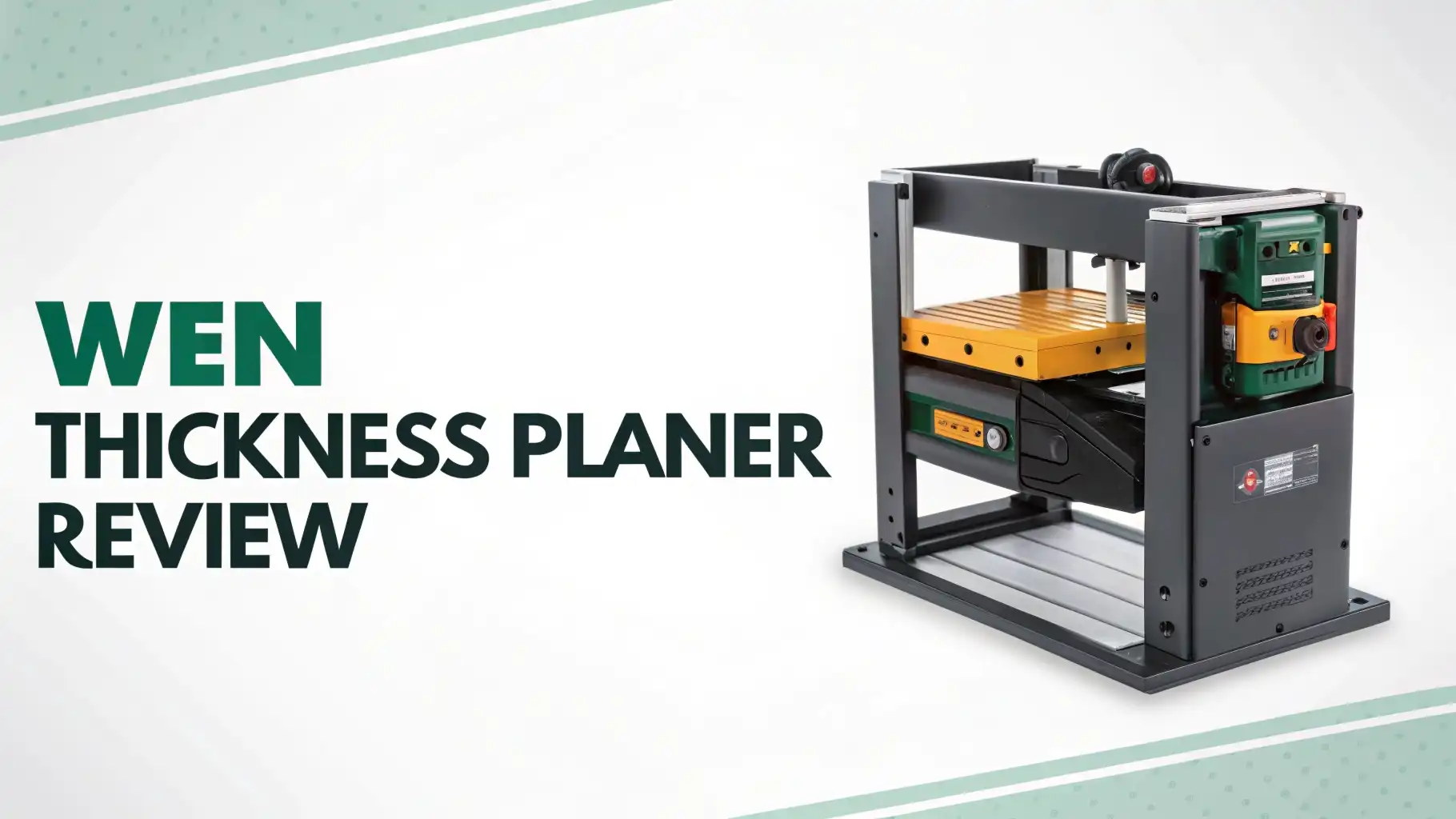
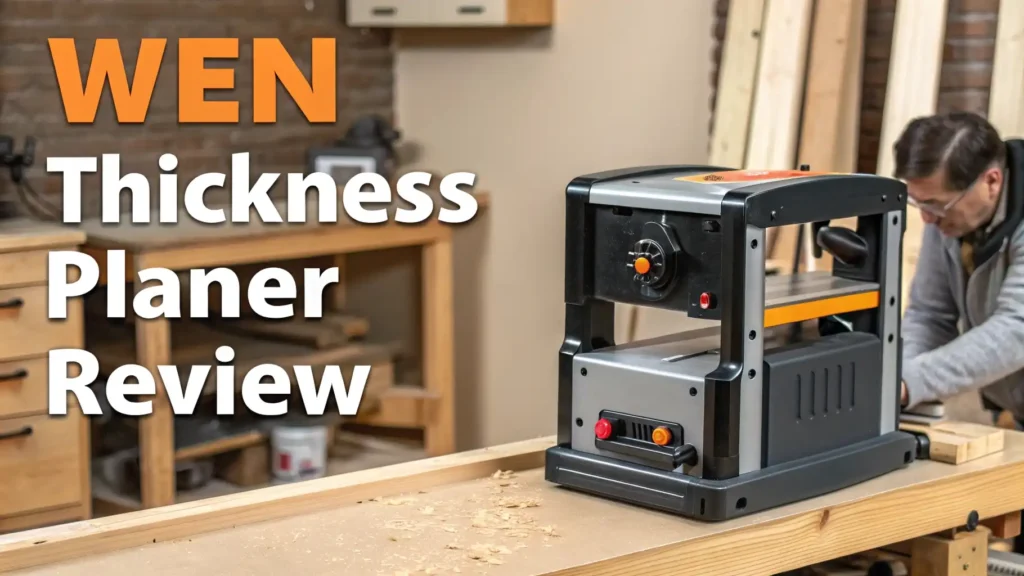
WEN Thickness Planer Review 2026: Is This Worth Every Penny?
You just bought a load of rough lumber and your hand plane is already giving you blisters. Sound familiar? A thickness planer can fix that problem in seconds.
But with so many planers on the market, picking the right one feels like choosing a needle from a haystack. That is where the WEN Thickness Planer steps in to save the day and your wallet.
The WEN PL1326 has been turning heads in the woodworking community for a good reason. It comes loaded with a spiral cutterhead, a powerful 15-amp motor, and a price tag that does not make you cry.
Key Takeaways:
- Powerful and affordable motor: The WEN PL1326 runs on a 15-amp motor capable of delivering over 25,500 cuts per minute. This is seriously impressive for a planer under $450. Most planers at this price point offer far fewer cuts per minute with straight-blade heads.
- Spiral cutterhead is a game changer: The 26 staggered HSS blades on the spiral cutterhead produce a far smoother finish than standard straight-blade systems. This cutterhead reduces tear-out on figured wood and keeps noise lower than traditional designs.
- Wide planing capacity: You can plane boards up to 13 inches wide and 6 inches thick. This covers the vast majority of lumber sizes used in furniture building, cabinetry, and general woodworking projects.
- Easy setup out of the box: The infeed and outfeed tables arrive level and aligned. Most users report they were up and running within 20 to 30 minutes of unboxing. That is a big deal for beginners who do not want to spend hours calibrating.
- Snipe is manageable: Like most benchtop planers, the WEN PL1326 does produce some snipe at the board ends. However, with proper technique such as supporting the board and taking lighter passes, snipe becomes minimal and easy to control.
- Value for money is hard to beat: Compared to the DeWalt DW735X at $639 or the Makita 2012NB at over $1,000, the WEN PL1326 at around $418 offers exceptional performance per dollar. For hobbyists and part-time woodworkers, this planer checks almost every box.

What Is the WEN Thickness Planer?
The WEN PL1326 is a 13-inch benchtop thickness planer made by WEN Products, a brand known for making affordable yet functional power tools for home workshops. This specific model launched as one of WEN’s most popular planers and continues to receive strong reviews from buyers in 2026.
The planer is designed to flatten, smooth, and resize rough or uneven lumber to a consistent and precise thickness. You feed a board in one side, and it comes out the other side at the exact thickness you set. This tool is essential for anyone working with rough-sawn lumber from a sawmill or reclaimed wood from old buildings.
The WEN PL1326 stands out from older WEN models because it uses a spiral cutterhead instead of a straight-blade system. This design change improves finish quality dramatically and makes the planer far more appealing to serious woodworkers who want clean results without sanding for hours afterward.
Key Features of the WEN PL1326 Thickness Planer
The WEN PL1326 comes packed with features that punch well above its price class. Here is what you get:
The 15-amp motor produces over 25,500 cuts per minute at a feed rate of 26 feet per minute. This allows you to process large volumes of wood efficiently without bogging down the motor.
The onboard material removal gauge shows you exactly how much material you are removing with each pass, which helps prevent accidents from taking too much off at once.
The depth stop feature lets you set a specific target thickness and return to it repeatedly across multiple boards. This is a huge time saver when milling multiple boards to the same dimension for a furniture project. The adjustable dust port fits standard 4-inch dust collection hoses, keeping your workspace cleaner during operation.
The planer also includes infeed and outfeed extension tables that add support for longer boards and reduce snipe. A carrying handle built into the top of the unit makes moving it around your shop much easier. At around 80 pounds, you will still want a friend to help lift it, but the handle at least gives you a good grip.
How Does the Spiral Cutterhead Work?
The spiral cutterhead is the star feature of the WEN PL1326, and it is worth explaining exactly why it matters. A traditional straight-blade cutterhead uses two or three long, straight blades that strike the full width of the board simultaneously. This creates a loud impact sound and can cause tear-out on woods with irregular grain patterns.
The WEN spiral cutterhead uses 26 individual HSS blades arranged in a staggered spiral pattern around the cutterhead cylinder. Instead of hitting the full board width at once, each blade only contacts a small portion of the wood. The result is a shearing cut that is quieter, smoother, and far less likely to tear out grain.
Another practical benefit is that each individual blade insert is rotatable and replaceable. When one edge of a blade gets dull, you simply rotate the blade 90 degrees to expose a fresh cutting edge.
Each square blade insert has four usable edges, so you get significantly more cutting life before you need to buy replacement inserts. This saves money over time compared to replacing full-width straight blades on competing models.
Top 3 Alternatives for WEN Thickness Planer


Performance Test: Hard and Soft Wood Results
The WEN PL1326 was tested on a range of wood species to evaluate real-world performance. On soft woods like pine and poplar, the planer produces an exceptionally smooth and clean finish right off the cutterhead. The surface quality is good enough to go straight to finishing without sanding in most cases.
On hard woods like oak and walnut, performance remains strong but requires lighter passes. Taking no more than 1/16 inch per pass on dense hardwoods keeps the motor running smoothly and prevents any bogging. At maximum depth on thick oak, the motor shows some strain, but it does not stall or trip the breaker under normal use.
The finish quality on figured and curly wood is where the spiral cutterhead truly earns its place. Straight-blade planers frequently tear out the wavy grain in figured maple or curly cherry. The WEN spiral head handles these materials with noticeably less tear-out, producing a cleaner surface that requires far less cleanup work.
Feed rate at 26 feet per minute means you can process lumber quickly during large projects. Overall, the performance sits well above what you would expect for the price.
Setup and Assembly: How Easy Is It?
One of the best parts of the WEN PL1326 experience is how simple the setup process is. The unit arrives with infeed and outfeed tables already attached, and most users report the tables are level and aligned straight out of the box. You do not need to spend an afternoon calibrating before you make your first cut.
The depth adjustment handle moves smoothly and the indicator scale is easy to read. Setting the cutting depth takes only a few seconds. Attaching a dust collection hose to the 4-inch port requires no tools and connects in seconds.
The full setup from unboxing to first cut takes roughly 20 to 30 minutes for a first-time user. Experienced woodworkers can likely have it running in 10 to 15 minutes.
WEN includes a detailed manual that walks you through every step clearly. If you prefer watching over reading, there are several helpful video tutorials available online that cover the WEN PL1326 setup in detail.
Dust Collection: Does It Keep Your Shop Clean?
Dust collection is a critical part of any planer experience, and the WEN PL1326 does a decent job here. The adjustable 4-inch dust port directs chips and dust away from the cutting area toward your dust collector or shop vac. When connected to a proper dust collector, the shop stays relatively clean during operation.
However, a few users have noted that the dust collection design is not perfect. Fine dust can sometimes escape around the port connection, and the internal chip deflector does not direct 100 percent of debris into the collection port.
Running the planer without any dust collection system results in a significant mess, so hooking it up to at least a shop vac is strongly recommended.
The good news is that the dust port documentation is clear and the port itself fits standard dust collection fittings. Using a 4-inch hose with a quality shop vac keeps the majority of debris under control. Overall, dust collection on the WEN PL1326 is adequate for a home workshop setting, though it is not as refined as on premium-priced planers.
Noise Level and Vibration
Thickness planers are never quiet tools, and the WEN PL1326 is no exception. However, the spiral cutterhead design does reduce noise compared to straight-blade alternatives.
Traditional straight-blade planers can hit 100 decibels or more, which is genuinely harmful to hearing over time. The staggered blade contact pattern on the WEN spiral head reduces peak impact noise noticeably.
In practical use, the WEN PL1326 runs at a noise level comparable to other quality benchtop planers in its class. Hearing protection is still strongly recommended during any extended planing session.
The vibration level during operation is moderate and the unit stays stable on a solid workbench without walking or moving excessively.
The motor produces a steady and consistent hum under normal load. On heavier cuts in dense hardwood, the pitch of the motor changes slightly, which gives you a helpful audio cue to slow down or reduce the cutting depth. This kind of feedback is genuinely useful for protecting both your wood and the machine.
WEN Thickness Planer Pros and Cons
Pros:
Spiral cutterhead delivers a smoother finish and quieter operation than most straight-blade competitors at this price. The 15-amp motor handles a wide range of wood species without constant bogging.
The onboard depth gauge is accurate and easy to use. Setup is fast and beginner-friendly. Individual blade inserts are rotatable for extended cutting life. The value for money is genuinely outstanding.
Cons:
Snipe at board ends requires some technique to minimize. Dust collection is effective but not perfect, and fine dust can escape even with a hose attached. The unit weighs around 80 pounds, which makes moving it around your shop a two-person job.
Storage can be slightly tricky because the outfeed table and dust port can interfere with each other. At maximum cutting depth on hard woods, the motor works noticeably harder.
Who Should Buy the WEN Thickness Planer?
The WEN PL1326 is the ideal choice for hobbyist woodworkers, beginners, and part-time woodworkers who want professional-level results without spending professional-level money. If you are building furniture in a home garage, flattening rough lumber for projects, or dimensioning wood for cabinetry, this planer handles those tasks with ease.
Intermediate woodworkers who already own a jointer and are looking for a capable benchtop planer at a fair price will find this model satisfying. The spiral cutterhead quality alone justifies the purchase price for anyone who regularly works with figured or difficult-grained wood.
Heavy production woodworkers who run a planer for several hours every day may want to consider the DeWalt DW735X for its greater durability under continuous use. But for the vast majority of home workshop users who plane lumber a few times per week, the WEN PL1326 delivers excellent results at a fraction of the cost of premium alternatives.
WEN Thickness Planer vs. DeWalt DW735X: Quick Comparison
The most common comparison shoppers make is between the WEN PL1326 and the DeWalt DW735X. Both are 13-inch planers with 15-amp motors, but they differ in meaningful ways.
The DeWalt DW735X uses three straight knives and offers two-speed operation, giving you better control over finish quality versus cutting speed. It is also significantly heavier at 92 pounds and costs around $639 compared to $418 for the WEN. The DeWalt has a longer track record of reliability under heavy professional use.
The WEN PL1326 wins on cutterhead design. The spiral head on the WEN outperforms the DeWalt’s straight knives on finish quality and tear-out reduction. For pure surface smoothness, many woodworkers actually prefer the WEN.
If budget is your priority and finish quality matters most, the WEN is the smarter buy. If durability under heavy daily use is your priority and budget is less of a concern, the DeWalt is worth the premium.
Maintenance and Blade Replacement Tips
Keeping the WEN PL1326 running well is straightforward. The most important maintenance task is keeping the tables clean and wax-coated. Apply paste wax to the infeed and outfeed tables every few months to help wood slide smoothly and prevent rust from developing.
When blades start to dull, you have two options with the spiral cutterhead. First, rotate each individual blade insert 90 degrees to expose a fresh cutting edge.
Each insert has four usable edges, so you can get four times the cutting life before replacement is needed. Second, when all four edges are dull, replace the individual inserts rather than the entire cutterhead assembly. Replacement inserts are widely available and inexpensive.
Clean the chip deflector and dust port regularly to prevent blockages that reduce dust collection efficiency. Check the roller feed system periodically for debris buildup and wipe it down with a dry cloth.
Lubricating the elevation screws with machine oil twice a year keeps the depth adjustment operating smoothly. These simple steps keep your WEN planer performing at its best for years.
Final Verdict: Is the WEN Thickness Planer Worth It?
After thorough testing and research, the answer is a clear yes. The WEN PL1326 15-Amp 13-Inch Spiral Benchtop Thickness Planer delivers impressive performance at a price that is hard to argue with. The spiral cutterhead genuinely sets it apart from other budget planers and produces results that rival machines costing twice as much.
It is not perfect. Dust collection could be better, snipe requires technique to manage, and it is heavy. But these are minor complaints for a tool in this price range. For hobbyists and home woodworkers, this planer represents one of the best value purchases in the benchtop planer category in 2026.
Frequently Asked Questions
What size boards can the WEN PL1326 handle?
The WEN PL1326 planes boards up to 13 inches wide and 6 inches thick. This covers the dimensions used in most furniture and cabinetry projects. Boards narrower than 6 inches wide must be planed in pairs to prevent the rollers from tipping. Always check your board dimensions before feeding them through.
Does the WEN thickness planer cause a lot of snipe?
Snipe is present on the WEN PL1326, as it is on virtually all benchtop planers. You can reduce snipe significantly by supporting the board fully through the entire pass, taking lighter cuts of no more than 1/16 inch, and slightly lifting the trailing end of the board as it exits. Leaving extra length on boards and trimming the ends after planing is another reliable method.
How often do the blades need replacing?
Because the spiral cutterhead has rotatable blade inserts, each individual blade has four usable cutting edges. You rotate a blade when it dulls instead of replacing it immediately. Under typical hobby use, you may go a year or more before needing to replace inserts. Heavy daily use will require more frequent rotation and replacement.
Is the WEN PL1326 good for beginners?
Yes, the WEN PL1326 is a great choice for beginners. Setup takes under 30 minutes, the controls are straightforward, and the spiral cutterhead reduces the risk of major tear-out mistakes on tricky wood. WEN also provides solid customer support and a two-year warranty, which gives new users peace of mind.
Can I connect the WEN planer to a shop vac for dust collection?
Yes. The WEN PL1326 has a 4-inch adjustable dust port that connects directly to standard shop vac or dust collector hoses. Using a shop vac is strongly recommended during any planing session. Running the planer without dust collection creates a significant chip and dust mess in your workspace.
How does the WEN PL1326 compare to the WEN PL1337?
The WEN PL1337 is a newer and more advanced model that adds two-speed operation to the spiral cutterhead design. The PL1337 costs around $540 compared to $418 for the PL1326. The two-speed feature gives you more control over finish quality, especially on delicate or figured woods. If budget allows, the PL1337 is a worthwhile upgrade. But the PL1326 remains the better value for most home woodworkers.