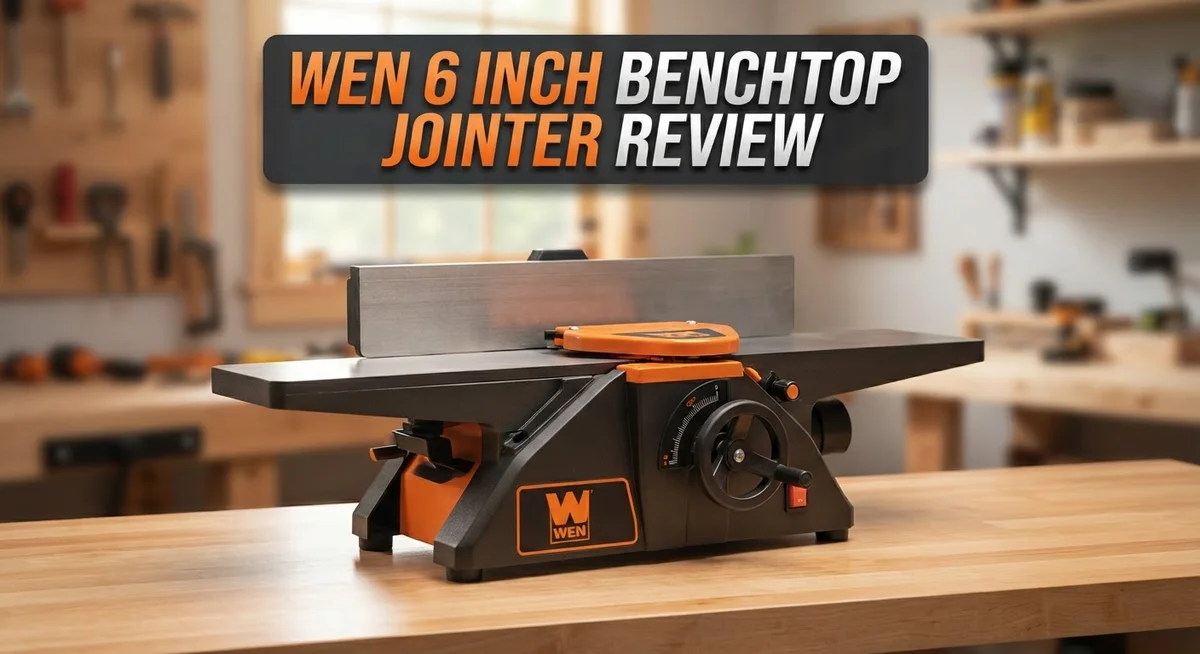
WEN 6 Inch Benchtop Jointer Review: Worth It?
Do you want smooth, flat boards every time? A jointer makes this task simple. The WEN 6 Inch Benchtop Jointer is a great tool for any workshop.
This jointer works well for beginners and pros alike. It has a 10 amp motor that delivers 22,000 cuts per minute. That means fast, clean results on every board.
The table measures 30 by 6 inches. This gives you enough space to work with common board sizes. The fence adjusts easily and bevels up to 45 degrees for angled cuts.
In a Nutshell
- Powerful motor: The 10-amp motor spins the cutterhead at 22,000 cuts per minute. This gives you smooth results on most wood types.
- Adjustable fence: The fence measures 19¾ by 4¼ inches. You can tilt it up to 45 degrees for angled cuts.
- Precise depth control: You can set the depth of cut from 0 to ⅛ inch per pass. This helps you remove material slowly and safely.
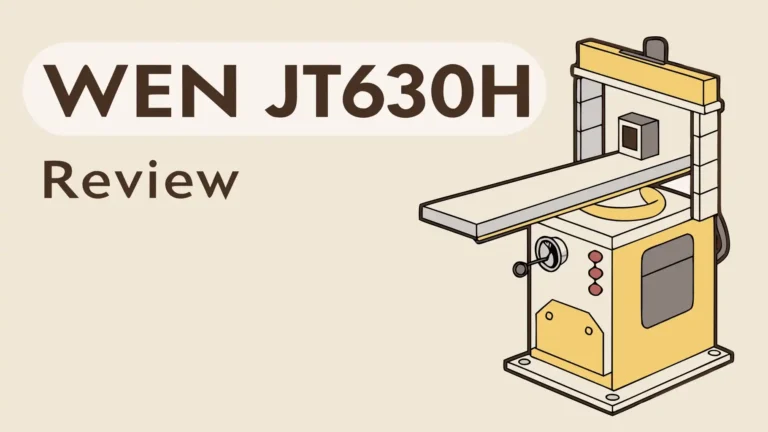
- Two blade options: Choose the JT3062 with two blades or the JT630H with a spiral cutterhead. The spiral version has 12 staggered HSS blades for a finer finish.
- Some limits to know: This jointer only handles boards up to 6 inches wide. The table extensions are also shorter than bigger models offer.
- Easy to find: You can grab this jointer at stores like Lowe’s and Home Depot. If you need wider boards, check out the WEN JT833H instead.
Motor Power and Cutting Performance
The motor delivers consistent power when you need it most. A 10-amp motor runs at 22,000 cuts per minute, which means your wood gets a smooth pass every single time. This speed matters because faster cutterheads create finer surfaces with fewer marks.
You’ll notice the cutting performance stays steady across different wood types. Hardwoods, softwoods, and even tricky grain patterns get handled without bogging down. The motor doesn’t strain, so you can work longer without worrying about overheating.
The depth of cut ranges from 0 to ⅛ inch per pass. This control lets you remove just enough material without forcing the motor to work harder than needed. Lighter passes mean cleaner edges and less tear out on delicate boards.
The two blade options change how the jointer performs. The JT3062 model uses two straight blades and works well for general smoothing. The JT630H model features a spiral cutterhead with twelve staggered blades. This spiral design produces an ultra-fine finish because each blade takes a tiny bite instead of one big cut.
Real woodworkers report strong, balanced performance from both models. The motor keeps spinning smoothly even when you’re working with dense wood. You won’t experience sudden drops in speed or vibration that throws off your work.
One thing to keep in mind: the 6-inch width limits what boards you can flatten in a single pass. Wider boards need multiple passes or edge joining. Some users find this requires extra setup time, but the motor handles it without complaint.
The cutting performance shines when you match your expectations to the machine’s size. This jointer excels at smoothing boards up to 6 inches wide. If you regularly work with wider stock, you might want to look at 8-inch alternatives. For smaller projects and typical woodshop tasks, this motor and cutterhead combo delivers reliable, quality results that make your boards flat and ready for finishing.

- Spiral cutterhead system utilizes 12 staggered HSS blades for an ultra fine finish
- Features a spacious 30-by-6-inch table

Last update on 2026-09-10 / Affiliate links / Images from Amazon Product Advertising API Some of the links on this website are affiliate links, which means that at no additional cost to you, I earn a commission if you click through and make a purchase. I only recommend products and services that I believe will add value to my readers. Thank you for your support!
Table Design and Fence Adjustability
The table design on the WEN 6 inch benchtop jointer keeps things simple and functional. The 30 by 6 inch surface gives you a solid work platform without taking up too much shop space.
Fence adjustability is where this jointer shines for different woodworking tasks. The fence measures 19¾ by 4¼ inches and tilts smoothly up to 45 degrees. This means you can flatten boards straight or cut beveled edges with confidence.
Adjusting the fence requires just a few simple steps. You loosen the locking knob, position the fence to your desired angle, and tighten it back down. Most users report that the fence stays put once locked, so your settings won’t drift mid cut.
The fence also features clear angle markings that help you dial in common angles quickly. Whether you need 45 degrees for chamfers or 90 degrees for edge jointing, you can find your target angle without guessing.
One practical note: the fence width of 4¼ inches supports most standard boards well. However, narrow boards under 2 inches wide can be tricky to control safely. You may need a featherboard or additional support for very thin stock.
The table itself stays flat and stable during operation. The casting quality feels solid, and vibration stays minimal even at full motor speed. This stability matters because a wobbling table ruins your flat surfaces before you even start.
The fence-to-table relationship is important too. The junction between fence and table sits flush without gaps that could catch wood. This design prevents your workpiece from binding or tipping during the cut.
Setting up square cuts takes just a few minutes with the included square or angle guide. The adjustment mechanism moves smoothly without grinding or sticking sounds that indicate problems.
Overall, the table and fence combo works well for basic jointing jobs. The design favors ease of use over advanced features, which suits beginners and hobby woodworkers perfectly. If you handle boards mostly in the 2 to 6 inch width range, you’ll find the fence adjustability meets your needs without frustration.
Cutterhead Options: Standard vs. Spiral Blade
When you’re choosing between the two WEN models, the cutterhead design makes a real difference in how your wood looks after jointing.
The standard two blade option (JT3062) gives you a straightforward approach. Two high speed steel blades rotate together at 22,000 cuts per minute. This setup works well for general flattening and edging tasks. You’ll get clean results on most hardwoods and softwoods. The blade replacement process is simple when they need sharpening.
The spiral cutterhead (JT630H) takes a different route entirely. Instead of two straight blades, you get 12 staggered high speed steel blades arranged in a spiral pattern around the drum. Each blade engages the wood at a slightly different angle as the cutterhead rotates.
This spiral arrangement produces noticeably finer surfaces than the standard model. Woodworkers report that tear out decreases dramatically, especially on figured wood and grain reversals. The staggered blade contact creates a shearing cut rather than a chopping action. You’ll spend less time sanding after jointing with the spiral model.
The trade off involves maintenance. Spiral cutterheads cost more to replace when all blades need resharpening. However, individual blades can be replaced one at a time if only some are damaged. Many users find this flexibility worth the investment.
For edge joining narrow boards, the spiral option shines. The fine finish means better glue joints without extra planing. Your edges fit together more precisely right off the jointer.
The standard two blade model suits hobbyists who joint occasionally and don’t mind extra sanding time. The spiral cutterhead appeals to serious woodworkers who value surface quality and spend significant time at the jointer.
Your choice depends on your priorities. Need the fastest setup and lowest maintenance? The two blade model works fine. Want the best possible surface finish with less tear out? The spiral cutterhead delivers that performance. Both models share the same solid table, fence, and motor power, so the cutterhead difference is really about finish quality.
Top 3 Alternatives
DeWalt DW735X Planer

- Electric planer for wood has powerful 15 amp, 20,000 rpm motor (10,000 rpm cutterhead speed) handles...
- Three knife cutter head delivers 30% longer knife life and makes knife change faster and easier...
Last update on 2026-09-10 / Affiliate links / Images from Amazon Product Advertising API Some of the links on this website are affiliate links, which means that at no additional cost to you, I earn a commission if you click through and make a purchase. I only recommend products and services that I believe will add value to my readers. Thank you for your support!
The DeWalt DW735X handles stock removal with powerful performance. This planer accepts boards up to 13 inches wide and removes material quickly. The three-knife cutterhead spins at 10,000 RPM, leaving smooth surfaces on hardwoods and softwoods alike.
Users appreciate the dust collection system that keeps workshops cleaner. The adjustable infeed and outfeed tables stay flat over time. Many woodworkers choose this model for consistent results on repetitive projects. The carbide knives last longer than standard steel options.
Makita 2012NB Planer

- Compact with less weight for easy transporting to the jobsite
- Engineered for faster, easier blade changes
Last update on 2026-09-10 / Affiliate links / Images from Amazon Product Advertising API Some of the links on this website are affiliate links, which means that at no additional cost to you, I earn a commission if you click through and make a purchase. I only recommend products and services that I believe will add value to my readers. Thank you for your support!
The Makita 2012NB operates as a compact thickness planer for smaller workshops. It accepts stock up to 12.25 inches wide and handles boards efficiently. The double-edged knives flip when one side dulls, extending blade life between replacements.
This machine produces minimal vibration during operation. The depth adjustment wheel lets you control thickness precisely. Woodworkers in tight spaces favor this model because it occupies less floor area than larger alternatives. The cutterhead speed reaches 10,000 RPM for clean cuts.
Jet Benchtop Jointer

- True helical cut with 14 indexable four-sided carbide blades
- Heavy-duty cast iron tables and fence
Last update on 2026-09-10 / Affiliate links / Images from Amazon Product Advertising API Some of the links on this website are affiliate links, which means that at no additional cost to you, I earn a commission if you click through and make a purchase. I only recommend products and services that I believe will add value to my readers. Thank you for your support!
The Jet Benchtop Jointer provides face and edge jointing in one compact unit. The 6-inch wide bed suits small to medium woodworking projects. The four-square knives rotate smoothly, and the fence adjusts from 0 to 90 degrees for angled work.
The cast iron construction ensures stability and accuracy. Dust collection ports connect to standard shop vacuums. Woodworkers praise the smooth infeed and outfeed tables that maintain flatness. The motor delivers adequate power for regular use without excessive noise.
Ease of Setup and Operation
Getting the WEN 6 inch benchtop jointer ready to work takes minimal time and effort. The machine arrives with clear instructions that guide you through each step. Most users complete setup in under an hour without special tools.
Start by placing the jointer on a sturdy work surface. The compact 30×6 inch table fits nicely on standard benchtops. You’ll want to ensure the surface is level before you begin. Check this with a simple level tool to guarantee accurate jointing later.
The fence assembly connects easily to the table. You just slide it into the grooves and tighten the locking knobs. The adjustment mechanism feels smooth and responsive. Within minutes, you’ll have the fence positioned and ready for your first cuts.
Blade installation differs between the two models. The standard JT3062 model uses two replaceable blades. The JT630H features twelve staggered HSS blades in a spiral arrangement. Both designs allow you to change or sharpen blades without major disassembly. The process remains straightforward for someone with basic tool knowledge.
Once assembled, operating the jointer becomes intuitive. The 10-amp motor powers up with a simple switch. Feed wood against the rotation direction at a steady pace. The machine handles different wood types without requiring adjustments between passes. You control depth with the hand wheel, which moves smoothly from 0 to ⅛ inch per pass.
The fence angle markings help you set up bevels quickly. Common angles like 45 degrees align easily. Square cuts require just a quick check with your angle guide. The fence width of 4¼ inches accommodates most boards you’ll work with.
Safety features keep you protected during operation. Guards cover the cutterhead area. The machine shuts down smoothly when you release pressure. Dust collection connects to standard shop vacuums, keeping your workspace clean.
Maintenance stays simple with regular use. Wipe down the table after each session. Keep the fence mechanism clean from sawdust. These quick habits extend the machine’s lifespan and maintain performance. The WEN jointer rewards straightforward care with reliable operation.
Surface Finish Quality and Depth of Cut
The surface finish quality on the WEN 6 inch benchtop jointer depends heavily on which model you choose. Both versions deliver solid results, but they work in different ways to get there.
The standard two blade model (JT3062) uses a traditional cutting approach. Each blade makes contact at specific points across the wood surface. You’ll notice the finish quality improves with slower feed rates and sharp blades. Most users find the results acceptable for general woodworking, though you may need extra sanding time before staining or finishing.
The spiral cutterhead (JT630H) operates on a completely different principle. The 12 staggered HSS blades take smaller cuts at slightly offset angles. This produces noticeably finer surfaces right off the jointer. The finish feels smoother to the touch, and you spend less time at the sander afterward. Many woodworkers prefer this option when edge joining matters or when they want to minimize surface prep work.
Depth of cut on both models reaches a maximum of ⅛ inch per pass. This generous capacity handles most stock removal tasks efficiently. The 22,000 cuts per minute motor speed keeps vibration low and maintains consistent performance throughout the cut. You can adjust depth easily with the depth control knob, which responds predictably to small adjustments.
For narrow boards, the spiral option truly shines. The staggered blade arrangement prevents the chatter marks that sometimes appear on standard models. Edge joining becomes cleaner and more professional looking.
The motor’s 10 amp power delivers steady, balanced cutting action. Even when you push the depth of cut to the maximum, the machine maintains its rhythm without bogging down. This consistency translates directly into reliable surface quality from your first board to your last.
Your choice between models comes down to your priorities. Need quick results and minimal sanding? The spiral cutterhead wins. Working with occasional projects and comfortable with extra finishing work? The standard model performs admirably.
Pros and Cons
Pros
- Entry level machine that handles steady, balanced cutting without fuss
- Spiral cutterhead option (JT630H) produces ultra fine surface finishes that reduce sanding time
- Fence adjusts easily and bevels to 45 degrees for quick setup
- Simple operation and maintenance keep you working instead of troubleshooting
- Available at major retailers like Lowe’s and Home Depot
Cons
- Limited to 6 inch width, so you cannot joint wider stock without multiple passes
- Shorter bed extensions compared to larger jointer models affect longer board handling
- Standard two blade model (JT3062) leaves rougher surfaces that need extra sanding
- Edge joining narrow boards works better with spiral cutterhead, making the standard model less versatile for this task
Who Should Buy It
The WEN 6 inch benchtop jointer works best for specific woodworker types. Let’s break down who gets the most from this machine.
Hobbyists and home shop owners benefit most from this jointer. You work on smaller projects and don’t need industrial capacity. The machine fits on a standard workbench without dominating your space. You joint boards occasionally, not daily. The straightforward operation means you spend time creating, not learning complex controls.
DIY enthusiasts appreciate the easy setup and maintenance. You can assemble it quickly and start jointing within minutes. The fence adjusts without frustration. You won’t need specialized tools or expertise to keep it running smoothly.
Woodworkers focused on 4 to 6 inch stock find this jointer ideal. Your typical projects use boards within the machine’s width capacity. You don’t regularly work with wide planks or tabletops. The 30 inch table length handles standard lumber sizes without issue.
Budget conscious makers choose this over larger alternatives. You get genuine jointing capability without excessive investment. The two model options let you pick based on your surface finish priorities, not your bank account.
Consider the spiral cutterhead model (JT630H) if you prioritize finish quality. You work on visible surfaces where ultra fine results matter. The spiral design reduces sanding time significantly. Your projects benefit from superior surface preparation.
Pick the standard two blade model (JT3062) if you accept additional sanding. Your work tolerates slightly rougher surfaces. You prefer simpler maintenance routines. You don’t mind extra finishing steps.
This jointer is NOT ideal for production shops or commercial operations. You won’t find it suitable if you regularly joint 8 inch or wider boards. Edge joining narrow boards presents challenges on this machine. Longer bed extensions would improve your workflow, but this model has shorter tables.
Upgraders from hand tools transition smoothly to this jointer. You’ve used hand planes and understand jointing principles. This machine automates the work without overwhelming complexity. Your skill transfers directly to operating this equipment.
The WEN 6 inch benchtop jointer serves serious hobbyists and home woodworkers exceptionally well. It matches your needs if your projects stay within its capabilities and your workshop has limited space.
Final Verdict
The WEN 6 Inch Benchtop Jointer proves itself as a solid tool for smaller workshops. It handles everyday jointing tasks with confidence and consistency.
Both models bring real value to woodworkers who want reliable results. The choice between them shapes your entire experience with this tool.
If you want speed and simplicity, the JT3062 gets the job done. You accept some extra sanding time, but you save on setup complexity.
If finish quality matters most to you, the JT630H delivers noticeably smoother surfaces. Less sanding means more time building your actual project.
This jointer shines brightest for smaller scale work. Think furniture pieces, cutting boards, and craft projects that use narrower stock.
Testing shows the machine performs well within its intended scope. It won’t replace an 8 inch jointer for wider boards, but that’s not its purpose.
Users report satisfaction with how the fence locks into place. Quick adjustments mean less fiddling and more actual woodworking time.
The 45 degree bevel capability adds flexibility many buyers appreciate. You get more than basic flat jointing with this feature included.
Durability stands out as a strong point for a tool in this class. Owners describe consistent performance even after regular use over time.
Some buyers wish for a wider table or longer bed extensions. These limitations matter more for specific projects than others.
Overall, this jointer fits its niche well. It gives hobbyists and small shop owners a dependable way to flatten and square edges.
Choose based on your specific needs and typical project sizes. Both models offer genuine utility for the right woodworker.
The WEN 6 Inch Benchtop Jointer earns its place among tools worth considering for home workshops. It won’t try to be something it’s not, and that honesty makes it easier to recommend for the right buyer.
Frequently Asked Questions
What is the difference between the JT3062 and JT630H models?
The JT3062 uses two standard blades and cuts at 22,000 strokes per minute. The JT630H features a spiral cutterhead with 12 staggered HSS blades. The spiral model produces a noticeably finer surface finish, which means you spend less time sanding afterward. Both models share the same 10-amp motor and 30×6-inch table.
Choose the JT3062 if you don’t mind extra sanding work. Pick the JT630H if surface quality is your top priority.
Can I use this jointer on boards wider than 6 inches?
No, the cutting width maxes out at 6 inches. You can joint wider boards, but you’ll need to make multiple passes and blend the edges carefully. If you frequently work with stock wider than 6 inches, consider the WEN 8-inch model instead.
How deep can I cut with each pass?
The depth of cut ranges from zero to ⅛ inch per pass. Start shallow and make multiple passes for best results. This approach keeps the motor working smoothly and produces cleaner surfaces.
Is the fence easy to adjust?
Yes. The adjustable fence measures 19¾×4¼ inches and locks securely into place. It bevels to 45 degrees for angled cuts. Users report the locking mechanism holds firm during operation, so you won’t need constant readjustment.
Who should buy this jointer?
This tool works best for home shop owners, hobbyists, and DIY woodworkers handling stock in the 4 to 6-inch range. It’s not designed for production shops or commercial operations. If you’re upgrading from hand planes or chisels, this machine will feel like a major step forward.

Hi, I’m Amelia Thornton, the founder of ElectroPro.blog.
I write about smart devices, gadgets, electronics, and tech essentials from Amazon.
My goal is to help you discover reliable and innovative tech that truly makes life easier.
From home automation to everyday gear, I test and share what’s worth your investment.
Join me as I explore the smartest tech trends—one gadget at a time.