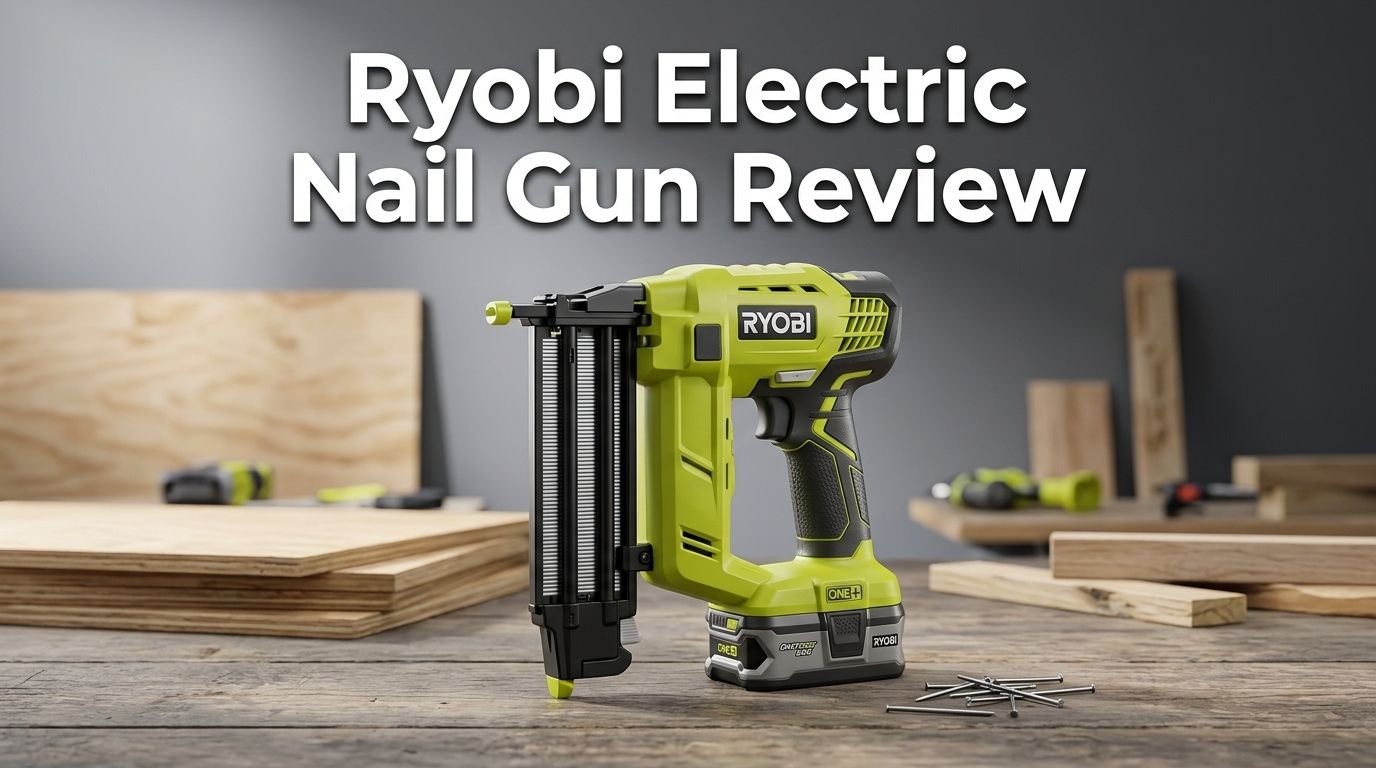
Ryobi Electric Nail Gun Review 2026: Worth Your Money?
Are you thinking about buying a Ryobi electric nail gun but not sure which model fits your needs? You are not alone.
Thousands of DIY enthusiasts and weekend warriors face this same question every year. Ryobi has built a strong reputation for affordable, battery powered tools. Their cordless nail gun lineup is no exception.
In this detailed review, we break down the most popular Ryobi electric nail guns available right now. We cover performance, build quality, battery life, ease of use, and value for money.
Key Takeaways
- Ryobi electric nail guns use AirStrike Technology, which removes the need for a compressor, hose, or gas cartridge. This makes them extremely portable and easy to set up for quick jobs around the house.
- The Ryobi P321 (18GA Brad Nailer) is the most popular model and costs around $139. It drives 18 gauge brad nails from 5/8 inch to 2 inches and holds up to 105 nails in the magazine. It works well for light to medium duty tasks.
- The Ryobi P322 (HP Brushless Brad Nailer) offers 60% more power than the P321 and can fire up to 2,250 nails per charge. It costs about $189 but delivers better consistency and longer run time thanks to its brushless motor.
- The Ryobi P326 (16GA Finish Nailer) handles heavier trim jobs like baseboards, crown molding, and casing. It fires 16 gauge nails from 3/4 inch to 2 1/2 inches and features a 78% smaller nose for tight spot access.
- All Ryobi nail guns run on the ONE+ 18V battery platform, which is compatible with over 300 Ryobi tools. If you already own Ryobi batteries, you save money by buying the tool only version.
- Common complaints include occasional jamming and the need to reset the battery after the warning light blinks. These issues affect a small percentage of users but are worth knowing about before you buy.

- Stens replacement parts have become a favorite among lawn and landscape professionals thanks to...
Last update on 2026-10-26 / Affiliate links / Images from Amazon Product Advertising API Some of the links on this website are affiliate links, which means that at no additional cost to you, I earn a commission if you click through and make a purchase. I only recommend products and services that I believe will add value to my readers. Thank you for your support!
Ryobi P321 ONE+ 18V AirStrike 18GA Brad Nailer
The Ryobi P321 is the entry level brad nailer in the Ryobi cordless lineup. It uses AirStrike Technology to drive 18 gauge brad nails without a compressor. This tool accepts nails from 5/8 inch to 2 inches in length and holds 105 nails in its magazine.
The P321 weighs about 5.7 pounds with a battery installed. That makes it one of the lightest cordless brad nailers in its class. You can use it for extended periods without arm fatigue. The tool free depth adjustment lets you control how deep each nail sits in your material.
The 45% smaller nose compared to older Ryobi models gives you better line of sight. It also helps you reach tight corners and narrow spaces. An LED work light illuminates your work surface for better accuracy in dim areas.
Users report that this nailer fires up to 1,900 nails per charge with a 4.0 Ah battery. That is plenty for most weekend projects. It earns an average rating of 4.5 stars across major retail sites. Most buyers praise its ease of use and quiet operation.
Ryobi P322 ONE+ HP Brushless AirStrike 18GA Brad Nailer

- (1) P322 RYOBI 18V ONE+ HP Brushless Cordless AirStrike 18-Gauge Brad Nailer
- (2) Non-Marring Pads
Last update on 2026-10-26 / Affiliate links / Images from Amazon Product Advertising API Some of the links on this website are affiliate links, which means that at no additional cost to you, I earn a commission if you click through and make a purchase. I only recommend products and services that I believe will add value to my readers. Thank you for your support!
The Ryobi P322 is the premium version of the brad nailer. It features a brushless motor that delivers 60% more driving power than the standard P321. This extra power means it sinks nails more consistently into harder materials like oak and maple.
This model also fires up to 2,250 nails per charge. That is a significant jump from the P321’s 1,900 nails. The brushless motor runs cooler and lasts longer over the life of the tool. You spend less time swapping batteries during big projects.
The P322 includes an AccuDrive nose for better visibility and nail placement accuracy. It also has a convenient adjustment dial that lets you fine tune the air pressure. A selectable drive switch gives you the option of sequential or contact firing modes.
At around $189 for the tool only, the P322 costs $50 more than the P321. But the improved power, battery life, and build quality justify the price for serious DIY users. Over 86% of buyers on the Ryobi website gave it a perfect 5 star rating.
Ryobi P326 ONE+ 18V 16GA AirStrike Finish Nailer

- Features AirStrike Technology, which eliminates the need for noisy compressors, bulky hoses, or...
- 78% smaller nose provides tight spot access and superior drive quality (compared to the RYOBI P325)
Last update on 2026-10-26 / Affiliate links / Images from Amazon Product Advertising API Some of the links on this website are affiliate links, which means that at no additional cost to you, I earn a commission if you click through and make a purchase. I only recommend products and services that I believe will add value to my readers. Thank you for your support!
The Ryobi P326 steps up from brad nailing to finish nailing. It fires 16 gauge nails from 3/4 inch to 2 1/2 inches. These thicker nails provide stronger holding power for heavier trim pieces like baseboards, crown molding, and door casing.
The P326 features a 78% smaller nose than the previous P325 model. This improvement gives you much better access in tight corners and improved visibility. The tool free jam release latch makes clearing stuck nails fast and simple.
This nailer also includes a dry fire lockout feature. It prevents the tool from firing once the magazine runs empty. This protects your work surface from dents and protects the internal mechanism from damage.
Users report that the P326 sinks nails cleanly in both softwood and hardwood. It has earned strong reviews for trim carpentry and furniture projects. It works with all Ryobi ONE+ 18V batteries and costs around $159 for the tool only version.
Top 3 Alternatives for Ryobi Electric Nail Gun
If you want to explore options beyond Ryobi, these three cordless nail guns offer excellent performance in the same category.
1. DEWALT DCN680B 20V MAX XR 18GA Cordless Brad Nailer

- 100% battery powered. Eliminates the hassle of using gas, compressor, and hose
- Brushless motor maximizes runtime and durability
Last update on 2026-10-26 / Affiliate links / Images from Amazon Product Advertising API Some of the links on this website are affiliate links, which means that at no additional cost to you, I earn a commission if you click through and make a purchase. I only recommend products and services that I believe will add value to my readers. Thank you for your support!
2. Milwaukee 2746-20 M18 FUEL 18GA Cordless Brad Nailer

- INCLUDES: M18 FUEL 18 GAUGE BRAD NAILER - Bare Tool
- Tool free jam clearing latch. Reversible belt hook included. Three interchangeable tips included.
Last update on 2026-08-29 / Affiliate links / Images from Amazon Product Advertising API Some of the links on this website are affiliate links, which means that at no additional cost to you, I earn a commission if you click through and make a purchase. I only recommend products and services that I believe will add value to my readers. Thank you for your support!
3. Metabo HPT NT1850DFQ4 18V MultiVolt Cordless Brad Nailer

- AWARD: Rated the Pro Preferred Nailer for 12 years running (2014 - 2025) by Builder and Developer...
- FASTENERS: Brad Nailer accepts 5/8 In. to 2 In. 18-gauge fasteners
Last update on 2026-10-26 / Affiliate links / Images from Amazon Product Advertising API Some of the links on this website are affiliate links, which means that at no additional cost to you, I earn a commission if you click through and make a purchase. I only recommend products and services that I believe will add value to my readers. Thank you for your support!
AirStrike Technology Explained
Ryobi’s AirStrike Technology is the core feature that sets these nail guns apart from traditional pneumatic models. It uses an internal piston mechanism powered by the 18V battery. There is no compressor, no hose, and no gas cartridge required.
This means you can start nailing within seconds of picking up the tool. Traditional pneumatic nailers need a compressor to build air pressure. That setup takes several minutes and creates a lot of noise. AirStrike removes all of that hassle.
The technology works well for finish carpentry, trim work, and light construction. It delivers consistent driving force across a wide range of nail sizes. The system also produces less noise than a compressor based setup. Your neighbors and your ears will thank you.
AirStrike does have limits. It may not match the raw power of a heavy duty pneumatic framing nailer. But for brad nails and finish nails, it performs at a very high level. Most users find it more than enough for home improvement projects.
Battery Life and Compatibility
All Ryobi electric nail guns use the ONE+ 18V battery platform. This platform supports over 300 tools. If you already own a Ryobi drill, saw, or blower, you can share batteries between all of them.
The P321 fires approximately 1,900 nails with a 4.0 Ah battery. The P322 pushes that number to 2,250 nails per charge. The P326 finish nailer sits in a similar range. These numbers mean you can complete most standard projects without recharging.
Ryobi recommends using the HIGH PERFORMANCE lithium ion batteries for best results with their HP models like the P322. Standard ONE+ batteries still work, but you may notice slightly reduced driving power. The HP batteries provide a steadier current that keeps the motor running at peak performance.
Charging times vary by battery size. A 2.0 Ah battery charges in about 60 minutes. A 4.0 Ah battery takes around 90 minutes. Ryobi also sells fast chargers that cut those times significantly.
Build Quality and Ergonomics
Ryobi nail guns feature a durable plastic and rubber overmold construction. They feel solid in hand without being too heavy. The rubber grip absorbs vibration and prevents slipping during extended use.
The P321 weighs 5.7 pounds with a battery. The P322 is slightly heavier at about 6 pounds due to the brushless motor components. The P326 finish nailer weighs around 6.2 pounds. All three models balance well and feel comfortable during overhead work.
Each model includes a belt clip attachment point. This lets you hang the tool from your belt or tool pouch between uses. It keeps your hands free while you position trim pieces or measure cuts.
The magazine loading system is straightforward. You slide nails into the bottom feed magazine and lock them in place. A clear window on the magazine lets you check your nail count without opening it. This small detail saves time and avoids dry fires during critical moments.
Depth of Drive Adjustment
Every Ryobi electric nail gun includes a tool free depth of drive adjustment. This feature controls how deep each nail sits below the wood surface. You can adjust it without stopping to grab a screwdriver or hex key.
Getting the depth right matters for clean results. Set the nails too shallow and they stick out above the surface. Set them too deep and they may blow through thin material or leave large holes. The adjustment dial lets you find the perfect balance quickly.
The P322 adds a pressure adjustment dial that gives you even more control. You can dial in the exact force needed for different materials and nail lengths. This is especially useful when switching between soft pine and hard oak in the same project.
Testing shows the depth adjustment holds its setting consistently across hundreds of nails. You do not need to readjust mid project unless you change materials. This reliability saves time and reduces wasted nails.
Jam Clearing and Maintenance
Nail jams happen with any nail gun. Ryobi addresses this with a tool free jam release latch on all current models. You flip the latch, open the nose, remove the jammed nail, and get back to work in under 30 seconds.
Users report that jams are infrequent with genuine Ryobi brand nails. Cheaper, third party brad nails can cause more frequent jams. Ryobi recommends using 18 gauge nails that meet their specifications for length and material quality.
Basic maintenance is simple. Keep the magazine clean and free from sawdust. Apply a drop of pneumatic tool oil to the driver blade every few hundred nails. Store the tool in a dry location with the battery removed.
Some users mention the warning light blinking issue. This typically means the tool needs a battery reset. Remove the battery, wait a few seconds, and reinsert it. This fix resolves the issue in most cases. If the problem persists, Ryobi’s 3 year warranty covers repairs.
Performance on Different Materials
The Ryobi P321 and P322 brad nailers perform best on softwoods like pine, cedar, and poplar. They sink 2 inch brad nails flush with minimal effort. Crown molding, chair rail, and window casing all respond well to these tools.
Hardwoods like oak and maple require more force. The P321 handles them at shorter nail lengths but may struggle with 2 inch nails in dense hardwood. The P322 brushless model performs much better here. Its extra 60% driving power pushes nails deeper into hard grain.
The P326 finish nailer excels on thicker trim stock. Its 16 gauge nails have more holding power than 18 gauge brads. This makes it the better choice for baseboards, door frames, and heavy crown molding.
MDF and engineered trim products work well with all three models. The softer composition of MDF means nails sink easily. Just reduce your depth setting to avoid blowing through the material.
Ryobi Nail Gun vs Pneumatic Nailers
A common question is whether a Ryobi cordless nail gun can replace a pneumatic nailer. The answer depends on your use case. For home improvement and DIY projects, the Ryobi cordless models match pneumatic tools in most situations.
Pneumatic nailers deliver more consistent raw force because they run on steady compressed air. They also fire faster in rapid succession. Professional trim carpenters who install molding all day may prefer the pneumatic option.
However, cordless Ryobi nail guns win on convenience. No compressor to haul around. No hoses to trip over. No loud motor running in the background. You grab the tool, insert a battery, and start working. Setup time drops from minutes to seconds.
For most homeowners and weekend DIYers, the Ryobi cordless option is the better value. A compressor alone can cost $150 to $300. Add in hoses, fittings, and oil, and your total investment grows fast. A Ryobi nail gun with a battery kit stays under $250.
Who Should Buy a Ryobi Electric Nail Gun
DIY homeowners benefit the most from Ryobi electric nail guns. If you install trim, build shelves, or do light carpentry once or twice a month, these tools deliver excellent results. They are easy to learn and forgiving for beginners.
Apartment dwellers and noise sensitive users also appreciate the quiet operation. AirStrike Technology produces far less noise than a compressor. You can work on projects without disturbing neighbors or family members in the next room.
Ryobi ONE+ ecosystem owners get the most value. You already have the batteries. Buying a tool only nail gun saves $50 to $80 compared to a kit. Your existing chargers and batteries work perfectly with any new addition.
Professional contractors may want to look elsewhere. While Ryobi nail guns perform well, heavy daily use may reveal their limits. Pros who need maximum power and all day durability often prefer DeWalt, Milwaukee, or Metabo HPT options.
Pricing and Value for Money
The Ryobi P321 starts at around $139 for the tool only version. A kit with a 4.0 Ah battery and charger costs about $229. This places it among the most affordable cordless brad nailers on the market.
The Ryobi P322 runs about $189 tool only. The kit version with a HIGH PERFORMANCE battery costs approximately $259. The brushless motor and improved performance justify the extra cost for frequent users.
The Ryobi P326 finish nailer sells for around $159 tool only. This is an outstanding price for a 16 gauge cordless finish nailer. Competing brands charge $250 or more for similar tools.
Compared to DeWalt and Milwaukee, Ryobi offers 40% to 50% lower prices on average. You sacrifice some raw power and durability, but the savings are significant. For casual to moderate use, Ryobi delivers the best value in the cordless nail gun market.
Pros and Cons of Ryobi Electric Nail Guns
The biggest strengths of Ryobi electric nail guns include their affordable price, lightweight design, and AirStrike Technology. They eliminate the need for a compressor. The ONE+ battery system adds huge value if you own other Ryobi tools.
Build quality is solid for the price range. The tool free jam clearing, depth adjustment, and LED work lights are thoughtful features. Battery life is strong enough for most projects without mid job recharging.
On the downside, some users experience occasional jams. The blinking warning light issue requires battery resets. The P321 model may lack power for long nails in dense hardwood. These are minor issues that do not affect most users.
The P322 brushless model addresses many of these concerns. Its extra power and efficiency make it the better long term investment. If you can spend the extra $50, the P322 offers a noticeably better experience over the P321.
Final Verdict on Ryobi Electric Nail Guns in 2026
Ryobi electric nail guns remain a top choice for DIY enthusiasts and budget conscious buyers in 2026. The P321 brad nailer is perfect for basic trim work and light projects. The P322 delivers premium performance at a mid range price. The P326 finish nailer handles heavier jobs with ease.
If you already own Ryobi ONE+ 18V batteries, buying a nail gun tool only version is a no brainer. You save money and get a capable, cordless nailing solution. The AirStrike system is reliable, quiet, and easy to use.
For casual to moderate use, Ryobi outperforms its price point. It may not satisfy professional contractors who need all day endurance. But for everyone else, these nail guns deliver strong value, solid performance, and hassle free operation.
We recommend the P322 as the best overall pick in the Ryobi nail gun lineup. Its brushless motor, superior battery life, and improved driving power make it the smartest investment for 2026.
Frequently Asked Questions
Does the Ryobi electric nail gun need an air compressor?
No. All Ryobi cordless nail guns use AirStrike Technology. This internal system drives nails with battery power alone. You do not need a compressor, hose, or gas cartridge. Just insert a charged ONE+ 18V battery and start working.
What is the difference between the Ryobi P321 and P322?
The P321 uses a brushed motor while the P322 uses a brushless motor. The P322 delivers 60% more power, fires up to 2,250 nails per charge versus 1,900, and includes an AccuDrive nose for better accuracy. The P322 costs about $50 more.
Can Ryobi nail guns fire into hardwood?
Yes, but performance varies by model. The P321 works well in softwood and handles shorter nails in hardwood. The P322 brushless model drives nails more consistently into oak, maple, and other dense woods. For best results in hardwood, use the P322 with an HP battery.
How do I fix the blinking light on my Ryobi nail gun?
Remove the battery, wait 5 to 10 seconds, and reinsert it. This resets the tool and clears the error in most cases. If the light continues to blink, check for a nail jam or contact Ryobi customer support. The tool is covered under a 3 year warranty.
Are Ryobi nail guns good for beginners?
Absolutely. Ryobi nail guns are lightweight, easy to load, and simple to adjust. The tool free depth control and jam release make them very forgiving for first time users. The quiet operation also reduces the intimidation factor that many beginners feel with pneumatic tools.
What size nails do Ryobi electric nail guns use?
The P321 and P322 accept 18 gauge brad nails from 5/8 inch to 2 inches. The P326 finish nailer accepts 16 gauge finish nails from 3/4 inch to 2 1/2 inches. Always use nails that match the gauge and length specifications for your specific model.

Hi, I’m Amelia Thornton, the founder of ElectroPro.blog.
I write about smart devices, gadgets, electronics, and tech essentials from Amazon.
My goal is to help you discover reliable and innovative tech that truly makes life easier.
From home automation to everyday gear, I test and share what’s worth your investment.
Join me as I explore the smartest tech trends—one gadget at a time.