Milwaukee Track Saw Review: A Comprehensive Guide
Getting perfect cuts in your woodworking projects can feel like a challenge. You want clean edges, no splintering, and the kind of precision that makes your work look professional.
Enter the Milwaukee track saw. This powerful tool has been turning heads in workshops everywhere. Contractors and DIY enthusiasts are asking the same question: Is this track saw worth the investment?
In this detailed review, we explore everything you need to know about Milwaukee track saws. We cover the best products available on Amazon, share real user experiences, and help you decide if this tool belongs in your workshop.

Key Takeaways
- Power and Performance: The Milwaukee M18 FUEL track saw features a Powerstate brushless motor delivering up to 6,300 RPM, providing enough power to cut through 2-inch thick hardwoods without bogging down. The variable speed dial lets you adjust from 2,500 to 6,300 RPM for different materials.
- Cordless Convenience: Built on the M18 platform, this track saw offers true cordless freedom with impressive battery life. Users report cutting multiple plywood sheets on a single charge with the included M18 REDLITHIUM HIGH OUTPUT XC6.0 battery.
- Professional Cut Quality: The 6.5-inch blade provides a maximum cutting depth of 2.25 inches at 0 degrees and 1.625 inches at 45 degrees. The plunge mechanism delivers smooth, splinter-free cuts that rival table saw precision.
- Excellent Dust Management: Milwaukee claims 90% dust collection efficiency, and users confirm this system works exceptionally well. The included dust bag captures most debris, and connecting a vacuum provides near-perfect collection.
- Festool Track Compatible: The Milwaukee track saw works with Festool-compatible guide rails, giving you flexibility to expand your track system. The anti-tip feature and smooth gliding action ensure stable, accurate cuts every time.
- Complete System Available: Amazon offers various kit configurations including bare tools, single-track kits, and complete packages with multiple rails, connectors, carrying cases, and extra batteries to suit different needs and budgets.
No products found.
Milwaukee M18 FUEL Track Saw Overview
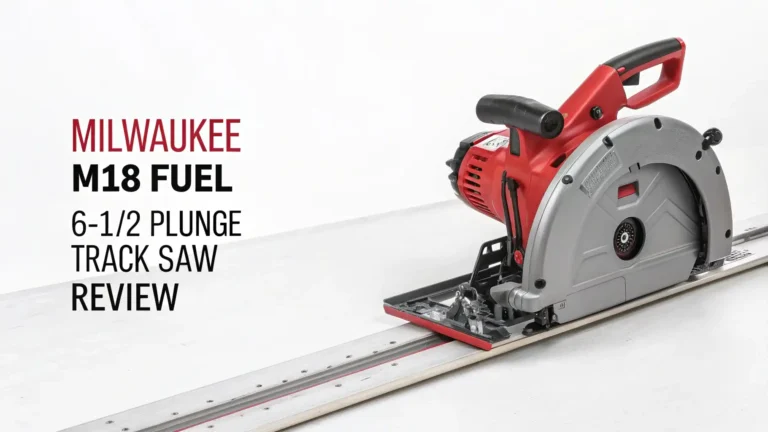
The Milwaukee M18 FUEL track saw represents a significant entry into the professional track saw market. This cordless powerhouse brings together cutting-edge motor technology with thoughtful design features. The tool weighs 9.8 pounds without the battery, making it manageable for extended use.
The Powerstate brushless motor stands at the heart of this saw. It generates enough torque to maintain consistent speed even in dense hardwoods. The REDLINK PLUS intelligence system monitors the tool and battery in real-time, protecting against overload and overheating. This smart system maximizes performance while extending the life of your investment.
Users appreciate the variable speed control that adapts to different materials. Cutting delicate veneered plywood? Dial down the speed. Ripping through solid oak? Crank it up to full power. This flexibility makes the saw versatile for various applications from fine furniture making to rough carpentry.
Cutting Performance and Power
The real test of any track saw comes when you put blade to wood. The Milwaukee track saw delivers impressive results across various materials. The 6,300 RPM top speed provides clean cuts with minimal tear-out, even on cross-grain cuts in plywood.
Breaking down full sheets of plywood becomes effortless. The saw glides smoothly along the track with consistent speed. The motor maintains power through the entire cut, never bogging down or slowing. Users report cutting through stacks of 3/4-inch plywood without any struggle.
Hardwood cutting showcases the saw’s true capabilities. Whether you’re working with oak, walnut, maple, or ash, the Milwaukee track saw powers through with confidence. The 2.25-inch maximum depth of cut handles most stock thicknesses you’ll encounter in furniture building and cabinetry work.
The anti-kickback features provide peace of mind during operation. The riving knife helps prevent binding, and the smooth power delivery reduces the chance of sudden jumps or catches. While it lacks the anti-kickback brake found on some premium competitors, the overall safety features perform well in real-world use.
Battery Life and Runtime

One concern many users have about cordless track saws centers on battery life. Will you spend more time charging batteries than cutting wood? The Milwaukee track saw alleviates these worries with impressive runtime performance.
The included M18 REDLITHIUM HIGH OUTPUT XC6.0 battery provides substantial cutting capacity. Real-world testing shows you can make dozens of cuts through 3/4-inch plywood on a single charge. Users report breaking down multiple full sheets before needing to swap batteries.
The battery management system keeps things running cool. Even during extended cutting sessions, the battery doesn’t overheat or require cooling breaks. When you do need to recharge, the Milwaukee REDLITHIUM batteries charge quickly and get you back to work fast.
For professional use, having two or three batteries in rotation keeps downtime minimal. The standard 6.0Ah battery strikes a good balance between runtime and weight. Upgrading to larger capacity batteries extends runtime further, though it adds some weight to the tool.
Top 3 Alternatives for Milwaukee Track Saw


Dust Collection System
Managing sawdust makes a huge difference in both cut quality and workshop cleanliness. The Milwaukee track saw excels in this critical area. The 90% dust collection efficiency claim holds up in real-world use, with most sawdust ending up in the collection bag or vacuum.
The saw features a dedicated dust port that connects to standard shop vacuum hoses. The shroud around the blade channels dust efficiently toward the collection system. Even without a vacuum attached, the included dust bag captures the majority of debris, keeping your work surface relatively clean.
When you connect a shop vacuum, dust collection becomes nearly perfect. Only a small amount of fine dust escapes, mostly at the entry and exit points of the cut. This excellent dust management improves cut visibility and reduces cleanup time significantly.
Guide Rail System and Compatibility
The track system makes or breaks a track saw’s usability. Milwaukee designed their rails to work with Festool-compatible tracks, giving users flexibility and options. This compatibility means you can mix and match rails from different manufacturers to build your ideal system.
The standard kit includes a 55-inch guide rail, which handles many common cutting tasks. For breaking down full sheets, you’ll want longer rails. Milwaukee and third-party manufacturers offer 110-inch rails and connector systems for extended cuts. The rails store efficiently and come with protective bags to prevent damage.
The saw locks onto the rail securely with an anti-tip feature that prevents the saw from rocking during cuts. This stability proves crucial for maintaining accuracy, especially on long cuts. Users report the saw glides smoothly along the track with consistent pressure required throughout the cut.
Accuracy and Cut Quality
Precision separates professional results from amateur work. The Milwaukee track saw delivers the accuracy woodworkers demand. Cuts come out square and true with minimal deviation over long runs. The saw maintains its track position without wandering or deflecting.
The plunge mechanism operates with smooth precision. You can make partial depth cuts with confidence, knowing the saw will maintain consistent depth throughout. The depth adjustment system provides fine-tuning capability, allowing you to dial in exact measurements for dados and grooves.
Bevel cuts maintain accuracy across the full range of angles. The angle adjustment system locks positively with detents at common angles. Between detents, the system holds angles securely without slipping during cuts. The saw remains stable even at maximum bevel, delivering clean angled cuts for miter joints and chamfers.
Ergonomics and User Experience
A tool’s comfort level affects both safety and work quality. The Milwaukee track saw scores well in ergonomics and overall user experience. The handle placement feels natural with good balance and control throughout the cutting motion.
The main handle features a soft-grip material that reduces fatigue during extended use. The trigger responds smoothly with good tactile feedback. The variable speed dial sits within easy reach, allowing speed adjustments without stopping or changing your grip.
The plunging action requires moderate pressure, striking a good balance between control and ease of use. The saw doesn’t fight you or feel heavy during the plunge. The smooth action inspires confidence, especially when making precision cuts in expensive materials.
Value and Price Point
Understanding the investment helps you make an informed decision. Milwaukee track saws fall into the mid to upper-mid price range, positioned below premium European brands but above budget options. The pricing reflects the professional-grade quality and cordless convenience.
The bare tool option works well if you already own M18 batteries and chargers. This saves money while getting you into track saw cutting. Kit configurations bundle batteries, chargers, rails, and accessories at various price points to match different needs and budgets.
Compared to corded competitors, the Milwaukee cordless option commands a slight premium for the battery-powered convenience. However, the performance matches or exceeds many corded models, making the extra cost worthwhile for users who value portability and flexibility.
Maintenance and Durability
Long-term reliability matters when investing in professional tools. The Milwaukee track saw features a robust construction designed for jobsite use. The motor housing and base plate resist the bumps and knocks of real-world work environments.
The brushless motor design eliminates the carbon brushes that wear out in traditional motors. This means less maintenance and longer motor life. The sealed motor housing protects internal components from dust infiltration, extending reliability even with heavy use.
Blade changes take seconds with the spindle lock system. No special tools required beyond the included wrench. The arbor design accommodates standard 6.5-inch blades with 20mm bore, giving you access to Milwaukee’s specialized track saw blades and quality aftermarket options.
What Users Say About Milwaukee Track Saw
Real-world experiences provide valuable insights beyond specifications and features. Milwaukee track saw users consistently praise the tool’s cutting performance and build quality. Professional contractors and serious DIYers report satisfaction with their purchases.
Many users highlight the smooth cutting action and excellent results in various materials. The saw handles everything from delicate plywood to thick hardwoods with confidence. Users appreciate how the tool maintains speed and power throughout cuts without bogging down.
The dust collection capability receives frequent praise in user reviews. Many note that connecting a shop vacuum provides nearly dust-free cutting. This feature proves especially valuable for finish work and projects in occupied spaces where dust control matters.
Some users mention the track length as a limitation, noting that the standard 55-inch rail requires extension for full-sheet breakdown. However, most consider this an acceptable trade-off, especially since longer rails and connection systems are readily available.
Comparing Milwaukee to Major Competitors
Understanding how Milwaukee stacks up against other brands helps you make an informed choice. The track saw market includes strong offerings from Festool, Makita, DeWalt, and others, each with distinct advantages and characteristics.
Festool represents the premium standard in track saws. Their saws offer features like anti-kickback brakes and exceptional build quality. However, Festool commands significantly higher prices than Milwaukee. The Milwaukee track saw delivers comparable cutting performance at a more accessible price point.
Makita’s track saw options include both corded and cordless models. Their 40V cordless model provides more power than Milwaukee’s 18V option. However, Milwaukee’s battery ecosystem proves more extensive, giving better value if you own other M18 tools. Cut quality and accuracy between the two brands remain quite similar.
Best Applications for Milwaukee Track Saw
Understanding where this tool excels helps you maximize your investment. The Milwaukee track saw shines in breaking down sheet goods into manageable pieces. Full plywood sheets become multiple precision-cut panels quickly and safely.
Cabinet makers appreciate the clean, square cuts for building face frames and carcasses. The ability to cut dados and grooves with the plunge feature adds versatility. Finish carpenters use the saw for trimming doors, cutting countertops, and other precision work requiring splinter-free edges.
The cordless design makes this saw ideal for jobsite work where access to power remains limited. Deck builders, siding installers, and remodelers benefit from the portability. You can make precision cuts wherever the work takes you without dragging extension cords.
How does Milwaukee track saw compare to traditional circular saws?
Track saws and circular saws serve different purposes in woodworking. A traditional circular saw offers maximum versatility and affordability. You can make freehand cuts, use various jigs, and tackle many cutting tasks. However, achieving consistently straight, square cuts requires skill and setup time.
The Milwaukee track saw sacrifices some versatility for precision and repeatability. The guided cutting system eliminates the skill factor in making straight cuts. Anyone can achieve professional results immediately. The zero-clearance guide prevents splintering, producing cleaner edges that need minimal cleanup.
Depth control proves more precise with a track saw. The plunge mechanism and positive depth stops make partial-depth cuts easy and repeatable. Cutting dados, grooves, and lap joints becomes straightforward. A circular saw requires more setup and concentration for similar cuts.
Is the Milwaukee track saw suitable for beginners?
Starting with professional-grade tools can feel intimidating. However, the Milwaukee track saw actually works well for beginners in many ways. The guided cutting system removes much of the skill needed for straight cuts. You get professional results from your first cut.
The safety features provide peace of mind for new users. The track system keeps the saw stable and prevents it from wandering. The blade guard and riving knife reduce kickback risk. The smooth power delivery gives you control without sudden surges or jumps.
Setup and operation prove straightforward. The user manual provides clear instructions, and numerous online tutorials demonstrate proper techniques. Most beginners feel comfortable using the saw after a few practice cuts. The intuitive controls don’t require extensive experience to master.
Can you use the Milwaukee track saw without the track?
This question comes up frequently from users considering a track saw purchase. Technically, yes, the Milwaukee track saw can operate without the track, but this defeats the tool’s primary purpose and offers few advantages over a regular circular saw.
Without the track, you lose the precise guidance system that makes track saws valuable. The saw functions as an awkward circular saw with a plunge feature. The base design optimizes for track use rather than freehand cutting, making it less stable and harder to control than a purpose-built circular saw.
The plunge mechanism still works without the track, allowing you to make plunge cuts freehand. However, maintaining a straight line and consistent depth becomes challenging. Most users who try freehand cutting quickly realize they’re better off using a standard circular saw for such applications.
What safety features does the Milwaukee track saw include?
Safety remains paramount when working with power tools. The Milwaukee track saw incorporates several features to protect users during operation. Understanding these features helps you work confidently while maintaining proper safety practices.
The blade guard covers the blade except for the active cutting area. This guard retracts automatically as you plunge the saw into the material, then springs back when you lift the saw. The guard prevents accidental contact with the spinning blade during transport and setup.
The riving knife behind the blade prevents material pinching that can cause kickback. This essential safety feature keeps the cut kerf open, allowing the blade to move freely through the material. While not as advanced as anti-kickback brakes on premium saws, the riving knife provides effective protection.
Frequently Asked Questions
Does the Milwaukee track saw work with Festool rails?
Yes, the Milwaukee track saw uses the Festool-compatible rail system. This compatibility gives you flexibility to use Milwaukee rails, Festool rails, or third-party alternatives. The standardized design means you can mix and match rails from different manufacturers to build your ideal system. Users report excellent performance with various rail brands, though Milwaukee’s own rails provide guaranteed fit and finish. The compatibility extends to rail connectors and clamps as well.
How long does the battery last on a Milwaukee track saw?
Battery life depends on the capacity of your battery pack and the material you’re cutting. The included M18 REDLITHIUM HIGH OUTPUT XC6.0 battery typically provides enough power to break down multiple sheets of 3/4-inch plywood. Users report 30 to 50 cuts per charge in typical applications. Cutting denser hardwoods drains the battery faster than plywood. For professional all-day use, having two or three batteries in rotation eliminates downtime. The battery gauge shows remaining charge so you can plan accordingly.
Can you cut metal with the Milwaukee track saw?
The Milwaukee track saw is designed and optimized for cutting wood and wood-based materials like plywood, MDF, and particleboard. While technically you could install a metal-cutting blade, this application falls outside the tool’s intended use. The motor speed and torque characteristics optimize for wood rather than metal. For cutting metal, use dedicated tools like metal-cutting circular saws or bandsaws that provide appropriate speeds and safety features for metal work.
What blade should I use with my Milwaukee track saw?
Milwaukee manufactures specialized track saw blades designed to deliver optimal performance in their saws. The 24-tooth general-purpose blade handles most applications well. For finish work and cross-cutting plywood, the 40-tooth blade provides smoother cuts with less splintering. The 20mm arbor accepts standard track saw blades from various manufacturers. Always ensure blades are rated for the saw’s maximum 6,300 RPM speed. Using sharp, appropriate blades significantly impacts cut quality and saw performance.
Is the Milwaukee track saw worth the investment for DIY users?
The value proposition depends on your project scope and long-term woodworking plans. If you regularly work with sheet goods, need precise straight cuts, or tackle cabinet and furniture projects, the Milwaukee track saw provides excellent value. The cordless convenience and professional results justify the cost. However, occasional users with basic cutting needs might find a circular saw with a guide more economical. Consider your budget, frequency of use, and the types of projects you typically undertake when deciding.
How does Milwaukee track saw handle plywood without splintering?
The zero-clearance guide rail supports wood fibers right up to the cut line, preventing tear-out on the top surface. The blade design with fine teeth and proper geometry minimizes bottom-face splintering. For critical finish surfaces, you can apply painter’s tape along the cut line or score with a utility knife for extra insurance. The combination of sharp blade, rail support, and controlled feed rate produces clean edges that typically require minimal cleanup. Users consistently praise the saw’s ability to deliver splinter-free cuts in plywood.