Kreg Pocket Hole Jig KPHJ320 Review 2026: A Scam or Legit?
Are you tired of struggling with weak wood joints that fall apart after a few months? The Kreg Pocket Hole Jig KPHJ320 might be exactly what your workshop needs.
This compact and affordable tool has earned a loyal following among DIY woodworkers and professionals alike. It creates strong, hidden joints in seconds with nothing more than a drill and a few screws.
But does it really live up to all the hype in 2026? I spent weeks testing this jig on various wood types, thicknesses, and project styles. I compared it to other pocket hole jigs on the market.
Key Takeaways:
- The Kreg KPHJ320 costs around $34, making it one of the most affordable pocket hole jigs from a trusted brand. It delivers excellent value for hobbyists and weekend DIYers who want strong joints without a big investment.
- It works with materials between 1/2″ and 1 1/2″ thick. This covers most common lumber sizes, plywood sheets, and even PVC boards used in furniture and home projects.
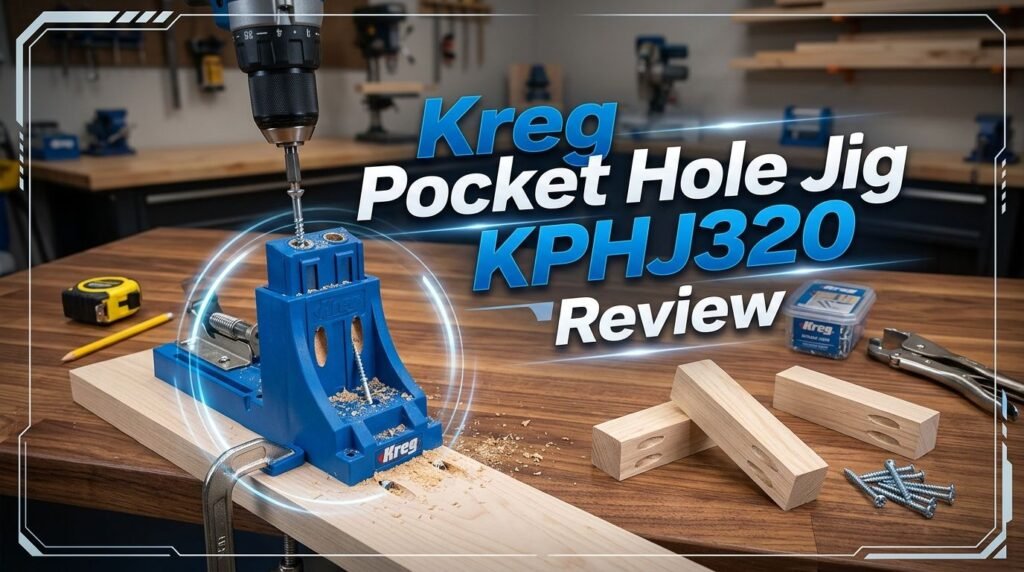
- The jig features two hardened steel drill guides, a removable spacer, material thickness stops, a clamp pad, a stepped drill bit with depth collar, and 40 pocket hole screws. Everything arrives in a durable plastic carry case ready to use.
- Setup takes just seconds. You snap the material thickness stops to one of three positions, clamp the jig to your workpiece, and drill. No complicated adjustments or calibration steps.
- It can be reconfigured for different joint types including single holes, closely spaced double holes, and widely spaced double holes. You can also remove the thickness stops to work in tight spaces like inside corners.
- The main downsides are that it requires a separate clamp (not included in the base kit) and horizontal drilling can feel less comfortable during long work sessions. Odd material thicknesses outside the three preset stops also need extra attention.

Kreg Pocket Hole Jig KPHJ320: Product Overview
The Kreg Pocket Hole Jig 320 is a portable, handheld pocket hole jig made by Kreg Tool Company. Kreg is an employee-owned business based in Iowa that invented and patented the first pocket hole jig back in 1990. The company has been refining this technology for over three decades.
The KPHJ320 sits in the middle of Kreg’s current product lineup. It offers more features than the basic Kreg 310 but costs far less than the premium Kreg 720PRO. This makes it a sweet spot for most home woodworkers.
The jig body is made from heavy-duty injection-molded plastic with hardened steel drill guide sleeves. It uses a 15-degree drilling angle, which is the standard for pocket hole joinery. The included stepped drill bit creates both the pilot hole and the pocket in a single pass.
Who Should Buy the Kreg KPHJ320?
This jig is built for a specific audience. Beginner woodworkers will love how simple it is to set up and use. There is almost no learning curve. You can create your first pocket hole joint within minutes of opening the box.
DIY home improvers who build shelves, tables, bed frames, and storage units will find this tool very practical. It handles the most common lumber sizes used in furniture projects. It also works well for quick repair jobs like fixing a wobbly chair or reinforcing a loose cabinet frame.
However, if you build cabinets full time or run a production shop, you should consider the Kreg 720PRO instead. That model offers auto-clamping, on-board storage, and a docking station that speeds up high-volume work. The KPHJ320 is best for people who drill pocket holes regularly but not constantly.
What Comes Inside the Box?
The KPHJ320 kit arrives in a well-organized hard plastic carry case that keeps everything tidy. Opening the case reveals each component neatly seated in its own slot.
Here is what you get: two drill guides with hardened steel sleeves, two material thickness stops that click into three preset positions, one removable spacer, a universal clamp pad, a stepped drill bit with a see-through depth stop collar, a combined hex key and thickness gauge tool, a square drive bit, and 40 Kreg pocket hole screws.
The carry case itself deserves mention. It is sturdy and compact enough to toss into a toolbox or bag. Many competing jigs ship in flimsy packaging or simple plastic bags. Kreg’s attention to organization and storage makes a real difference for portability.
One important note: a clamp is not included in the base KPHJ320 kit. You will need a locking C-clamp or bar clamp to hold the jig onto your workpiece. Kreg sells a bundle version (KPHJ320-22) that includes a face clamp, which is worth considering.
Top 3 Alternatives for Kreg Pocket Hole Jig KPHJ320


How to Set Up the Kreg KPHJ320
Setting up the Kreg 320 takes less than 30 seconds once you understand the process. Start by measuring your material thickness. Use the included hex key tool, which doubles as a thickness gauge, to confirm the measurement.
Next, press and slide the material thickness stops on each drill guide until they click into the correct position. The three presets are 1/2 inch, 3/4 inch, and 1 1/2 inch. These cover the most common board and plywood thicknesses in standard woodworking.
After that, insert the clamp pad into any hole on the jig body. Position the jig on your workpiece and clamp it down with the edge stops pressed firmly against the edge of the board. Adjust the drill bit’s depth stop collar to match the corresponding mark on the drill bit shaft. Tighten it with the hex key. You are now ready to drill.
The process becomes almost automatic after your first few joints. Most users report that setup time drops to under 15 seconds with a little practice.
Drilling Performance and Joint Quality
The Kreg KPHJ320 drills clean, precise pocket holes across a range of materials. I tested it on pine, oak, poplar, 3/4-inch plywood, 5/4 decking boards, and PVC trim. The hardened steel drill guides held the bit at a consistent 15-degree angle every time.
The stepped drill bit performed well. It created smooth pockets with minimal tearout in softwoods and produced clean results in hardwoods too. The see-through depth stop collar is a nice quality-of-life feature. It lets you visually confirm the drill depth without removing the bit from the jig.
Joint strength was impressive. Pocket hole joints made with Kreg’s zinc-coated screws held tight under stress. I joined two pieces of 3/4-inch pine and tried pulling them apart by hand. The wood itself started to split before the joint failed. That speaks volumes about the reliability of pocket hole joinery done with this jig.
One thing to note: always match your screw type to your material. Use coarse-thread screws for softwoods and fine-thread screws for hardwoods and plywood. Kreg offers both options in various lengths.
Build Quality and Durability
The KPHJ320 feels solid in hand despite being made primarily of injection-molded plastic. Kreg reinforced the clamping area with a honeycomb structure. This distributes clamp pressure evenly and prevents cracking under repeated use.
The hardened steel drill guide sleeves are the most critical wear components. They resist the friction of the drill bit spinning through them at high speeds. Many users report thousands of holes before noticing any meaningful wear on these sleeves. Kreg also sells replacement guide blocks if they ever do wear out.
The rubber non-skid base pad grips the workpiece surface well. It reduces the chance of the jig slipping mid-drill, even with moderate clamping force. The snap-together connections between the drill guides, spacers, and thickness stops feel tight and secure. There is no wobble or play in the assembled jig.
For a tool at this price point, the build quality is genuinely impressive. It will last for years of regular weekend workshop use without any issues.
Versatility and Reconfiguration Options
One of the biggest advantages of the KPHJ320 is how many ways you can configure it. The modular snap-together design lets you adapt the jig for different project types.
In its default configuration, the jig has two drill guides with the spacer between them. This sets the holes about 1 1/2 inches apart, which is ideal for the ends of 4-inch-wide boards. Remove the spacer, and the drill guides lock together with only about 3/4 inch between the holes. You can also separate the guides completely and use them individually for single-hole applications.
Removing the material thickness stops opens up another use case. Without the stops, the drill guides can fit into tight spots like inside corners of existing cabinets, drawers, and frames. This is incredibly useful for repair work where you cannot disassemble the piece.
Kreg sells expansion kits with additional drill guides and spacers. These let you line up three or more holes in a row for wider boards. This modular approach means the KPHJ320 can grow with your skills and project requirements.
Ease of Use for Beginners
If you have never used a pocket hole jig before, the Kreg 320 is a fantastic starting point. The instructions are clear. The components are clearly labeled. The three-position thickness stops eliminate guesswork.
You do not need to measure drill angles or calculate screw depths. Everything snaps into place with positive click stops. Even the drill bit has embossed markings for the three thickness settings.
The learning curve is basically flat. Most first-time users successfully drill their first pocket hole within 5 minutes of opening the kit. Compare that to traditional mortise-and-tenon joinery, which can take years to master. Pocket holes with this jig are fast, forgiving, and effective.
One tip for beginners: practice on scrap wood first. Get comfortable with the feel of the drill bit entering the guide and how much pressure to apply. Once you have that muscle memory, every pocket hole after that will feel second nature.
Limitations You Should Know About
No tool is perfect, and the KPHJ320 has some clear limitations worth mentioning. The biggest one is the three fixed thickness stops. They only cover 1/2-inch, 3/4-inch, and 1 1/2-inch materials. If you work with 5/8-inch or 1-inch stock, you will need to manually adjust the drill bit depth and position. This is doable but less convenient.
You must supply your own clamp. The base kit does not include one. This can be frustrating for a first-time buyer who expects to start building right away. Budget an extra $10 to $20 for a suitable clamp, or buy the bundle version that includes one.
Horizontal drilling is the default orientation with this jig. The jig clamps to the top of your workpiece, and you drill downward at an angle. For large projects with many holes, this position can become tiring on your wrists and arms. Bench-mounted jigs like the Kreg 720PRO solve this problem, but they cost significantly more.
Finally, this jig is not designed for materials thicker than 1 1/2 inches. If you work with 2x4s in their full 1 1/2-inch dimension, you are fine. But if you need pocket holes in true 2-inch or thicker stock, you will need the Kreg Pocket Hole Jig XL.
Kreg KPHJ320 vs. Kreg 720PRO: Which One Should You Pick?
This is the most common question buyers ask. The answer depends on how often you use pocket holes and what you build.
The Kreg KPHJ320 costs around $34. The Kreg 720PRO costs around $150. That is a significant price gap. For weekend hobbyists building a few projects per year, the 320 offers everything you need at a fraction of the cost.
The 720PRO shines in speed and convenience. Its auto-clamping system lets you position your board, press down, and drill. No separate clamp needed. It also has a built-in docking station, on-board screw storage, and a dust collection port. These features add up to major time savings on large projects.
The 320 wins on portability and flexibility. It is small enough to carry in a toolbox and can be used in tight spaces where the larger 720PRO cannot fit. For repair work, on-site jobs, and small builds, the 320 is often the better practical choice.
My recommendation: start with the 320. If you find yourself drilling pocket holes frequently and wanting a faster workflow, upgrade to the 720PRO later. The 320 gives you a low-risk way to discover whether pocket hole joinery fits your building style.
Real User Feedback and Ratings
The Kreg KPHJ320 earns consistently high ratings across multiple retail platforms. On Amazon, it holds a strong rating with thousands of reviews. On Home Depot, customers praise it as an easy-to-use tool that delivers professional results.
Common positive themes in user reviews include quick setup time, strong joints, and excellent value. Many reviewers specifically call it a “must-have” for anyone working with wood. Beginners especially appreciate how the jig simplifies their first furniture builds.
The most common complaints center on the need for a separate clamp and some difficulty with non-standard material thicknesses. A small number of users mention that the plastic body feels less premium than metal alternatives. However, most agree the plastic construction does not affect performance or durability.
Overall, user sentiment for the KPHJ320 is overwhelmingly positive. It delivers on its promises and does exactly what Kreg says it will do.
Maintenance and Care Tips
Keeping your Kreg KPHJ320 in top condition requires very little effort. After each use, blow or brush sawdust out of the drill guide holes. Built-up sawdust can affect drill bit alignment over time.
Inspect the steel drill guide sleeves periodically for signs of wear. If you notice the drill bit wobbling or the holes becoming less precise, it may be time to replace the guide block. Kreg sells affordable replacement parts for this.
Keep the drill bit sharp. A dull bit creates rough pockets, requires more force, and generates excess heat. Replace the bit if you notice it struggling to cut cleanly. Kreg’s replacement bits are inexpensive and widely available.
Store the jig in its carry case to protect the components. This prevents the small parts from getting lost and keeps everything organized for your next project. A few minutes of care after each session will keep this tool performing like new for years.
Final Verdict: Is the Kreg KPHJ320 Worth It in 2026?
Yes, the Kreg Pocket Hole Jig KPHJ320 is absolutely worth buying in 2026. It remains one of the best values in pocket hole joinery. For around $34, you get a versatile, durable, and easy-to-use jig that produces strong, clean joints.
It is ideal for beginners, weekend woodworkers, and DIY enthusiasts who build furniture, shelving, storage, and home repair projects. The modular design gives it surprising flexibility for such a small tool. It handles most common lumber and plywood thicknesses without any issues.
If you need more speed and convenience for large or frequent projects, consider stepping up to the Kreg 520PRO or 720PRO. But for the majority of home workshop users, the KPHJ320 delivers everything you need at a price that is hard to beat.
Frequently Asked Questions
Does the Kreg KPHJ320 come with a clamp?
The base KPHJ320 kit does not include a clamp. You will need a locking C-clamp or bar clamp to secure the jig to your workpiece. Kreg offers a bundle version (KPHJ320-22) that includes a Classic 2-inch face clamp if you want everything in one purchase.
What material thicknesses does the Kreg 320 support?
The Kreg 320 works with materials between 1/2 inch and 1 1/2 inches thick. It has three preset thickness stops for 1/2-inch, 3/4-inch, and 1 1/2-inch materials. You can also manually adjust the drill bit depth collar for intermediate thicknesses.
Can I use the Kreg KPHJ320 on plywood?
Yes, the Kreg 320 works very well on plywood. It is effective on 1/2-inch and 3/4-inch plywood sheets, which are the most common plywood thicknesses used in furniture and cabinet building. Use fine-thread Kreg screws for the best results with plywood.
How does the Kreg 320 compare to the Kreg 310?
The Kreg 320 includes two drill guides, a spacer, and two material thickness stops. The Kreg 310 has a single drill guide with one thickness stop. The 320 offers more configuration options and drills two holes at once, making it faster and more versatile for most projects.
Is the Kreg 320 good for building cabinets?
The Kreg 320 can handle small cabinet projects and face framing. For full-scale cabinet building with many joints, the Kreg 720PRO is a better fit because of its auto-clamping system and bench-mounted design. The 320 works well for occasional cabinet work and repairs.
What drill do I need to use with the Kreg KPHJ320?
You need a standard corded or cordless drill. A drill with variable speed control is recommended so you can start slowly and increase speed as the bit enters the wood. Any drill that accepts a standard 3/8-inch hex shank bit will work with the included Kreg drill bit.