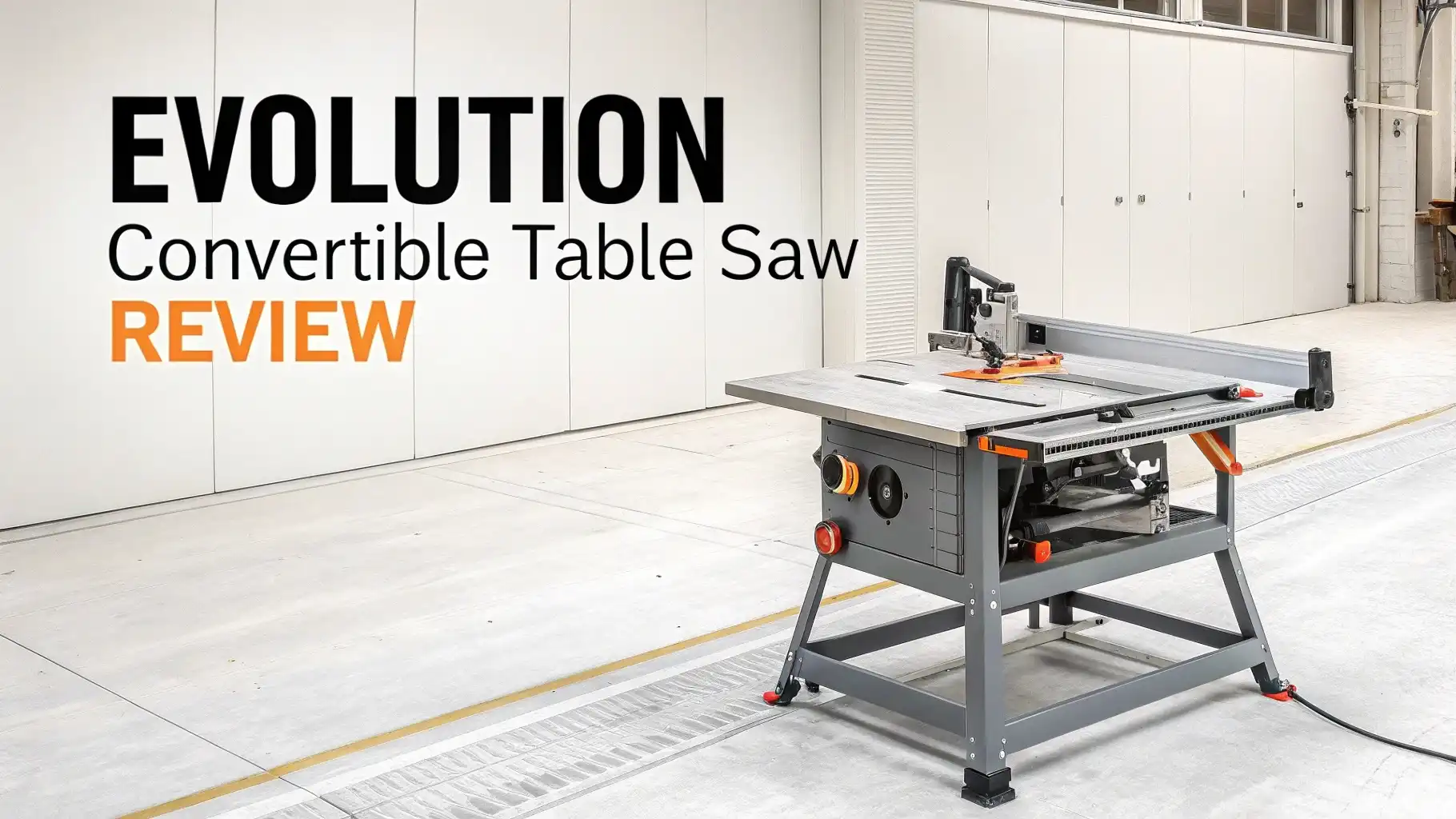
Evolution Convertible Table Saw Review: The Ultimate Guide
Finding the right table saw can feel like searching for a needle in a haystack. You want power. You need precision. But space is limited.
The Evolution R8MTS Convertible Table Saw claims to solve this problem by combining two essential tools into one compact package.
This review cuts through the marketing claims and gives you the real story. We tested this saw. We pushed it to its limits.
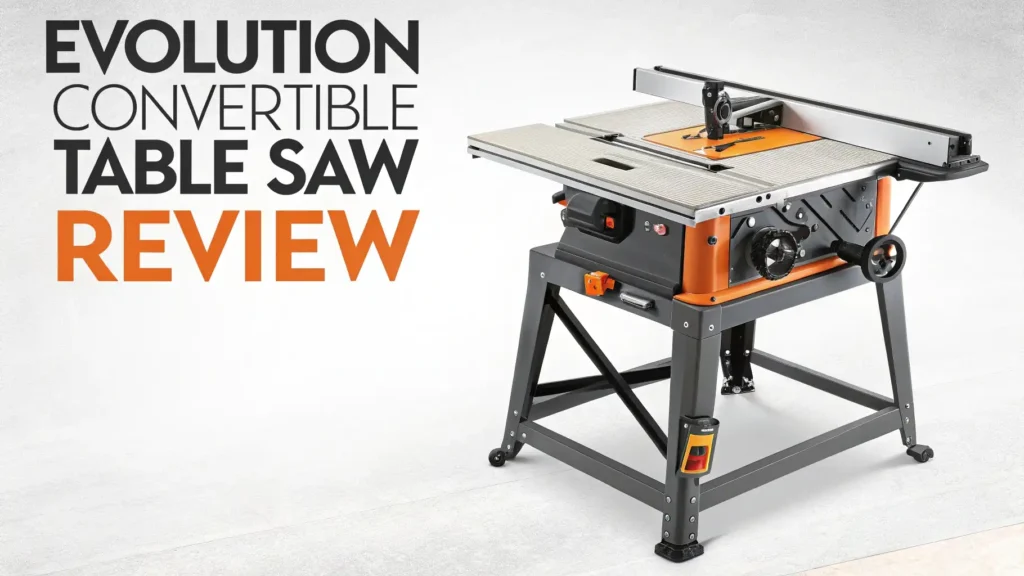
Key Takeaways
- Space Saving Champion: The R8MTS combines a table saw and miter saw in one unit, perfect for small workshops and garages where every square foot counts.
- Multi Material Cutting Power: This saw cuts wood, plastic, mild steel, aluminum, and composites with a single blade, eliminating the need for multiple specialized tools.
- Budget Friendly Option: At around $275, the R8MTS costs less than buying separate table and miter saws while delivering comparable performance for DIY and light professional work.
- Portability Matters: The compact design weighs less than traditional table saws, making it easy to transport between job sites or store away when not in use.
- Learning Curve Required: The dual mode functionality takes some practice to master, but once you understand the system, it becomes second nature and saves significant time.
- Not For Heavy Production: While capable, this saw works best for light to medium duty projects rather than continuous heavy duty commercial applications.

What Makes the Evolution R8MTS Different From Traditional Table Saws
The Evolution R8MTS breaks the mold of traditional table saws. Most saws force you to choose between a table saw or a miter saw. This tool gives you both. The convertible design features a pivoting blade spindle that optimizes cutting capacity in both modes.
When you close the lid, it functions as a full fledged table saw. Open the lid, and it transforms into a compound miter saw. The transition takes seconds. No complex adjustments. No special tools required. Just flip the lid and start cutting.
The 8 and 1/4 inch blade sits at the heart of this system. It may seem small compared to traditional 10 inch table saws.
But the engineering behind this design maximizes cutting capacity. The pivoting blade spindle ensures optimal blade positioning for both table and miter saw operations.
Power and Performance Specifications That Matter
The R8MTS packs a 12 amp motor that delivers consistent power across different materials. This motor generates enough torque to handle 2×4 lumber rips and crosscuts without bogging down. The motor runs at optimal RPM to maintain blade speed through tough cuts.
Cutting capacity in table saw mode includes a 1 and 1/2 inch rip capacity. While this seems limited, it handles most common DIY and light professional tasks.
The crosscut capacity measures 4 and 3/4 inches by 2 and 3/16 inches, perfect for dimensional lumber and trim work.
The bevel function ranges from 0 to 47 degrees in miter saw mode. This range covers standard bevel cuts and compound angles needed for crown molding and trim carpentry. The miter capacity swings plus or minus 45 degrees, giving you flexibility for corner joints and angled cuts.
Two Tools in One: Understanding the Dual Mode System
The conversion system represents the core innovation of the R8MTS. In table saw mode, the blade sits perpendicular to the table surface. The fence system allows for rip cuts parallel to the blade. You can process sheet goods, rip lumber, and make precise straight cuts.
Miter saw mode activates when you open the lid. The blade assembly pivots to a vertical position. The workpiece sits on the table while the blade comes down from above. This configuration excels at crosscuts, miter cuts, and bevel cuts.
The transition mechanism uses a simple latch system. Release the latch, lift the lid, and the blade assembly automatically pivots into position. The process reverses just as easily. The entire conversion takes less than 10 seconds once you know the routine.
Top 3 Alternative for Evolution Convertible Table Saw


Real World Cutting Performance Across Different Materials
Wood cutting represents the primary use case for most users. The R8MTS handles softwoods like pine and cedar effortlessly. Hardwoods including oak, maple, and walnut require slower feed rates but cut cleanly. The blade leaves a relatively smooth finish that works well for most projects.
Metal cutting capability expands the saw’s versatility. Aluminum cuts like butter with minimal burr formation. Mild steel up to 1/8 inch thickness cuts successfully, though it generates more heat and noise. Copper tubing and electrical conduit cut precisely for plumbing and electrical work.
Plastic and composite materials cut without melting or chipping. PVC pipe, acrylic sheets, and laminate flooring all process smoothly. The blade speed prevents heat buildup that can melt thermoplastics. This versatility eliminates the need for dedicated plastic cutting tools.
Setup and Assembly: What to Expect Out of the Box
The R8MTS arrives mostly assembled. Unpacking takes about 10 minutes. The main components include the saw body, fence assembly, blade guard, and accessories. Evolution includes clear instructions with detailed diagrams.
Initial assembly requires basic hand tools. You attach the fence rails, install the blade guard, and check blade alignment. The process takes 20 to 30 minutes for first time users. Experienced woodworkers complete assembly in 15 minutes.
Blade installation follows standard procedures. Remove the throat plate, use the included wrenches to loosen the arbor nut, and mount the blade.
The arrow on the blade must match the rotation direction marked on the saw. Tighten the arbor nut firmly, replace the throat plate, and you’re ready to cut.
Safety Features and Blade Guard Design
Blade guards differ between the two operating modes. Table saw mode uses a traditional overhead guard with anti kickback pawls and a riving knife.
The guard assembly mounts to the riving knife, which sits directly behind the blade. This configuration prevents workpieces from pinching the blade and kicking back.
The riving knife thickness matches the blade kerf. It stays aligned with the blade automatically, rising and falling with blade height adjustments. This feature represents a significant safety improvement over older table saws with fixed splitters that must be removed for certain cuts.
Miter saw mode employs a full coverage blade guard. The guard completely encircles the upper half of the blade.
When you pull down the saw arm, the guard retracts automatically, exposing only the portion of blade needed for the cut. The guard returns to full coverage when you release the arm.
Precision and Accuracy: How It Compares to Dedicated Saws
Table saw accuracy depends on proper setup and maintenance. The fence system uses a locking mechanism at the front of the saw.
When properly aligned and locked, the fence maintains parallel cuts within acceptable tolerances for most projects. Professional grade table saws offer tighter tolerances, but the R8MTS performs well for its price range.
Miter cuts require attention to the angle indicator. The detents at common angles (0, 15, 22.5, 30, 45 degrees) lock firmly. Cuts between detents need verification with a protractor or digital angle gauge. The angle adjustment mechanism holds settings reliably once locked.
Bevel cuts introduce additional variables. The bevel scale provides reasonable accuracy for rough cuts. Critical angle work benefits from test cuts and adjustment. The bevel lock holds the setting throughout the cut, preventing drift that plagued older saw designs.
Portability and Storage for Small Workshops
Weight comes in at a manageable level for one person transport. The compact design eliminates unnecessary bulk.
Integrated handles on the saw body provide secure grip points for lifting and carrying. The weight distribution keeps the saw balanced during transport.
Footprint when set up measures significantly smaller than separate table and miter saws. You can position the R8MTS against a wall or in a corner.
When not in use, it stores vertically or horizontally depending on your space constraints. The compact dimensions fit in closets, under workbenches, or in vehicle cargo areas.
No stand required for basic operation. The saw sits directly on a workbench or sturdy table. This flexibility helps when working in different locations or temporary setups. For permanent installation, you can mount it to a dedicated stand or workbench.
User Experience: Pros and Cons from Real Owners
Positive feedback consistently highlights the space saving design. Users with small workshops or garages appreciate combining two tools into one footprint.
The multi material cutting capability receives praise from contractors who work with diverse materials. Homeowners love the versatility for various projects without buying multiple specialized saws.
Value proposition impresses budget conscious buyers. Getting both a table saw and miter saw functionality for under $300 represents significant savings compared to buying quality dedicated tools.
The included blade works well enough that many users delay purchasing additional blades.
Learning curve appears in several reviews. New users need time to understand the conversion system and optimal techniques for each mode.
Once familiar with the saw, operation becomes intuitive. The instruction manual provides basic guidance, but online videos offer more detailed tutorials.
Maintenance Tips to Keep Your Saw Running Smoothly
Blade care directly impacts cutting performance. Clean the blade regularly using blade cleaning solution or household cleaner to remove pitch and resin buildup.
Inspect teeth for damage after cutting metal or hitting hidden fasteners. Replace or sharpen blades when cut quality declines noticeably.
Lubrication points include the bevel adjustment mechanism, miter pivot, and fence rails. Use dry lubricant or light machine oil on moving parts. Avoid heavy greases that attract sawdust. Clean parts before lubricating to prevent grinding paste formation.
Dust removal prevents performance degradation. Sawdust accumulation affects moving parts and electrical components.
Blow out internal cavities monthly using compressed air. Remove the throat plate and clean beneath the table surface. Vacuum collection ports and dust extraction systems regularly.
Is the Evolution R8MTS Worth Your Money in 2026
Price analysis shows the R8MTS offers excellent value for specific use cases. At approximately $275, it costs less than most quality standalone table saws or miter saws. For hobbyists and DIY enthusiasts working with space constraints, the investment makes sense.
Target audience includes home woodworkers with limited shop space, mobile contractors needing portable solutions, and budget conscious buyers seeking versatility.
The saw fits perfectly for weekend projects, home renovations, and light professional work. It serves as an excellent first serious power saw for newcomers.
Long term value depends on your expectations and use patterns. The saw should provide years of service with proper maintenance and appropriate use.
The multi material capability remains valuable as project needs change. The ability to work in tight spaces or remote locations adds utility beyond basic cutting tasks.
Purchase considerations include your available space, budget limitations, project types, and skill level. Compare the R8MTS against buying separate entry level table and miter saws.
Factor in the floor space savings and convenience of one tool versus two. Read recent reviews to understand current quality and any recent design changes.
Comparing the R8MTS to Evolution’s Larger R10TS Model
The Evolution R10TS represents the company’s full size jobsite table saw. It features a 10 inch blade versus the R8MTS’s 8 and 1/4 inch blade.
The larger blade diameter provides greater cutting depth and rip capacity. The R10TS focuses solely on table saw functionality without the convertible miter saw feature.
Cutting capacity differs significantly between models. The R10TS offers 26 inch rip capacity and 3 and 3/8 inch maximum cut depth. These specifications handle full size sheet goods and thicker stock. The R8MTS trades some capacity for its dual mode functionality.
Price difference reflects the additional capability. The R10TS sells for around $475 to $575 depending on stand configuration.
This higher price point positions it against traditional jobsite table saws from established brands. The R8MTS at $275 targets buyers prioritizing space savings and dual functionality.
Motor power increases in the R10TS with a 15 amp motor versus the 12 amp motor in the R8MTS. The additional power handles sustained cutting in thicker materials and hardwoods. Both saws include multi material blades, but the R10TS blade features more teeth for smoother cuts.
Best Projects and Applications for the Convertible Design
Trim carpentry benefits enormously from the dual mode design. Cut baseboards to length in miter saw mode, then switch to table saw mode for ripping narrow pieces. The quick conversion eliminates the need to move between two separate stations. This efficiency speeds up room trimming significantly.
Small furniture projects work well within the saw’s capabilities. Build bookcases, small tables, and storage units using dimensional lumber. The saw handles common joinery including miters, bevels, and crosscuts. Projects using plywood and sheet goods benefit from the rip capacity for breaking down full sheets.
Deck building and outdoor projects utilize the metal cutting capability. Cut aluminum posts, copper pipe for outdoor lighting, and metal brackets. Switch to wood cutting for deck boards, railings, and framing. The saw travels easily to outdoor work sites.
How It Stacks Up Against DeWalt and SKIL Competitors
DeWalt DWE7485 represents direct competition in the compact table saw category. The DeWalt features an 8 and 1/4 inch blade similar to the Evolution but focuses solely on table saw functionality.
It offers 24 and 1/2 inch rip capacity, significantly more than the R8MTS table saw mode. Price ranges around $349, about $75 more than the Evolution.
SKIL TS6307 provides another comparison point. This 10 inch jobsite table saw includes a folding stand and rack and pinion fence system.
At approximately $279, it competes directly on price with the R8MTS. The SKIL excels as a dedicated table saw but lacks miter saw functionality and multi material cutting capability.
Performance comparison shows trade offs. The DeWalt and SKIL saws deliver better table saw performance with more power, greater capacity, and superior fence systems.
The Evolution R8MTS sacrifices some table saw capability for its convertible design and multi material blade. Neither competitor offers miter saw functionality.
Build quality generally favors the established brands. DeWalt and SKIL benefit from decades of table saw manufacturing experience. Their saws feel more solid and include refined fence mechanisms. Evolution focuses on innovation and versatility rather than matching premium brand fit and finish.
What Should You Know Before Buying This Saw
Space requirements extend beyond the saw’s footprint. Allow clearance for the lid to open fully in miter saw mode. Plan for workpiece extension on all sides during cutting operations. The compact design helps, but you still need adequate working room.
Power requirements include a standard 120 volt outlet with adequate amperage. The 12 amp motor draws significant current under load. Avoid using lightweight extension cords that cause voltage drop. Dedicated circuits prevent breaker trips when using the saw with other tools.
Accessories worth considering include additional blades for specific materials, a mobile base for easier positioning, better dust collection solutions, and safety gear. Budget for these items beyond the initial saw purchase. Quality accessories enhance performance and safety.
Warranty coverage from Evolution includes a 3 year limited warranty. This coverage protects against manufacturing defects and premature failure. Keep your purchase receipt and register the product for warranty service. Understand what the warranty covers and excludes before making claims.
Frequently Asked Questions
Can the Evolution R8MTS cut through steel studs?
Yes, the R8MTS cuts mild steel up to 1/8 inch thickness successfully. Steel studs typically measure 16 to 20 gauge, well within the saw’s capability. The included multi material blade handles this task, though cutting metal dulls blades faster than cutting wood. Use appropriate safety equipment as metal cutting generates sparks and sharp edges.
How long does the blade last when cutting different materials?
Blade life varies significantly by material and usage. Cutting wood exclusively, the blade lasts for numerous projects spanning months. Adding metal cutting reduces blade life proportionally to usage. Hitting nails or other embedded objects causes immediate damage. Most users replace blades every 3 to 6 months with mixed material use.
Does it require a special stand or can I use any workbench?
The R8MTS works on any sturdy workbench or table. No special stand is required for basic operation. The saw sits flat and stable on level surfaces. Mount it to a workbench for permanent installation using lag bolts through the mounting holes. Some users build custom rolling carts for enhanced portability. Ensure the supporting surface handles the saw’s weight plus workpiece and cutting forces.
Can beginners use this saw safely without prior experience?
Beginners can use the R8MTS safely with proper instruction and caution. Read the manual thoroughly before operating the saw. Watch instructional videos demonstrating safe techniques for both modes. Start with simple cuts in scrap material to build confidence and skills. Always use blade guards, eye protection, and hearing protection.
What size dust collection system works best with this saw?
A shop vacuum rated for at least 4 HP or 16 gallon capacity works well. The dust ports accept standard shop vacuum hoses. Larger dust collectors with 650 CFM or greater airflow provide excellent collection efficiency. Match the hose diameter to the dust port size to prevent restriction. Use fine dust filters to capture small particles effectively.