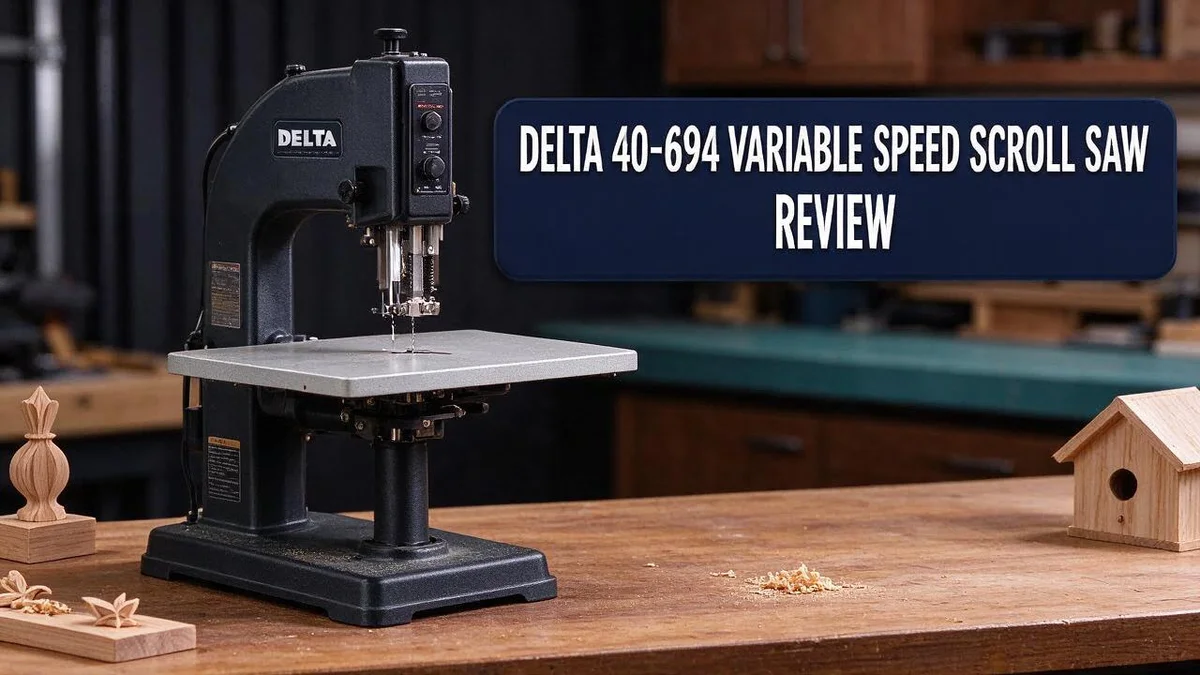
Delta 40-694 Variable Speed Scroll Saw Review
Are you looking for a scroll saw that handles detailed curves with ease? The Delta 40-694 could be the right machine for your next project. It offers variable speed control, so you can match the speed to your material.
Its 20 in. throat gives you plenty of room for larger panels. The 3/4 in. blade stroke and 13/16 in. cutting capacity suit most hobby work. A dual parallel link arm also supports smooth blade action.
The steel stand keeps the saw firmly in place during long sessions. The blade mechanism is simple, which makes quick changes easier. However, some users report upper and lower blade clamps that sit slightly out of line.
In this review, you will learn about the saw’s strengths, its weak spots, and who it suits best.
In a Nutshell
-
Speed matching: Variable speed lets you match the pace to your material. Slow settings suit tight patterns and thin stock. Faster settings move through softer wood with less effort.
-
Motor and stroke: A 1.3 A motor drives a 3/4 in. blade stroke. This pairing keeps the blade moving with steady power through each cut. Steady power helps when you work with denser material.
-
Thickness limit: The saw cuts stock up to 13/16 in. thick. Plan your projects around that limit. Thicker boards need a different tool.
-
Dual parallel arm: This arm may add extra blade action. One source describes it as twice the blade action of regular saws. That claim remains unverified, so test it on your own projects.
-
Alignment check: One user reported blade clamps about 5° off vertical. This caused frustration when squaring the blade. Test squareness with a square before you start important cuts.
-
Other options: Compare the Shop Fox W1713, DeWalt DW788, and Delta 40-695. The Shop Fox offers a 16 in. throat. The Delta 40-695 uses the same blade holders, so blades swap easily between them.
Build and Stability

- ADJUSTABLE: Upper arm lifts and locks in the raised position during blade changes or while adjusting...
- LONG-LASTING: Single lever, tool-free blade tensioning allows for quickly adjusting the blade to the...
Last update on 2026-11-18 / Affiliate links / Images from Amazon Product Advertising API Some of the links on this website are affiliate links, which means that at no additional cost to you, I earn a commission if you click through and make a purchase. I only recommend products and services that I believe will add value to my readers. Thank you for your support!
A sturdy base makes a big difference on any scroll saw. Vibration can pull your cuts off line fast. This section looks at how the build holds up during real work.
Bench setup matters as much as the machine. Bolt the saw to a heavy workbench or a thick plywood base. A loose surface can wobble, and that wobble shows up as rough edges.
Mass and footprint help control shaking. Scroll saws move the blade up and down many times each minute. General guidance says a heavier body and a wider base absorb that motion better.
Test the blade before every project. Hold a small square against the blade from the front and the side. Adjust the clamps until the blade stands straight in both directions. Blade alignment changes your cut quality more than most people expect.
Check the table if it tilts. Make sure the table locks firmly at 90 degrees. A table that slips can change your bevel angle in the middle of a cut.
Rubber feet or pads can help too. Place the saw on a mat if your bench feels thin. Pads also reduce the noise that travels through the floor.
Tighten the hardware often. Vibration slowly loosens bolts over time. Check the stand bolts and table lock every few weeks. A quick tightening keeps the saw steady for years.
Choose a spot with clear space. Give the saw room on all sides. Your arms need space to guide longer pieces without bumping the base.
Stability also protects your focus. A steady saw lets you follow your pencil line. You spend less energy fighting the machine and more time shaping the piece.
Before you decide, compare frames side by side. Look closely at the Shop Fox W1713 and the DeWalt DW788. Lift each stand, press on the table, and watch for flex. Your hands will tell you which build feels most solid.
Cutting Performance and Capacity
Cutting performance decides whether a scroll saw fits your daily projects. Most hobbyists care about two things: clean edges and steady control.
The Delta 40-694 works well for fine puzzles, sign lettering, and intricate fretwork. Thin blades follow tight lines with little drift when the saw runs at a comfortable pace.
Plan your stock before you buy it. Thin pieces cut quickly, while thicker boards need slower passes and more patience.
Stacking thin layers is a smart workaround. You can cut several matching pieces at once by taping boards together. Keep the top edge flat and secure before you start.
Blade choice changes the result a lot. Fine tooth blades give smoother edges on hardwood. Skip tooth blades clear waste faster in softwood.
Cut speed also affects the finish. Slow feeding lets the blade work without burning the wood. Let the blade do the cutting instead of pushing hard.
Dust can hide your cut line. Clear the chips often with a soft brush or a small puff of air. A clear line helps you follow curves with confidence.
Inside cuts take extra care too. Drill a small entry hole in the waste area, thread the blade through, and reconnect it. Mark the path with a pencil so your eye stays on the line.
Long cuts reward a steady hand. Support the workpiece with both hands on either side of the blade. Move the wood gently and let the blade set the pace.
Sharp corners need careful handling. Back the blade out, rotate the workpiece, and then push forward again. This method keeps the blade from bending or snapping.
Practice on scrap wood first. Test a few curves, inside corners, and tight circles. This simple step shows how the saw handles your favorite designs before you cut the final piece.
Overall, the cutting performance suits detailed hobby projects well. Crafters who enjoy precise work will find plenty to like here.
Blade Changes and Alignment
Changing blades on this saw starts with safety. Always unplug the machine first. This small step prevents surprise starts while your hands sit near the moving arm.
Next, release the blade tension. Turn the tension knob until the old blade feels loose. Then remove the blade from the upper and lower clamps.
Pin end blades and plain end blades need different handling. Check your blade type before you start. Pin end blades slide into a holder, while plain end blades clamp directly.
Teeth direction matters a lot. Point the teeth downward so the cut pulls the wood down onto the table. Most scroll saws cut on the downstroke, so this setup counts.
Insert the new blade into the lower clamp first. Then lift the arm and place the upper end into the top clamp. Tighten both ends firmly.
Tension matters too. A blade that feels too loose can bend and snap. A blade that feels too tight can break early. Pluck the blade like a guitar string, and it should give a clear, firm tone.
Before plugging in, turn the arm by hand. Make sure the blade moves smoothly through the table opening without rubbing. This quick check catches clamp problems early.
Alignment after a blade change deserves a second look. Pick a scrap board and make a short test cut. A blade that drifts often points to clamp trouble.
Blade changes get faster with practice. Keep a small tray for spare blades and a small wrench nearby. Quick access saves time during long projects.
The Delta 40-695 uses the same blade holders, so blade stock often crosses between the two models. Stock a spare set on hand for either machine. This tip saves a trip to the store.
Overall, a clean blade change protects both you and your work. Take your time, follow each step, and enjoy cleaner cuts on every project.
Top 3 Alternatives
DeWalt DW788

- 20 in. Variable-Speed Scroll Saw

Last update on 2026-11-16 / Affiliate links / Images from Amazon Product Advertising API Some of the links on this website are affiliate links, which means that at no additional cost to you, I earn a commission if you click through and make a purchase. I only recommend products and services that I believe will add value to my readers. Thank you for your support!
The DeWalt DW788 suits buyers who want a larger cutting area. It offers a 20 inch throat for bigger projects. Variable speed control lets you match the speed to your material. Blade changes stay simple, and the dust blower keeps your cut line clear.
The saw feels steady during longer sessions. It fits hobbyists who cut thicker wood or want room to grow their skills.
WEN 3921

- Unique design accepts blades in two directions (standard and 90 degrees) to allow for infinite...
- Variable speed goes from 400 to 1600 strokes per minute
Last update on 2026-11-16 / Affiliate links / Images from Amazon Product Advertising API Some of the links on this website are affiliate links, which means that at no additional cost to you, I earn a commission if you click through and make a purchase. I only recommend products and services that I believe will add value to my readers. Thank you for your support!
The WEN 3921 is a budget friendly choice for beginners. It has a 16 inch throat and variable speed settings. You can start slow for fine detail work and speed up for simple cuts.
The saw is light, so you can move it to a new spot with ease. It works well for toy making, sign cutting, and small craft projects.
Shop Fox W1704

- Motor: 3 HP, 220V
- Swing over bed: 22", distance between centers: 42"
Last update on 2026-11-18 / Affiliate links / Images from Amazon Product Advertising API Some of the links on this website are affiliate links, which means that at no additional cost to you, I earn a commission if you click through and make a purchase. I only recommend products and services that I believe will add value to my readers. Thank you for your support!
The Shop Fox W1704 offers a good mix of control and value. It features a 16 inch throat and variable speed control. The saw runs smoothly, which helps you follow curves with less effort.
Setup takes only a few minutes. Woodworkers who want a dependable saw for everyday scrollwork often consider this model.
Speed Control and Motor Power
Speed control shapes how every cut feels. The Delta 40-694 offers variable speed, so you pick the pace that suits your material. A slow setting gives you more control on tight curves. A higher setting moves through softer wood with less effort.
Start low on new materials. Let the blade find its path before you raise the speed. This habit protects your fingers and keeps your cut line clean.
The motor carries a 1.3 A rating. That number shows the electrical current the motor draws. It does not show the full picture of cutting strength, so test the saw on scrap first.
Listen to the saw as you cut. A smooth hum means the speed suits the job. A strained growl means the blade is working too hard. Ease off the feed pressure or lower the speed.
Thick hardwood asks more from any motor. Choose a slower setting and a steady feed rate. Let the blade do the work instead of pushing hard.
Soft pine and basswood need less power. They let you move faster while keeping clean edges.
Speed also affects blade life. Fast cuts through dense material heat the teeth quickly. Slow down when you notice burn marks or a faint smell of smoke.
Many hobbyists run a simple speed test. Make a few practice cuts at different dial positions. Note which setting gives the cleanest edge for each wood type. Keep a small chart near the saw for quick reference.
The dual parallel link arm works with the motor to drive the blade. One source says it adds cutting action, but that claim lacks proof.
Overall, the speed control and motor suit detailed hobby work well. A calm pace and a patient hand bring the best results. Take your time with each new project.
Value and Budget Positioning
Many shoppers compare this saw with other models before they decide. The Delta 40-694 competes with several well known machines. Each one offers a different mix of strengths.
The Shop Fox W1713 is a close rival. It offers a 16 in. variable speed design that suits people who work with mid sized panels. Readers who need a little more cutting room may lean toward this option.
The DeWalt DW788 takes a different path. It comes from a brand that many woodworkers already know. If you already own DeWalt tools, the familiar name may feel comforting in your shop.
The Delta SS350 has a long history with hobbyists. A 2006 post named it the best pick among saws in its group. That praise shows how Delta built trust over the years.
The Delta 40-695 deserves attention too. It is the newer sibling in the Delta lineup. If you like the design of the 40-694, this model may feel like a natural next step.
Every saw brings trade-offs. One user reported that the upper and lower blade clamps sat about 5 degrees out of vertical alignment. That problem caused real frustration during blade squaring. Some reviewers also say this type of saw rewards patience and a little extra setup time.
One source claims the dual parallel link arm gives twice the blade action of regular saws. That claim is unverified. Test the saw yourself before you trust it.
Hobbyists who focus on fine detail work will likely find this saw a good match. Shoppers who plan heavy production work may want to compare more options first.
Look at cutting size, blade handling, and alignment side by side. A clear comparison helps you choose the right scroll saw for your projects.
Pros and Cons
Pros
– A steel stand keeps the saw firmly in place.
– The 20 in. throat depth gives room for larger workpieces.
– Blade swaps feel quick with a simple mechanism.
– Variable speed lets you match the pace to each project.
– Some users say the dual parallel link arm helps the cutting action.
Cons
– One user reported the blade clamps sat about 5° out of vertical alignment.
– The 13/16 in. cutting capacity limits thicker stock.
– Thick hardwood can push the 1.3 A motor harder.
– Blade squaring can frustrate some owners.
Who Should Buy It
This saw suits people who enjoy slow, patient woodwork. It fits well for makers who like to sit down and work with care.
New scroll saw users often find this machine a friendly place to begin. The layout feels simple, so learners can focus on guiding the wood.
Puzzle makers and sign carvers will also enjoy the tool. They can trace curves, letters, and small shapes with steady control.
Hobby crafters with limited space may appreciate the setup. A scroll saw sits on a sturdy table, so it works well in a small room.
Families who want a shared craft hobby can also benefit. Kids and adults can learn together with close supervision and clear safety habits.
Gift makers and small craft sellers may like the steady output. Repeated shapes look similar when the pace stays even.
Production shops should look elsewhere. Large orders and heavy daily use need a machine built for long runs.
Anyone who wants fast, large-scale output may feel limited here. Slow, careful work fits this saw best.
Think about your skill level over time. Some people start with simple shapes and grow into intricate inlays. This saw can support that growth without forcing an upgrade right away.
Plan your work hours around household routines. Shared spaces run more smoothly when everyone knows when the saw runs.
Readers who like hands-on learning will enjoy the process. Each cut teaches something new about grain, pace, and control.
Teachers running school or community workshops can also find this saw useful. Small groups learn well with one machine that stays steady and easy to explain.
In short, this saw fits patient makers who enjoy detail work. Match your goals, your space, and your schedule before you decide.
Final Verdict
The Delta 40-694 works best for patient hobbyists. It gives you a steady machine for slow, careful cuts. Beginners and detail lovers can both find a good fit here.
Think about what you cut most often. If your projects stay thin and small, this saw matches your needs well.
Check the blade clamps first. Set a square against the blade when the saw arrives. Make sure the clamps line up before your first real project.
A quick test cut on scrap wood tells you a lot. Watch how the blade tracks through the line. Smooth travel means you can trust the machine.
Compare this saw with the Shop Fox W1713 and the DeWalt DW788. Line up the cutting size, the throat depth, and how each one feels in your hands.
Look past bold marketing claims. Simple specs matter more than dramatic promises. Use your own project list as your guide.
The Delta 40-695 shares the same blade holders. That means you can keep a familiar setup if you upgrade later.
New users often worry about blade changes. A simple mechanism helps, but practice makes the process faster. Keep spare blades within reach so your work never stalls.
Dust and space matter too. Set the saw on a stable bench with good light. A steady workspace improves every cut you make.
Think about your learning curve over time. Start with simple patterns and move to detailed designs later. This approach builds skill without frustration.
Plan your next steps today. Write down your top three projects. Then compare each saw against those exact jobs.
Your final choice should feel comfortable. Hold the saw in a shop if you can. Trust your instincts when the machine feels right.
Final thought: the Delta 40-694 rewards careful work. It may not satisfy anyone chasing speed or large batches, but it fits many home workshops well.
Frequently Asked Questions
What speed should I use for different cuts?
Start on a slow setting for tight curves. Slow speeds give you more control. Faster speeds work well for long, straight lines. You can raise the speed once your hands feel steady.
What kinds of wood work best on this saw?
Thin softwoods and basswood cut cleanly. Dense hardwood takes more time. Work in small passes so the blade does not bind or slow down.
How often should I maintain the saw?
Dust builds up around the arm and table over time. Wipe the work area after each session. Check that all bolts stay snug. If the manual suggests it, add a light drop of machine oil to the moving pivots.
Can beginners practice before starting a real project?
Yes, practice on scrap wood first. Cut simple shapes like circles, waves, and zigzags. Practice builds steady hands and better timing. Repeat the same shape until your cuts look smooth.
What should I keep nearby while I work?
Keep spare blades in several sizes on hand. Use good safety glasses to protect your eyes from flying chips. Bright lighting helps you follow fine lines. A small brush or air blower keeps your cut line clear.

Hi, I’m Amelia Thornton, the founder of ElectroPro.blog.
I write about smart devices, gadgets, electronics, and tech essentials from Amazon.
My goal is to help you discover reliable and innovative tech that truly makes life easier.
From home automation to everyday gear, I test and share what’s worth your investment.
Join me as I explore the smartest tech trends—one gadget at a time.