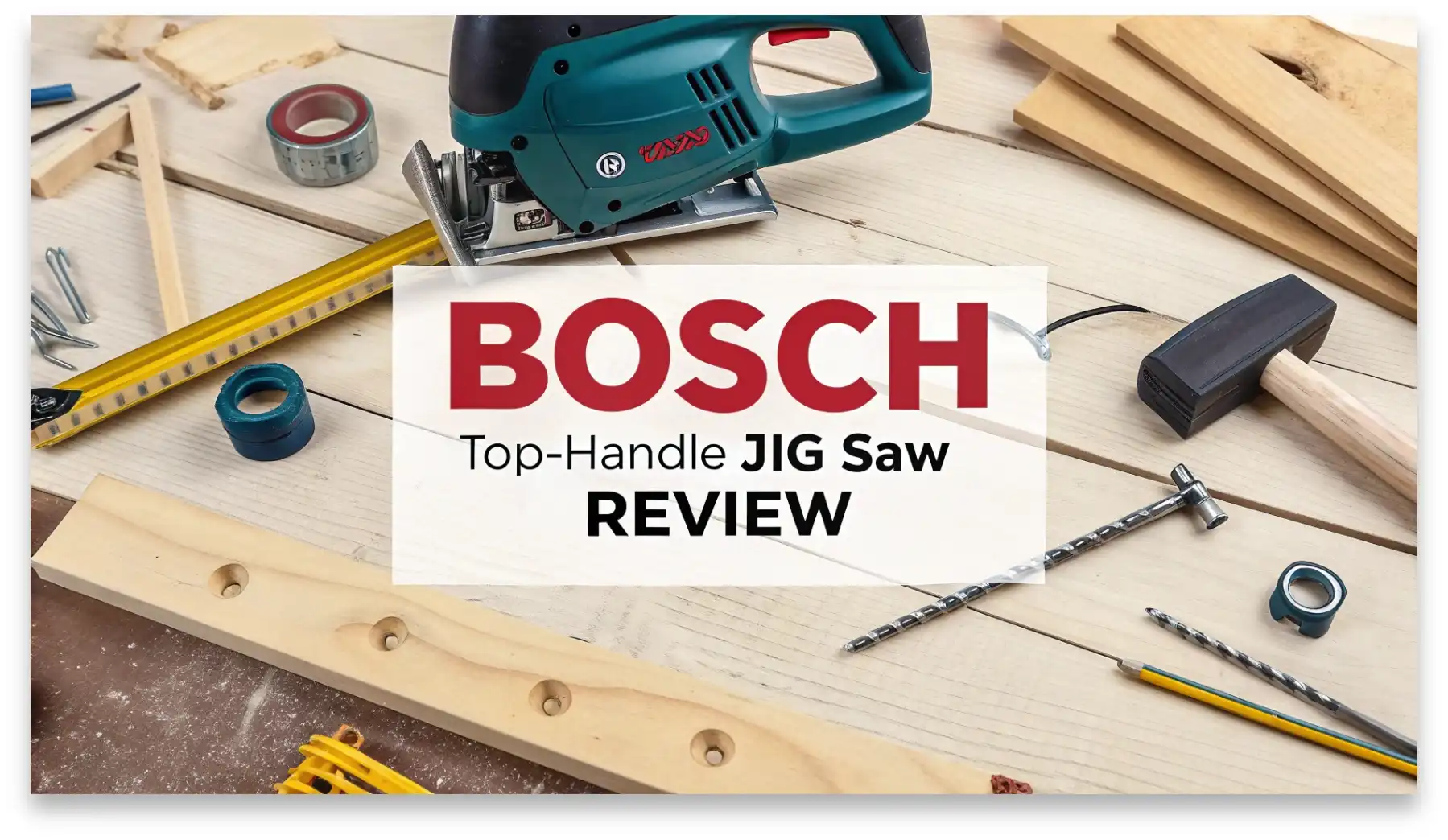
BOSCH Top-Handle Jig Saw Review: Your Complete Guide
Are you tired of struggling with rough cuts and hard-to-handle tools? The BOSCH top-handle jig saw might just be the game changer your workshop needs.
This powerful cutting machine has been making waves among professionals and DIY enthusiasts alike, and today we’re diving deep into what makes it stand out from the crowd.
In this detailed review, we’ll explore everything from the powerful motor specs to real-world performance.
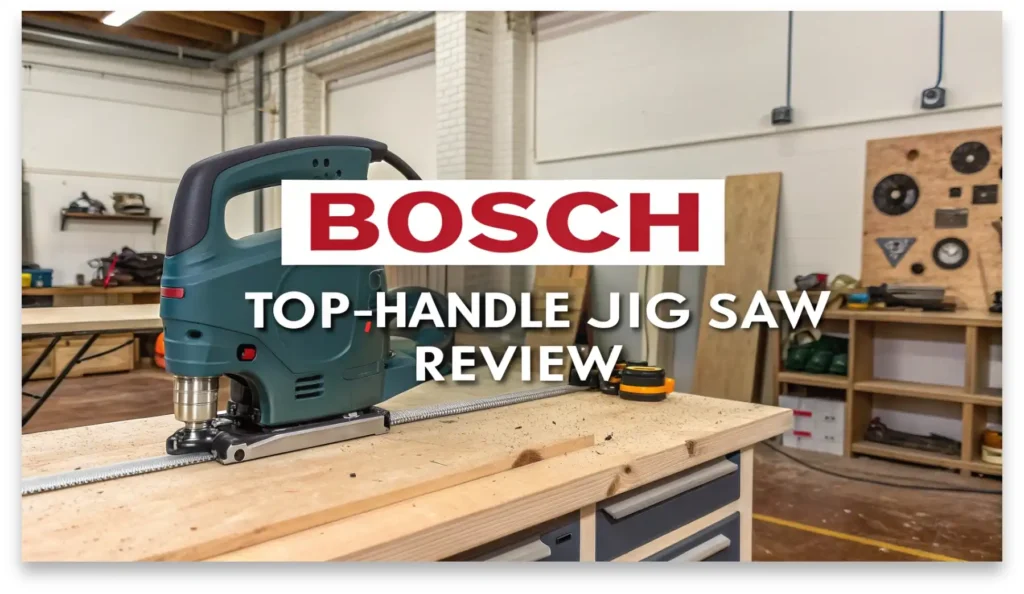
Key Takeaways:
- Powerful Performance: The 7.0-amp motor delivers consistent power with speeds ranging from 500 to 3,100 strokes per minute. This means you can tackle everything from delicate curved cuts to aggressive ripping through thick hardwood.
- Tool-Free Blade Changes: No more fumbling with Allen wrenches or burning your fingers on hot blades. The innovative tool-free blade change system lets you swap blades in seconds, and the ejection mechanism keeps your hands safe.
- Four Orbital Settings: Adjust cutting aggressiveness on the fly. From smooth finishing cuts to fast material removal, these orbital action settings give you complete control over how the blade behaves.
- Comfortable Design: The ergonomic top-handle design with soft-grip molding reduces hand fatigue during extended use. Plus, the ambidextrous lock-on button works perfectly for both right and left-handed users.
- Professional Quality at Home: With a sturdy die-cast aluminum footplate, precise bevel capabilities up to 45 degrees, and an adjustable dust blower to keep your cutting line visible, this saw brings professional-grade features to your home workshop.

- Ergonomic Top-handle: Soft-grip areas of this electric hand saw for wood cutting supply a solid...
- Accuracy: Internal precision machined plunging system and low vibration design of our electric saw...

Last update on 2026-09-13 / Affiliate links / Images from Amazon Product Advertising API Some of the links on this website are affiliate links, which means that at no additional cost to you, I earn a commission if you click through and make a purchase. I only recommend products and services that I believe will add value to my readers. Thank you for your support!
BOSCH JS470E Top Handle Jig Saw: The Flagship Model
The BOSCH JS470E represents the pinnacle of BOSCH’s top-handle jig saw lineup. This model packs a serious punch with its 7.0-amp motor, making it one of the most powerful options in its class. The motor delivers between 500 and 3,100 strokes per minute, giving you incredible flexibility for different materials and cutting needs.
What sets the JS470E apart is its constant response circuitry. This technology maintains consistent blade speed under load, so your cutting speed doesn’t drop when you hit a hard knot in the wood. The saw just keeps cutting smoothly, which means cleaner results and less frustration for you.
The four orbital-action settings are where this saw really shines. Setting zero gives you straight up-and-down blade motion for the smoothest possible cuts in finished materials.
As you increase the orbital action, the blade adds a forward-cutting motion that removes material faster. This aggressive cutting action is perfect when you need speed over a perfectly smooth edge.
The toolless blade-change system is brilliantly simple. You just pull the lever, pop out the old blade, insert the new one, and you’re ready to go. The system accepts all standard T-shank blades, which are easy to find and available in varieties for wood, metal, plastic, and other materials.
BOSCH JS260 Top Handle Jig Saw: The Budget-Friendly Option

- STURDY 6.0 AMP MOTOR: delivers up to 3,100 strokes per minute
- VARIABLE SPEED CONTROL: includes a dial for max speed and accelerator trigger to control operating...
Last update on 2026-09-13 / Affiliate links / Images from Amazon Product Advertising API Some of the links on this website are affiliate links, which means that at no additional cost to you, I earn a commission if you click through and make a purchase. I only recommend products and services that I believe will add value to my readers. Thank you for your support!
The BOSCH JS260 offers excellent value for those who want BOSCH quality without the premium price tag. This model features a 6.0-amp motor that still delivers impressive cutting power, reaching speeds up to 3,100 strokes per minute just like its bigger brother.
This jig saw includes the same toolless blade-change system that makes BOSCH tools so convenient to use. You won’t sacrifice ease of use just because you’re choosing a more affordable model. The low-vibration design ensures smooth operation, and your hands won’t feel like they’re holding a paint shaker after an hour of work.
The variable-speed dial lets you set your maximum speed, while the trigger gives you real-time speed control. This dual-control system means you can dial in the perfect speed for your material, then use the trigger to slow down for corners or speed up for straight runs.
Top 3 Alternatives for BOSCH Top Handle Jig Saw

- 6.5 AMP motor and 3 orbital settings plus straight cutting deliver faster and more accurate cuts in...
- Variable speed control dial (500-3,100 SPM) enables user to march the speed to the application
Last update on 2026-09-13 / Affiliate links / Images from Amazon Product Advertising API Some of the links on this website are affiliate links, which means that at no additional cost to you, I earn a commission if you click through and make a purchase. I only recommend products and services that I believe will add value to my readers. Thank you for your support!

- Variable speed control dial (500-3,100 SPM) enables user to match the speed to the application for...
- Ergonomically designed rubberized grip for increased comfort and control
Last update on 2026-09-13 / Affiliate links / Images from Amazon Product Advertising API Some of the links on this website are affiliate links, which means that at no additional cost to you, I earn a commission if you click through and make a purchase. I only recommend products and services that I believe will add value to my readers. Thank you for your support!

- HIGH PERFORMANCE ELECTRIC JIG SAW - 5 amp electric jig saw with a 3⁄4” blade orbital action for...
- CURVE CONTROL TECHNOLOGY - Four curve settings for maximum control over rounded cuts
Last update on 2026-09-13 / Affiliate links / Images from Amazon Product Advertising API Some of the links on this website are affiliate links, which means that at no additional cost to you, I earn a commission if you click through and make a purchase. I only recommend products and services that I believe will add value to my readers. Thank you for your support!
Understanding Orbital Action: The Secret to Versatile Cutting
Orbital action is one of those features that sounds complicated but makes perfect sense once you understand it. In a standard jig saw, the blade moves straight up and down. With orbital action engaged, the blade also moves forward as it comes up and backward as it goes down, creating an elliptical cutting pattern.
Why does this matter? The forward motion helps clear chips from the cut and makes the blade cut more aggressively. This means faster cutting, especially in softwoods and thick materials. The BOSCH top-handle models typically offer four orbital settings ranging from zero to maximum.
Setting zero gives you pure vertical blade motion. Use this for metal, plastic, and any material where you need the smoothest possible cut. The blade stays in contact with the material throughout its stroke, creating fine, clean edges.
Settings one through three progressively increase the orbital action. Setting one adds slight orbital motion, perfect for hardwoods where you want faster cutting without sacrificing too much finish quality.
Motor Power and Speed: What the Numbers Really Mean
Let’s talk about motor power because numbers alone don’t tell the whole story. The BOSCH JS470E features a 7.0-amp motor, while the JS260 has a 6.0-amp motor. More amps generally mean more power, but what does that actually give you?
A more powerful motor maintains speed under load better. When you’re cutting thick hardwood or making long cuts, a stronger motor won’t bog down as much. This translates to smoother cuts, cleaner edges, and less burning on the cut surface. You also don’t have to push as hard, which means better control and less fatigue.
The variable speed range from 500 to 3,100 strokes per minute gives you incredible versatility. Lower speeds are essential for cutting metal, where too much speed can burn up blades quickly. Medium speeds work great for hardwoods and thick materials. Maximum speed lets you zip through softwoods and sheet goods efficiently.
Blade System and Tool-Free Changes: No More Frustration
BOSCH revolutionized blade changing with their tool-free system, and once you’ve used it, you’ll never want to go back to Allen wrenches and set screws. The mechanism is beautifully simple. A spring-loaded lever locks the blade in place, and you just pull it to release.
The system accepts T-shank blades, which have become the industry standard. T-shank blades have a tang shaped like the letter T that slots into the blade holder. This design is inherently more stable than older U-shank systems, and T-shank blades are available in every variety you could possibly need.
What really impresses users is the blade ejection feature. After making a long cut, blades get hot. Really hot. The ejection mechanism lets you pop out a hot blade without touching it, saving your fingers from burns. It’s a small detail that shows BOSCH thinks about real-world use.
Comfort and Ergonomics: Why Design Matters
You might think a saw is just a saw, but ergonomics make a huge difference when you’re using a tool for extended periods. The BOSCH top-handle design puts your hand in a natural position directly over the blade, giving you excellent control and visibility.
The soft-grip overmold on the handle isn’t just padding. It’s carefully shaped to fit your hand comfortably and reduce pressure points. The material stays comfortable even when your hands get sweaty, maintaining grip without becoming sticky or slippery.
Weight distribution on these saws is well-balanced. The JS470E weighs about 5.9 pounds, which is substantial enough to feel stable but not so heavy that it tires you out. The weight centers over the blade, so the saw doesn’t want to tip forward or backward during cuts.
Cutting Capacity and Bevel Capabilities
The BOSCH top-handle jig saws can cut through softwood up to 5-7/8 inches thick and hardwood up to 3-5/8 inches thick. For metal work, you can cut mild steel up to 3/8 inch thick. These capacities cover the vast majority of projects you’ll encounter in woodworking and general construction.
Bevel cutting is where jig saws really prove their versatility. The footplate tilts up to 45 degrees in both directions, allowing you to make angled cuts for joinery, decorative edges, and compound cuts. The die-cast footplate on the JS470E includes a steel insert at the blade opening for durability.
The bevel adjustment requires a hex wrench on most BOSCH models. While some users wish for tool-free bevel adjustment, having a wrench ensures the setting stays locked during cuts. The wrench stores right on the saw in a clever little holder, so it’s always there when you need it.
Real-World Performance: What Users Actually Experience
Let’s talk about how these saws perform in actual use. Users consistently praise the smooth cutting action of BOSCH jig saws. The low-vibration design makes a noticeable difference compared to cheaper models. Your cuts come out cleaner because the saw isn’t shaking around as much.
Curve cutting is where jig saws shine, and the BOSCH models excel at following tight radius curves. The 1-inch stroke length provides good cutting speed while maintaining control. The narrow blade holder allows you to see the cutting line clearly, which helps tremendously when following intricate patterns.
For straight cuts, these saws perform admirably though straight cutting isn’t really a jig saw’s specialty. The key is using a straightedge guide and moving at a steady pace. The variable speed control helps you establish a rhythm and maintain consistent cutting speed.
Plunge cutting works well once you get the technique down. You tip the saw forward on the front of the footplate, start the blade, and gradually lower it into the material. The smooth operation and good visibility make this easier than on many competing saws.
Dust Management and Visibility Features
Sawdust is the enemy of accurate cutting. You can’t follow a line if you can’t see it. The adjustable dust blower on BOSCH jig saws addresses this problem elegantly. A jet of air from the motor’s cooling fan blows across the cutting line, clearing sawdust as you work.
You can adjust the blower direction by rotating a small nozzle, directing the air stream exactly where you need it. This simple feature makes a surprising difference in cutting accuracy. Instead of constantly stopping to brush away dust, you maintain clear visibility throughout the cut.
The blade guard is minimal by design, giving you excellent visibility of the blade and cutting line. Some saws have bulky guards that block your view, but BOSCH keeps things streamlined. You can see exactly where the blade enters the material, making it easier to start cuts precisely.
Maintenance and Blade Selection Tips
Keeping your BOSCH jig saw running smoothly requires minimal maintenance. The motor is sealed, so you don’t need to worry about carbon brush replacement. Occasionally blow out any accumulated sawdust from the body vents to maintain good cooling airflow.
The blade holder mechanism needs no regular maintenance. The spring-loaded system is robust and reliable. If you ever notice the blade isn’t locking securely, a tiny drop of machine oil on the mechanism can help, but this is rarely necessary.
Blade selection matters more than most people realize. For smooth cuts in wood, use blades with 10-12 teeth per inch. For faster, rougher cuts, use 6-8 TPI blades. Metal-cutting blades typically have 18-24 TPI for smooth cutting action. Specialty blades exist for cutting plastic, laminate, and other materials.
Blade quality varies enormously. Cheap blades dull quickly and cut poorly. Premium blades from BOSCH, DeWalt, or other quality manufacturers cost more but last longer and cut better. For important projects, invest in good blades. For rough work, budget blades are fine.
Comparing Models: Which BOSCH Jig Saw is Right for You
Choosing between BOSCH models comes down to your needs and budget. The JS470E at around $149 represents the premium option with its 7.0-amp motor and die-cast construction. If you’re a professional or serious hobbyist who will use the saw frequently, the extra performance and durability justify the cost.
The JS260 at around $109 offers excellent value for occasional users and budget-conscious buyers. You still get BOSCH quality, the great blade-change system, and smooth operation. The slightly less powerful motor handles most tasks just fine, and the cost savings are significant.
The JS365 splits the difference at about $142, offering 6.5 amps and coming in a kit with accessories. This middle-ground option makes sense if you want more power than the JS260 but don’t need the full capability of the JS470E.
What Can You Do Wrong When Buying or Avoiding Common Mistakes
Many buyers make the mistake of choosing power when precision matters more. A jig saw is a finesse tool, not a brute force cutter. Don’t assume more power automatically equals better results. Focus on features like orbital settings, smooth operation, and comfortable ergonomics.
Skimping on blades ruins the performance of even excellent saws. The best jig saw in the world cuts poorly with a dull or wrong blade. Invest in quality blades appropriate for your materials. Keep a selection on hand so you’re always using the right blade for the job.
Some users never explore the orbital settings, leaving the saw at maximum orbital action for everything. This creates unnecessarily rough cuts in materials that deserve smoother treatment. Take time to experiment with different settings and learn what works best for various materials.
How Does BOSCH Compare to Major Competitors?
Makita jig saws offer comparable quality to BOSCH models. The Makita 4329K and JV0600K compete directly with BOSCH’s lineup. Makita saws are known for smooth operation and excellent build quality. Some users prefer Makita’s ergonomics, while others find BOSCH more comfortable. Both brands are excellent choices.
DeWalt jig saws emphasize ruggedness and job-site durability. DeWalt tools often feel more industrial and less refined than BOSCH equivalents. They hold up well to abuse and harsh conditions. If you work in demanding environments, DeWalt deserves consideration.
BLACK+DECKER offers budget options like the BDEJS600C at under $60. These saws work fine for light-duty home use but lack the power, smoothness, and durability of professional-grade tools. If you only use a jig saw occasionally for simple projects, budget options might suffice.
Frequently Asked Questions
Can the BOSCH top-handle jig saw cut through metal?
Yes, the BOSCH top-handle jig saw cuts metal effectively when equipped with the appropriate blade. Use metal-cutting blades with 18-24 teeth per inch for best results. The saw can handle mild steel up to 3/8 inch thick and cuts aluminum, copper, and other non-ferrous metals easily. Set the orbital action to zero for smoothest cuts in metal, and use lower speeds to prevent overheating the blade.
How do you change blades on a BOSCH jig saw?
Changing blades on BOSCH jig saws is incredibly simple thanks to the tool-free system. First, make sure the saw is unplugged or the battery is removed for safety. Locate the blade-release lever near the blade holder. Pull this lever to release the old blade, which will eject automatically thanks to the spring-loaded mechanism. Insert the new T-shank blade into the holder, making sure it’s fully seated.
What is the difference between top-handle and barrel-grip jig saws?
Top-handle jig saws position the handle directly above the blade, giving you excellent visibility and straight-down control. This design is ideal for precision work, intricate cuts, and situations where you need to see your cutting line clearly. Barrel-grip models have a handle more like a drill, positioned behind the blade. This style offers better control for curves and allows you to grip the saw with your hand closer to the material.
Do BOSCH jig saws work with all blade brands?
BOSCH jig saws accept standard T-shank blades, which is the most common blade type today. This means you can use blades from virtually any manufacturer, including BOSCH, DeWalt, Makita, Milwaukee, and generic brands. T-shank blades have a universal tang design that fits all modern jig saws. The older U-shank blade system is not compatible, but T-shank blades are widely available and come in every specialty you might need for wood, metal, plastic, and other materials.
What materials can you cut with a BOSCH top-handle jig saw?
BOSCH top-handle jig saws are incredibly versatile tools that cut numerous materials when equipped with appropriate blades. They excel at cutting all types of wood, including softwoods, hardwoods, plywood, and particle board. With metal-cutting blades, they handle aluminum, copper, brass, and mild steel. Specialty blades allow cutting plastic, fiberglass, laminate countertops, and even ceramic tile.
How long do BOSCH jig saw blades last?
Blade life varies enormously based on material, blade quality, and cutting conditions. In softwood, a quality blade might make hundreds of feet of cuts before dulling noticeably. Hardwood and engineered materials like plywood dull blades faster. Cutting metal wears blades relatively quickly compared to wood. Signs of a dull blade include burning, rough cut edges, and requiring excessive pressure to maintain cutting speed.

Hi, I’m Amelia Thornton, the founder of ElectroPro.blog.
I write about smart devices, gadgets, electronics, and tech essentials from Amazon.
My goal is to help you discover reliable and innovative tech that truly makes life easier.
From home automation to everyday gear, I test and share what’s worth your investment.
Join me as I explore the smartest tech trends—one gadget at a time.