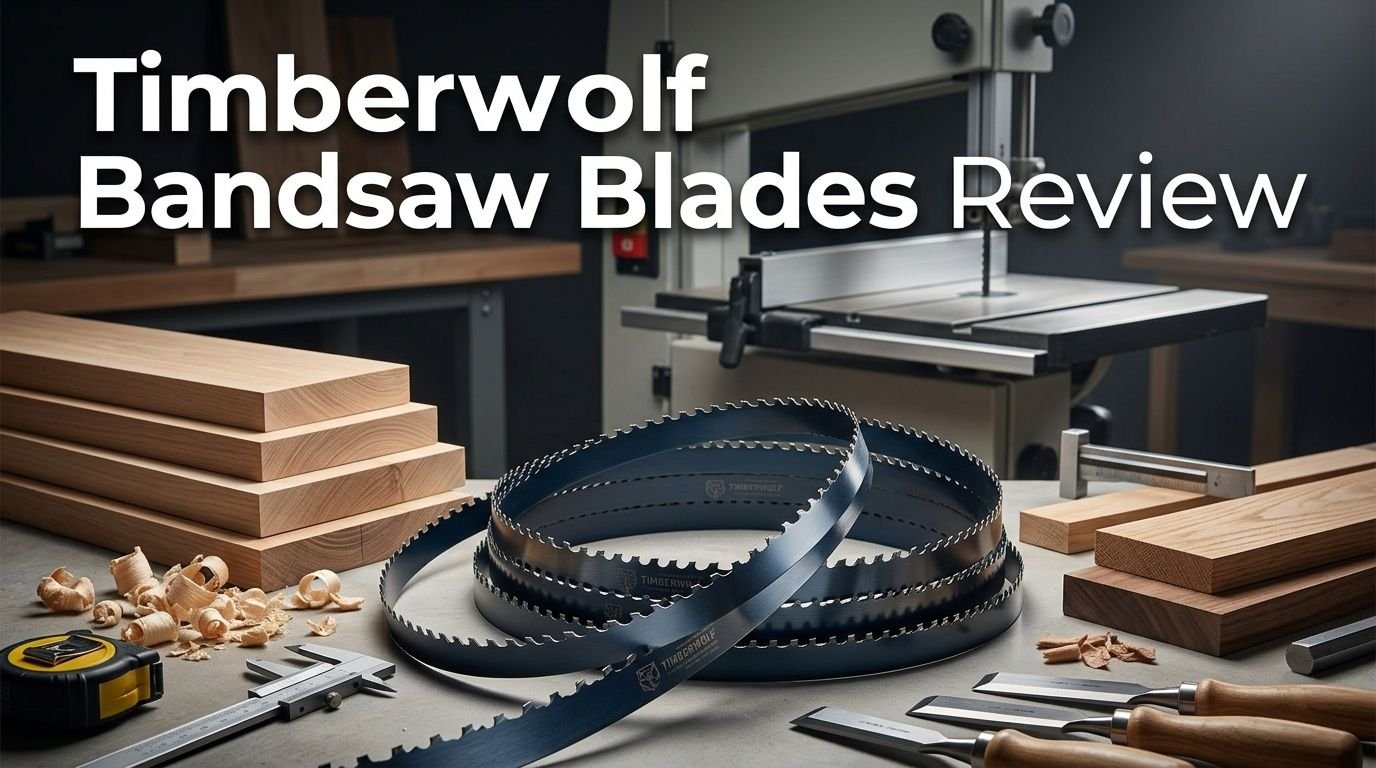
Timberwolf Bandsaw Blades Review 2026: Is It Worth the Hype?
If you own a bandsaw, you already know that the blade makes or breaks your cuts. A dull, poorly made blade will leave you with rough edges, burned wood, and endless frustration.
Timberwolf bandsaw blades have earned a strong reputation among woodworkers for years. They promise sharper teeth, cooler cuts, and longer blade life than standard carbon steel options.
But do they actually deliver in 2026? Are they worth the higher price tag compared to budget blades? I spent time researching user feedback, technical specs, and real workshop results to answer these questions.
Key Takeaways:
- Timberwolf blades are made from Swedish silicon steel, which allows them to run cooler and last longer than standard high carbon steel blades. This steel also gives the blade more flex life, so it resists fatigue and breakage over time.
- The teeth are milled, not stamped or ground. This process creates a sharper cutting edge right out of the box. Milled teeth stay sharp up to 20% longer than teeth on regular carbon blades.
- These blades run under low tension. This puts less stress on your bandsaw’s bearings, wheels, and motor. Your machine lasts longer, and you use up to 20% less horsepower during operation.
- Timberwolf offers multiple blade series for different tasks. The PC series handles kiln dried wood. The AS series excels at green or exotic lumber. The VPC series is built for straight line resawing with a clean finish.
- All blades are made to order in Bethel Park, Pennsylvania. PS Wood Machines manufactures every blade in their own facility, with a typical lead time of three business days.
- Users on forums like LumberJocks and Reddit rate them highly, though some note that the Wood Slicer from Highland Woodworking gives similar performance at a comparable price. The choice often comes down to personal preference and specific cutting needs.

- High silicon, low carbide steel
- Runs under low tension which requires less horsepower
Last update on 2026-10-21 / Affiliate links / Images from Amazon Product Advertising API Some of the links on this website are affiliate links, which means that at no additional cost to you, I earn a commission if you click through and make a purchase. I only recommend products and services that I believe will add value to my readers. Thank you for your support!
What Is Timberwolf and Who Makes These Blades?
Timberwolf is a brand of bandsaw blades produced by PS Wood Machines, a company based in Bethel Park, Pennsylvania. PS Wood has been in the woodworking equipment business for decades. They focus on scroll saws, bandsaw blades, and related accessories.
Every Timberwolf blade is manufactured in their own facility. They cut, weld, and package each blade on site. This gives them direct quality control over the entire production process. You are not getting a generic imported blade repackaged under a fancy name.
The company uses premium Swedish silicon steel as the base material for all Timberwolf blades. This type of steel dissipates heat three times faster than standard high carbon steel. It also has greater flexibility, which means the blade can bend around bandsaw wheels thousands of times before it develops fatigue cracks.
PS Wood developed proprietary induction hardening methods for these blades. Induction hardening heats the metal more precisely than traditional flame hardening. The result is a blade with consistent hardness from tooth tip to body, which leads to better cutting performance and longer life.
Timberwolf blades are available in widths from 1/8 inch to 1 inch and in lengths to fit virtually any bandsaw on the market. They also offer custom lengths if your saw has a non-standard measurement.
Timberwolf Bandsaw Blade 1/2″ x 93-1/2″, 4 TPI (PC Series)
The 1/2 inch, 4 TPI Positive Claw blade is one of the most popular Timberwolf models. It fits standard 14 inch bandsaws from Delta, Grizzly, Jet, Rikon, and other brands that use a 93-1/2 inch blade length.
This blade uses the PC (Positive Claw) tooth design. The PC series is built for kiln dried wood. It combines the speed of a hook tooth with the smooth finish of a skip tooth. The unique 6.5 degree rake angle and round gullet shape allow fast chip removal without clogging.
At 4 teeth per inch, this blade works well for general ripping, crosscutting, and light resawing in stock up to about 6 inches thick. It leaves a surprisingly clean surface that often needs minimal sanding. The kerf measures just .042 inches, which means less waste on every cut.
Users on Amazon give this blade 4.7 out of 5 stars across hundreds of reviews. Many buyers comment on how sharp the blade feels right out of the box. Several report that it tracks true with very little drift, even at low tension settings.
The .025 inch blade thickness keeps it flexible enough for moderate curves while still providing good stability on straight cuts. If you own a 14 inch bandsaw and want one blade that handles multiple tasks well, this is a strong choice.
Timberwolf Bandsaw Blade 3/4″ x 93-1/2″, 3 TPI (TPC Series)

- High silicon, low carbide steel
- Ideal for resawing thick stock
Last update on 2026-10-21 / Affiliate links / Images from Amazon Product Advertising API Some of the links on this website are affiliate links, which means that at no additional cost to you, I earn a commission if you click through and make a purchase. I only recommend products and services that I believe will add value to my readers. Thank you for your support!
The 3/4 inch, 3 TPI blade in the TPC (Thin Positive Claw) series is built for one job: resawing. If you cut boards into thinner slabs or make your own veneers, this blade deserves your attention.
What sets this blade apart is its extremely thin kerf. At just .025 inches thick with a total set under .049 inches, it removes very little material during each pass. This matters a lot when you are slicing expensive hardwoods like walnut, cherry, or figured maple into thin pieces.
The 3 TPI tooth pitch is ideal for thick stock resawing up to 6 inches or more. The teeth clear chips efficiently without bogging down. The Positive Claw geometry keeps the cut smooth and straight, reducing the planing or sanding you need to do afterward.
This blade runs under low tension, which is a common trait across all Timberwolf models. For resawing, low tension is a real advantage because it reduces strain on your bandsaw’s frame and wheel bearings during extended use.
Top 3 Alternatives for Timberwolf Bandsaw Blades

- Milled teeth are 50 PERCENT SHARPER than competitors stamped or crush ground blades
- Precision Induction hardening throughout the blade vs competitors flame hardening
Last update on 2026-10-21 / Affiliate links / Images from Amazon Product Advertising API Some of the links on this website are affiliate links, which means that at no additional cost to you, I earn a commission if you click through and make a purchase. I only recommend products and services that I believe will add value to my readers. Thank you for your support!

- "INCLUDES: 93 ½ inch bandsaw blade (one piece) – suitable for most 93-1/2” long, 1/2” wide...
- QUALITY: The band saw blade is made from premium, high grade carbon steel with heat resistance and...
Last update on 2026-10-21 / Affiliate links / Images from Amazon Product Advertising API Some of the links on this website are affiliate links, which means that at no additional cost to you, I earn a commission if you click through and make a purchase. I only recommend products and services that I believe will add value to my readers. Thank you for your support!

- OLSON SAW FB14593DB HEFB Band 6-TPI Skip Saw Blade, 1/4 by .025 by 93-1/2-Inch Onе Paсk
- For hard or soft wood, plastic, mild steel and non-ferrous metal
Last update on 2026-10-21 / Affiliate links / Images from Amazon Product Advertising API Some of the links on this website are affiliate links, which means that at no additional cost to you, I earn a commission if you click through and make a purchase. I only recommend products and services that I believe will add value to my readers. Thank you for your support!
Timberwolf Bandsaw Blade 1/4″ x 93-1/2″, 6 TPI (PC Series)

- Milled teeth are 50 PERCENT SHARPER than competitors stamped or crush ground blades
- Precision Induction hardening throughout the blade vs competitors flame hardening
Last update on 2026-10-21 / Affiliate links / Images from Amazon Product Advertising API Some of the links on this website are affiliate links, which means that at no additional cost to you, I earn a commission if you click through and make a purchase. I only recommend products and services that I believe will add value to my readers. Thank you for your support!
The 1/4 inch, 6 TPI blade is your go-to option for curve cutting, template work, and pattern cutting on a 14 inch bandsaw. The narrow width lets you follow tight curves and intricate shapes that wider blades simply cannot handle.
This blade uses the same PC (Positive Claw) tooth geometry found in the larger Timberwolf blades. The 6 TPI pitch provides a good balance between cutting speed and surface finish on kiln dried wood. It removes material quickly but leaves a clean enough edge for most projects.
The .025 inch thickness makes this blade very flexible around small radius turns. Timberwolf lists the minimum cut radius at about 3/8 inch, which opens up a wide range of detailed cutting possibilities.
Like all Timberwolf blades, this model is made from Swedish silicon steel with milled teeth. You get the same heat dissipation, sharp tooth edges, and low tension operation as the larger blades. The induction hardened tooth tips hold up well against kiln dried hardwoods.
Understanding the Timberwolf Blade Series: PC, AS, VPC, TPC, and RK
Timberwolf offers five main blade series, and each one is designed for a specific type of cutting. Picking the right series matters more than most people think.
The PC (Positive Claw) series is the most versatile. It handles kiln dried wood with a unique gullet design that combines the speed of a hook tooth and the finish of a skip tooth. The 6.5 degree rake angle and 5 tooth set pattern produce a thin kerf and smooth cut. This is the series most woodworkers should start with.
The AS (Alternate Set) series is built for green wood, exotic species, and thick lumber. These blades are thicker at .032 inches and have a full alternate set with a 6.5 degree rake angle. Woodturners use them to cut blanks from large burls. They perform best on stock thicker than 6 to 8 inches.
The VPC (Variable Positive Claw) series targets straight line resawing. The variable tooth spacing reduces vibration and blade resonance. This produces an extremely clean finish that almost polishes the wood during the cut. The VPC comes in 1/2 inch, 3/4 inch, and 1 inch widths.
Swedish Silicon Steel: Why the Material Matters
The steel used in a bandsaw blade directly affects how it cuts, how long it lasts, and how hot it gets. Timberwolf blades use Swedish silicon steel, and this choice gives them several advantages over standard high carbon steel blades.
Silicon steel dissipates heat about three times faster than regular high carbon steel. Heat is the enemy of any cutting tool. It dulls teeth, warps blades, and can burn your workpiece. A blade that stays cooler under load keeps its edge longer and produces cleaner cuts.
The silicon content also makes the steel more ductile, meaning it can flex back and forth around bandsaw wheels more times before it cracks. Standard carbon steel blades often break at the weld or develop fatigue cracks in the body. Timberwolf blades resist this type of failure significantly better.
PS Wood Machines uses induction hardening instead of flame hardening. Flame hardening heats the blade unevenly, which can create soft spots and hard spots. Induction hardening is far more precise. It allows different hardness levels at the tooth tip versus the blade body, giving you a hard cutting edge on a flexible backbone.
How Timberwolf Blades Perform for Resawing
Resawing is the single most demanding task you can give a bandsaw blade. You are pushing a thin strip of steel through the full height of a board, and any weakness in the blade shows up immediately as drift, rough surfaces, or stalling.
Timberwolf blades handle resawing remarkably well for several reasons. The thin kerf means less material removal per pass, which reduces the load on your motor. Less load means more consistent feed speed and fewer stalls.
The VPC and TPC series are specifically engineered for resawing. The VPC series with its variable tooth spacing reduces harmonic vibration that can create washboard patterns on the cut face. Users report finish quality that rivals planed surfaces in many cases.
Low Tension Operation: What It Means for Your Bandsaw
Every bandsaw blade needs tension to track straight on the wheels. Most standard carbon steel blades require significant tension to perform well, especially during resawing. This creates stress on the machine.
Timberwolf blades are designed to operate at much lower tension settings than typical blades. PS Wood Machines states that their blades need roughly 20% less tension than comparable carbon steel options. This is a direct result of the silicon steel’s stiffness and the precision manufacturing process.
Lower tension means less strain on your bandsaw’s frame, tires, bearings, and motor. Over time, this reduces maintenance costs and extends the working life of your machine. If you own a smaller 14 inch bandsaw with a lighter frame, this benefit becomes even more significant.
Many users report that their bandsaws run quieter with Timberwolf blades installed. Less tension means less vibration transfer through the frame. This also contributes to smoother cuts, because a quieter machine produces fewer oscillations in the blade path.
Timberwolf Blades for Curve Cutting and Detail Work
While Timberwolf is famous for resawing, their narrower blades perform very well for curve cutting, scrollwork, and detailed pattern work on a bandsaw.
The 1/8 inch HP blade at 14 TPI handles the tightest curves. With a body thickness of just .025 inches, it can follow intricate patterns that approach scroll saw territory. The high tooth count gives a fine, smooth finish on thin stock.
The 3/16 inch and 1/4 inch PC blades offer a step up in durability while still making tight turns. The 1/4 inch blade at 6 TPI can cut curves with a radius as small as 3/8 inch. This covers the majority of bandsaw curve cutting needs for most woodworkers.
The RK (Raker) tooth style in these narrow widths has a zero degree rake angle. This means the teeth scrape rather than bite aggressively. The result is a very controlled, precise cut at slower feed speeds. For detailed work where accuracy matters more than speed, the RK blades shine.
Timberwolf vs. Wood Slicer: How Do They Compare?
The Highland Woodworking Wood Slicer is the most common competitor mentioned alongside Timberwolf blades. Both brands have loyal followings, and the debate between them has been running for years on woodworking forums.
The Wood Slicer uses a bi-metal construction with a flexible spring steel body and hardened tool steel teeth. Timberwolf uses a single piece of silicon steel with induction hardened teeth. Both approaches work well, but they produce different cutting characteristics.
Wood Slicer blades tend to produce a slightly smoother finish on resawing tasks, according to many side-by-side comparisons shared on Reddit and LumberJocks. The bi-metal design allows for a very aggressive tooth set that still leaves a clean surface.
Timberwolf blades last longer on average because the silicon steel resists heat and fatigue better. If you resaw large volumes of lumber regularly, the longer blade life can offset the slightly higher price over time.
Blade Maintenance Tips to Extend Timberwolf Blade Life
A quality blade deserves proper care. Even the best Timberwolf blade will underperform if you neglect basic maintenance. Here are some practical steps to keep your blades cutting well for as long as possible.
Clean your blades regularly with a blade cleaning solution or simple green mixed with water. Pitch and resin build up on the teeth over time, especially when cutting softwoods like pine or cedar. This buildup acts like insulation, trapping heat and reducing cutting performance.
Store blades properly when not in use. Fold them into three loops and hang them on a nail or hook. Do not lay them flat in a drawer where other tools can nick the teeth. Even small dings on the tooth tips will affect cut quality.
Never use more tension than necessary. Timberwolf blades are designed for low tension. Over-tensioning will stretch the blade, cause premature fatigue, and potentially damage your bandsaw. Use the flutter test or a tension gauge to find the right setting.
Check your bandsaw’s tires and guides periodically. Worn tires or misaligned guides will cause any blade to wander and wear unevenly. A well-maintained saw makes every blade work better.
Are Timberwolf Blades Worth the Price in 2026?
Timberwolf blades cost more than budget options like POWERTEC or basic Olson blades. A single Timberwolf blade typically runs $25 to $50 depending on width, length, and series. Budget blades can cost half that amount or less.
The price difference is justified for serious woodworkers who use their bandsaw frequently. The longer blade life, cleaner cuts, and reduced machine wear add up to real savings over time. If you burn through two cheap blades for every one Timberwolf, the economics favor the premium blade.
For occasional users who make a few cuts per month, a budget blade might make more sense financially. The performance gap between a Timberwolf and a decent POWERTEC blade is noticeable but may not matter for rough cuts or simple projects.
The made to order model from PS Wood Machines means you can get exactly the blade length and specification you need. This is valuable if you own a bandsaw with an unusual blade length that mass-produced brands do not stock.
Where to Buy Timberwolf Bandsaw Blades
You can purchase Timberwolf blades from several reliable sources. The most convenient option for many buyers is Amazon, where most popular sizes and series are available with Prime shipping.
PS Wood Machines sells directly through their website at timberwolfblades.com. Ordering direct gives you access to every blade configuration they offer, including custom lengths. The lead time is about three business days since each blade is made to order.
Woodcraft retail stores and their website also stock a good selection of Timberwolf blades. If you prefer to buy from a specialty woodworking retailer, Woodcraft is a solid option. They carry the most popular sizes for 14 inch bandsaws.
Woodline USA is another online retailer that carries the full Timberwolf lineup. They often have competitive pricing and run occasional sales.
One important note about buying from Amazon: some users on Reddit have reported receiving blades in damaged packaging from third party sellers. Buy from authorized sellers to ensure you get a fresh, properly stored blade. Look for “PS Wood Machines” or “Woodcraft” as the seller.
If you order directly from PS Wood Machines, you get the freshest blade possible since they weld it after you place the order. This guarantees you are not getting old stock that has been sitting in a warehouse.
Common Mistakes to Avoid with Timberwolf Blades
Even great blades fail when used incorrectly. Here are mistakes that new Timberwolf users make most often.
Using too much tension is the number one error. These blades are built for low tension. Cranking the tension knob to the same level you used on a generic blade will shorten the Timberwolf’s life and can cause tracking problems.
Picking the wrong blade series for the job leads to disappointing results. Using a fine-toothed RK blade for resawing thick hardwood will be painfully slow. Using a coarse 3 TPI PC blade for detail curve cutting will tear the wood. Match the blade to the task.
Feeding too fast is a common issue during resawing. Timberwolf blades cut cleanly at moderate feed rates. Pushing the wood too fast overloads the teeth, generates excess heat, and produces a rougher surface. Let the blade set the pace.
Frequently Asked Questions
Where are Timberwolf bandsaw blades made?
All Timberwolf blades are manufactured by PS Wood Machines in Bethel Park, Pennsylvania. Every blade is cut, welded, and packaged in their own facility. They do not outsource production. The lead time for new orders is typically three business days.
What type of steel does Timberwolf use?
Timberwolf blades are made from Swedish silicon steel. This material dissipates heat three times faster than high carbon steel and has greater flex life. The teeth are induction hardened for precise, consistent hardness across the blade.
Can I use Timberwolf blades on any bandsaw?
Yes, Timberwolf blades come in a wide range of lengths to fit virtually any bandsaw. They offer standard lengths for popular machines from Delta, Grizzly, Jet, Rikon, and many others. PS Wood Machines also makes custom lengths for non-standard bandsaws.
How long do Timberwolf bandsaw blades last?
Blade life depends on usage, material, and maintenance. Most users report that Timberwolf blades outlast standard carbon steel blades significantly. The milled teeth stay sharp about 20% longer, and the silicon steel resists heat-related dulling. Proper tension settings and regular cleaning extend blade life further.
Are Timberwolf blades good for beginners?
Absolutely. Timberwolf blades are actually easier for beginners to use because they require less tension and produce less drift than cheap blades. The PC series at 4 TPI in 1/2 inch width is a great starting point for someone learning to use a bandsaw.
What is the best Timberwolf blade for resawing?
For resawing on a 14 inch bandsaw, the 3/4 inch VPC (Variable Positive Claw) blade at 2/3 TPI is the top choice. It produces an extremely clean finish with minimal vibration. The 3/4 inch TPC at 3 TPI is also excellent if you want the thinnest possible kerf.
Do I need to break in a new Timberwolf blade?
A brief break-in period is recommended. Make light cuts at moderate speed for the first few minutes of use. This hones the tooth tips and helps the blade reach its full cutting potential. After break-in, you can increase feed rate and cut heavier stock.

Hi, I’m Amelia Thornton, the founder of ElectroPro.blog.
I write about smart devices, gadgets, electronics, and tech essentials from Amazon.
My goal is to help you discover reliable and innovative tech that truly makes life easier.
From home automation to everyday gear, I test and share what’s worth your investment.
Join me as I explore the smartest tech trends—one gadget at a time.